Tuesday, September 16, 2008

How I Approach Cartooning #1

One of what I intend to be a series of occasional essays on what I think about when I'm writing and drawing. I'm not saying this is the best way, right way, or only way. It's just a way that works for me that I hope someone finds interesting.


"I have made this letter longer than usual,
because I lack the time to make it short."
--Blaise Pascal

I tend to overwrite. I learned that about myself a long time ago--probably in my first real job out of college as a reporter for a small daily newspaper--and also learned to use it to my advantage. I made it part of my writing process. For example, when I write a first draft and check my word count, I'm very happy if it comes out 10% to 20% over. I know I can go through it a few times, tighten it up, release some gas, and polish it into a nice lean piece that clearly says what it needs to and nothing else. That's my goal.

I have a friend who wrote a novel. When he finished and started showing it to agents, they told him it was too long to be marketable in his genre. He'd have to cut it by a quarter. This seemed a daunting, despairing task: go through and slice out every fourth word? Impossible! His finely drawn characters would become caricatures, his carefully balanced plot would fall apart. Yet he did it, and when he finished cutting he was amazed by how much it'd improved his book. Yes, he'd lost some favorite bits, but the novel had a new flow and energy that made it a better story.

Cartooning is that to an extreme. Back when I fruitlessly submitted comic strip ideas to newspaper syndicates, I made up a rule that if the text for a daily strip didn't fit on a 3-by-5-inch index card, it was too wordy. That worked pretty well. I wrote both Mom's Cancer and WHTTWOT as pages of script accompanied by doodles and thumbnail sketches that captured the visuals I imagined--the screenplay for the movie playing in my head. Then I cut.

Not everyone works that way. Some find inspiration in starting with the drawing, brainstorming visually and then building a story from that. Although an image sometimes comes to me full-blown, I usually start with words and then consciously seek opportunities for pictures to take their place, add meaning, and carry as much of the narrative load as possible. A graphic novel should be more than an illustrated prose novel. In my ideal graphic novel, both the words and art convey equal meaning and neither is complete without the other.

For example, in Mom's Cancer I wrote about the ordeal of managing Mom's many medications (pp. 59-61). In my first-draft script, I'd written something about it being like "walking a tightrope." Now, aside from that being a lazy, obvious simile I didn't like, I couldn't figure out how to illustrate it. What do you draw, Mom sitting around taking medications? Rows of pill bottles? Boring. I wanted to capture the precarious uncertainty of this experience and, at the same time, fix the clunky metaphor. My solution was to draw the metaphor: The pictures show Mom actually walking on a tightrope surrounded by danger while everything goes wrong around her, freeing the words from having to mention it at all. It also gave me a chance to play some absurd dark humor against Mom's grim situation. Cartooningwise, I was very satisified with how this bit turned out.


I looked for similar opportunities in WHTTWOT. I'm very aware of how my words and pictures balance, and which is pulling more weight through different passages. For example, the first chapter of WHTTWOT is exposition-heavy, so I deliberately followed it with a chapter that's almost pantomime with hardly any text at all. My aim was to give readers a break and exercise a different part of their brains that interprets visual rather than verbal information. The last chapter is again light on words and heavy on visuals, which reads quicker and I hope creates some momentum that pulls readers through. In addition, as the book nears the end, each page provides less visual information than the page before, prodding readers to pick up their pace as they barrel toward what I hope is a satisfying climax.

That's how I'm trying to manipulate you, anyway. Don't know if I pulled it off.

Monday, September 15, 2008

In Which My Family Calls My Bluff

When we left for our long vacation, it felt like summer around here. We returned to autumn. Of course, the great thing about taking an 11-day vacation is, when you come back, you've got 11 days worth of work backed up and waiting for you.

So for our big summer holiday we went to South Dakota. People who know South Dakota, and particularly the Black Hills, may be nodding their heads in understanding. Everyone else--like pretty much everyone we told about our trip--says "Huh?"

I grew up in Rapid City, South Dakota, surrounded by a close extended family of grandparents, aunts, uncles, and cousins. It was terrific. Although the movie "A Christmas Story" is set a generation before mine in a different part of the country, I remember a childhood very much like little Ralphie's. When I was 11 we moved to California, and within just a couple of years my entire South Dakota family had scattered across the country, as if spun out of the state by centrifugal force. Throughout my marriage and my kids' whole lives, my family has been hearing me blather about this idyllic wonderland I grew up in. Finally, they called my bluff. "Put up or shut up, pal!"

I'd been back to South Dakota once as an adult, accompanying Mom to her 25th high school reunion (just about 25 years ago--Yikes!), so I thought I'd shaken the "everything looks so small!" effect. That trip also confirmed that my judgment wasn't entirely addled by nostalgia; the Black Hills are a genuinely beautiful and unique part of the country. I was pretty sure I could show my family a good time, with a nice mix of sight-seeing for them and misty watercolored mem'ries for me. So I accepted their dare, and next thing I knew we had reservations and an itinerary.

We took Amtrak from California to Denver, two full days on the train through the Sierra Nevada and Rockies, much of it following the Colorado River. Amazing scenery. Spent a day in Denver--one of my favorite second-tier U.S. cities (Portland being another)--and then drove north to Rapid City, where we spent three days before reversing course to Denver and then back on the train.

A note on train travel: it's fun, interesting, a great way to see the country. We encountered people from around the world doing the same (especially Germans, it seemed). We had sleeper rooms and ate in the dining car, which provided more privacy, comfort, and luxury than the poor schmoes in Coach got. But--and I say this with all affection--it gets old. After four days on the rails, we all agreed it felt very much like camping. Great fun, something you'd love to do once in a while, but at the end you're really looking forward to a good shower, nice meal, and comfortable bed.

I think the trip was a big success. We all forgot what day it was, which is one of my criteria for judging the quality of a vacation. My kids got a feel for the big empty nothingness of the western U.S. that they'd never experienced before. We mixed sight-seeing at places like Mt. Rushmore, Custer State Park and the Badlands with detours to my old houses, school, and grandparents' cabin in the woods, where the Best Christmases Ever took place and which the current owner was kind enough to let us tour after I bribed him with old photos of the place being built. We strolled through restored cavalry forts, stooped and clambered through a cave (another first for my girls), and walked in the wheel ruts ground into rock by pioneers following the Oregon Trail. And my family finally got to attach real places to all the tall tales I'd been telling for years, and maybe find out that I wasn't entirely lying.
.
Although everything looked so small.

I've always been proud of originating in the Midwest. I think being from the middle of the country can give people a core of straight-shootin' decency that's good for the soul. Near the top of the list of things I hate are people who think of "flyover country" as a wasteland full of morons, hicks and rubes. You're talking about me and my kin, pardner, and I take that kind of personally. They often have a different lifestyle and way of looking at things, but it's valid and valuable doesn't deserve anyone's condescension. I hoped my two California girls would get a sense of that as well, although I don't ever expect them to stop teasing me about my roots. That's what Dads are for.
.
Sylvan Lake, one of the prettier spots in the Black Hills.
Although part of the movie "National Treasure 2" was filmed
there, we did not find a secret cave leading to a lost city
of gold. Very disappointing.
.
The Badlands east of Rapid City, an amazing
geological laboratory. Look at those strata!
.
Me, Karen, Laura and Robin, right under the presidents' noses.
.

Thursday, September 11, 2008

Interview with Editor Charlie

"Editor Charlie," a character who occasionally appears in my posts, is my friend Charles Kochman, executive editor of my publisher's new imprint, Abrams ComicArts. Apart from his other accomplishments, Charlie is the guy who pulled Mom's Cancer out of the Abrams slush pile and is working with me again on WHTTWOT. Now I see that ComicMix has posted a great interview by Martha Thomases profiling the star to which I've hitched my wagon.

The interview reveals details about jobs Charlie has had and people he's worked with that I didn't know (though just try to get him to shut up about Alex Ross...). He was kind enough to mention Mom's Cancer in the piece. I was happy to see the interview hit on a couple of points I know to be absolutely true: Charlie's respect for the experience and knowledge of industry veterans, and the importance to his work of building relationships. It is an amazing thing to stroll around a comic convention floor with Charlie: he knows everyone, and can hardly walk twenty steps without introducing you to a legendary writer or artist. When Charlie vouches for you, you're in the club. More than one person has compared the experience to hanging with The Godfather, and I mean that in the very best possible sense. The number of people Charlie has actually had whacked is probably very small.

I have boundless respect and affection for Charlie, and I was fortunate my work found its way to his desk (this is why I never have good advice for people asking how to get published; "be lucky enough to send it to the right person" isn't very constructive). Aside from the biographical information, I think the interview provides a good look at the publishing industry as it follows Charlie's career arc from writing coloring books (really?) to heading an imprint at a respected house. Good stuff.

The Godfather and Fredo

I'm Baaaa-ack

As my six regular readers may recall, I've got this quirk about not announcing to the entire Internet that my home is unoccupied and available for plunder. Might as well post a big sign on the garage door that reads, "we'll all be gone until the tenth, the key is under the mat."

The "hiatus" I mentioned in my last post was cover for a long family vacation from which we've just returned (in fact, the last post was written in advance and autoposted after we left). When we told people where we were going, almost all of them asked, "Why would you go there?" And yet we did, and I think we all had a great time. I'll tell you all about it as soon as I catch up on some e-mails and work. More soon!

Tuesday, September 2, 2008

Kicking Back

Well, I made my deadline, although a technical problem at my publisher's end (I think) over the weekend prevented me from uploading about one-third of my final digital files. We'll fix that. The past two months I've worked virtually 12 hours a day, seven days a week to finish this book. The past two weeks I've worked a lot harder, including a couple near all-nighters that left my fingers gnarled and my eyeballs jiggly. It is an exhausting/satisfying milestone that, as I said before, doesn't mean I'm all done. But I'm mostly done.
.
("There's a big difference between mostly dead and all dead. Now, mostly dead--he's slightly alive. All dead--well, with all dead, there's usually only one thing that you can do: go through his clothes and look for loose change." Miracle Max, The Princess Bride.)
.
I'm going to take a week or so to catch up on some things and enjoy a little computer-free family time. Unless something comes up that I'm irresistably compelled to blog about, I'm taking a brief late-summer hiatus until sometime around Sept. 12. More then. And thanks!
.

Saturday, August 30, 2008

Assistant Assistance

I've mentioned that I took on the first assistants of my career to help me finish WHTTWOT. Here's how that happened:
.
Coloring comic artwork with Photoshop takes some effort. It has to be done right, especially when destined for four-color print, and I had particular ideas about the palettes and techniques I wanted to use on this book. At least the way I do it, coloring can be a two-stage process in which flat colors are first laid down to define areas--at that point it almost doesn't matter which colors they are--after which their values are refined, details are spotted, effects are added, and so on. It's easier to start with something than nothing.
.
Mom's Cancer had just 26 color pages, some with only a dab or two of tint. It was still a chore. WHTTWOT has 200 full-color pages. I realized several months ago that I could use some help. I also realized that summer vacation was coming up and I'd soon have all the necessary talent close at hand.
.
My 20-year-old girls, Laura and Robin, are very good artists. That's not just Dad talking, it's objectively true. They've been friends with Kelly and her younger sister Kristen, also talented artists, since high school. When the four of them get together, they spend most of their time writing stories and drawing pictures. (I know: "Where did my parenting go so wrong?") Best of all, they all know Photoshop better than I do. It's not uncommon for me to walk past one of their computers, look at the screen, and ask, "how did you do that?" Their software is four versions newer than mine. When everyone got home for their respective colleges' breaks, I made them an offer and they accepted.
.
So throughout the summer I copied black-and-white art files to flash drives, provided the appropriate palettes, drew up quick color guides, and passed out assignments. I tried to leave them some latitude to apply their talents--I wanted more than robots doing paint-by-number. I suspect the work frustrated them because slabbing in rough colors barely drew on their skills at all. They had to hold back. They nevertheless did a great job, completing nearly 100 pages faster than I could supply them and often surprising me with their initiative and creativity. It wasn't unusual for me to open up their files and think, "Huh. I wouldn't have done it like that, but I really like it!" Even when their choices didn't work for me, just giving me something to react to was more valuable than I expected.
.
So my first experience hiring assistants went very well. One nice dividend is that Kelly and Kristen plan to attend art college next year to become computer animators, and I like the idea that I was able to give them their first professional credit. It's not much, but I know from my own freelance writing that small jobs accumulate into bigger and better ones and, if you're not careful, can actually grow into a career.
.
Another nice dividend was that when my story called for four girls sitting in a soda shop in 1965, I knew where to find my models:

Top to bottom, Kelly, Laura, Robin,
and Kristen. Keep in mind, this is how
I humiliate people I like. You don't
want to get on my bad side.

.

Wednesday, August 27, 2008

Wednesday's Agenda

Today's Wednesday, right? I've lost track...

I colored the final four pages by midday, and plan to spend the next day and a half drawing repairs to be pasted over art I'm not happy with, rewriting bits, plugging holes, putting out fires, whacking down moles, etc. Friday I'm trying to reserve entirely for checking and formatting files, preparing notes for my editor and designer, giving one last proof-read, and getting everything ready to send. I hope to upload the final-draft files to Abrams on Saturday, if not sooner. That'll take a while. They're big, high-resolution images and I have 200 of the suckers.

In the weeks to come, I'm sure Abrams and I will do a lot of work on them, both editorially and technically. I am far from done, but I can finally foresee a day when I will be. That will be a good day.

I had a micro-revelation this afternoon. Now that I've got the pages looking pretty good and can lay them all out together, I realized that for the first time it's starting to look like the book I always imagined in my head. In many cases, better and cooler. It also occurred to me that no one else--including my editor and family--could ever see what was in my head and pretty much had to take it on faith that the rough outlines and random artwork I showed them justified the time and risk I was asking them to take. That was quite a leap.

I really love this story. We'll find out if anyone else does, and if it was worth the time and risk, next spring. The lag time leading up to release is one of excitement and anticipation, sifting through tea leaves for subtle clues: How many copies did the chain stores order? What did the trade press people say? What's the buzz? Oh please let there be a buzz.

I've written before about how Mom's Cancer took on a life completely independent of me, occasionally sending home notes from Germany, Italy, or Australia to let me know how it was doing. This time coming up is when that life begins for WHTTWOT. Once it's out of your hands, all you can do is hope it has a good one.

Tuesday, August 26, 2008

Tuesday's Agenda

A poem is never finished, only abandoned.
--W.H. Auden


As soon as I'm done typing this, I'll begin coloring the final 16 pages of WHTTWOT. About half those pages already have rough colors laid down, which is a big help. If I can average one per hour I'll be done around midnight, but since they're some of the most detailed pages in the book I doubt I'll maintain that pace.

After the coloring is done I still have tons of redrawing, correcting, and general fixing ahead. My "To Do" list is still growing instead of shrinking. My deadline is the end of the week; that's when I contractually owe my publisher a "final" draft. "Final" is in quotes because we all know it won't be final final--we'll still do a lot of fiddling before the files get to the printer. However, when September rolls around, I should be able to take a breath, stumble out of my cave, and spend more time blogging. And sleeping.

Today will be a great day if I can finish coloring all 16. I expect to complete about 12, and will be disappointed if I only get to 8 or 9. I'll report my progress at the end of the day.

UPDATE: Just past 1 a.m., and the count is 12. I admit I cheated a bit by grabbing an easy one at the end, but on the other hand I had some very productive digressions and distractions throughout the day. All in all, a fair day's labor.

Monday, August 25, 2008

Recommended Reading

Bob Thompson of The Washington Post has written probably the most comprehensive and best-sourced article I've ever read about the rise of graphic novels, what they are, and "what it all means." He interviewed anyone who's anyone in the business (though it's curious that he wrote about preparing to interview Pantheon's Chip Kidd--who was responsible for one of the most delightful evenings of my life--but I don't think mentioned or quoted him subsequently).

Thompson comes at it from an interesting perspective, that of a self-described Prose Guy earnestly trying to figure out what the fuss is all about. He avoids most of the easy journalistic cliches such as "Gee, comics aren't just for kids anymore!"--Thompson already knew that--and comes to appreciate the skill and talent involved in the best graphic novels while still feeling that they maybe aren't quite his cup of tea. I thought it was a unique and honest approach.

The long article starts here; you may have to register (free) on the Washington Post website to enter, although I was able to access it directly. And don't miss the best part, a three-page comic written by Thompson and drawn by Jonathan Bennett illustrating the article's highlights. Here's a sample panel:
.

Once in a while I do a convention panel or am asked a question about The Rise of the Graphic Novel. The problem is, my perspective is so narrow and the field so large that it's hard to grasp it and really come up with something insightful to say. I think that's true for most writers and artists: they know their little corner of the universe but don't or can't focus on the big picture. As one Prose Guy's attempt to figure it out, I think this article is a very interesting, informative, and worthwhile read..

Thursday, August 21, 2008

CMYK and Trapping

I'm rerunning a post below on the topic of "trapping" that I originally wrote in August 2005, when it came up while we were readying Mom's Cancer for press. It's an apt time for this particular rerun because it's trapping time again with Whatever Happened to the World of Tomorrow? But first some foundation....

Most books with color art are printed in CMYK, whose letters stand for cyan, magenta, yellow and black (I believe the "K" actually stands for "key color"--which is always black). When printed in various intensities, those four inks can make most (but not all) other colors. For example, equal amounts of yellow and magenta make red. Cyan plus yellow is green, magenta plus cyan is purple, etc.

The next voice you hear will be me from three years ago. Ah, I was so young and innocent then....
.
***

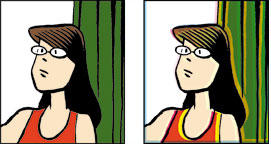
"Trapping" is an obscure but interesting part of the pre-press process. In CMYK printing each color of ink is printed separately, one after the other, so that a page actually goes through the press four times. If the paper lines up perfectly with each pass, all the colors align and you get perfect registration. Very often, though, if you look at four-color printing closely enough, you can see that the inks are just a bit off. You'll see a colored halo on one side, or colors slopping out of their black boundaries, or a gap where colors don't meet up.

Good registration (left) and bad (right)

Trapping helps minimize registration problems by spreading out the non-black colors a few pixels wherever they meet a black line. That way, even if registration is a little bit off, they still have some "wiggle room" to overlap as intended. With Photoshop, trapping is as easy as pushing a button (I can't imagine how anyone did it pre-digitally, or whether they bothered at all). Coincidentally, a private cartoonists' board I frequent just had a long discussion about trapping.

That discussion came in handy when I got word late last week that the printer wasn't happy with my color registration. It wasn't coming out right. Not lining up. Within half a second I realized the problem: no trapping. When I submitted my final image files to Abrams they were trapless. Trap-free. Bereft of trap. My trapping had shuffled off this mortal coil, run down the curtain, and joined the choir invisible. The subject never came up and I never thought to ask. My bad.

So I spent a few hours this morning speedily trapping the 26 color pages scattered throughout Mom's Cancer. I envisioned the overseas printer tapping his toe, glancing nervously at his watch, paying overtime while the presses waited in idle silence for my upload.

Assuming my trapping worked, I should have first proofs to review in a few days. Next book, I'm hiring a high school kid to take care of this.

***

Me back in the present again (old and cynical). I learned a lot from my mistakes on Mom's Cancer, which might have made me a little cocky going into WHTTWOT. What I've realized, of course, is that now I have whole new opportunities to make entirely different mistakes. Despite my threat above, I did not hire any high school kids to do my trapping this time. However, I did hire some college kids to--but that's a subject for a future post.

.

Sunday, August 17, 2008

A Big, Satisfying Milestone

Fifteen minutes ago I drew the final inky jot on the final page of Whatever Happened to the World of Tomorrow? That doesn't mean my work is finished. I still have hours and days and weeks of coloring, correcting, cutting, pasting, editing, rewriting, and Photoshoppin' to do. I still don't expect to get a lot of sleep or surface for air for a while. Still, completing the ink-and-paper drawing is a goal I've been working toward a long time and reaching it feels like a real accomplishment.

My final page is not the last page of the book, by the way. I didn't do them in order. The page I just finished and still have lying face down in my scanner is Page 162. Remember that and check it out in five or six months. It's a good one!

Each page of a 200-page book represents 0.5% of the total. I kept a running tally in my mind. I remember how daunting it was to be at 1%, 2%, 5%. I remember being 20%, 50%, 80% done. The day before yesterday I was at 99%. Today: 100%.

Wahooo! Now, back to work.
.

Friday, August 15, 2008

The Olympics

I like the Olympics. I'm still idealistic enough to think they're a little more than just another athletic event, which I wouldn't usually care a whit about. I'm a sucker for the parade of nations. And the theme music can still give me goosebumps. I am a sap.

The first one I have any memory of is 1968 (Bob Beamon!), and by 1972 I watched them avidly (Dave Wottle! Mark Spitz!). My sister Brenda and I still tell the story of our parents taking us on vacation during the '72 Games--which would've been swell, except their idea of vacation was renting a house on the northern California coast with no television. Which still would've been swell except, you know, the Olympics were on! So while our parents were downstairs enjoying their silent coastal solitude, Brenda and I were crouched in a loft with a pair of binoculars, taking turns watching the Games on TV through the window of another house fifty yards away.

I've been enjoying this year's Olympics well enough, though NBC's programming choices puzzle and annoy me. How many hours of beach volleyball quarterfinal eliminations do they think we want to see? I'm not yet convinced it's even a sport. I keep expecting to see a bonfire and beer keg at courtside. The coverage is also awfully heavy on gymnastics and swimming. Michael Phelps is an amazing athlete, but as he stocks his pantry with gold medals I keep thinking about the poor schlub from Ukraine swimming three lanes away whose single bronze medal will be the highlight of his life and who deserves to go home justifiably proud of being one of the best in the world, but you know all anyone will ever ask is what it's like to lose to the great Phelps. I guess this just wasn't his decade to try a swimming career.

My main disappointment in the TV coverage has been not seeing the less popular events that only percolate up to public attention every four years. Would it kill the network to show us 20 minutes of badminton, judo, or trampoline (yes! It's an event!)? Fortunately, we have the Internet, and in contrast to NBC's television coverage, its online coverage is comprehensive and excellent. Although I ought to be working, I just watched 15 minutes of archery eliminations online, with no commercials or commentary--just two guys taking turns shooting arrows at their targets. It was terrific.

My girls and I like archery. They got interested in it as counselors at Girl Scout camp, where they had to be trained and certified to run the archery range. They've got their own bows and it looked like so much fun I got one as well (in my August 11 post, you can see it lying on top of my desk). We're not good or fancy--we don't belong to a club or have all the counterweights and doo-dads dangling off our modest equipment--but it's a nice thing to do together once in a while. Sometimes when I'm home working in the middle of the day, I'll go out back and shoot a couple of flights just to breathe fresh air and blow off some steam. I find it very meditative. And it's fun to see how the real Olympic archers do it.

Now back to work, for as long I can resist the online allure of obscure athletic competition.
.

Tuesday, August 12, 2008

Continuing Coverage

I inaugurated my new blog by showing what I teasingly described as part of the new book's cover:

All right. So picture that in hardcover ... then wrap it in a paper dust jacket that looks like this:


And you get something that looks a little bit like:


This is only approximate. We've already made a few changes since putting this version together, but this is the concept. Pretty cool, huh? This is how book editors and designers earn their pay.

In contrast to my experience designing a cover for Mom's Cancer, we arrived at this pretty quickly and easily. We had this basic idea and one other very different one, but didn't spend a lot of time brainstorming other options. Everyone liked both contenders from the start and we ended up going with my favorite, so I'm very happy.

Covers are important. They need to convey something about the book's content, but their essential purpose is advertising. "Pick me up, check me out, carry me to the register!" From my perspective, writing the rest of the book doesn't involve anyone except me and Editor Charlie, a relationship that can feel fairly private and intimate. However, the cover is a whole big fat hairy deal that involves a separate Cover Committee and everyone else with an opinion all the way to the top of the food chain. I think it's not unusual for authors to have very little say in how their covers turn out, sometimes to their great chagrin. One of the nicer aspects of working with Charlie and Abrams has been their willingness--even eagerness--for my input on decisions like this.

We're still working on the back. And I haven't even mentioned the silver ink yet.

.