Showing posts with label A Fire Story. Show all posts

Thursday, September 17, 2026

After the Fire USA 2026


I just spent 1.5 days at a 2.5-day conference hosted by After The Fire USA, a nonprofit I love and support that was founded by Jennifer Gray Thompson and others after our 2017 firestorms. After the Fire USA supports communities that have faced similar devastating fires--sadly, there's no shortage of them--and lobbies local, state and federal lawmakers on behalf of fire victims. 

The conference was held in Sonoma, Calif., less than an hour from my house, and drew approximately 250 (?) attendees from across the country and internationally. There were fire victims, firefighters, fire prevention specialists, city planners, architects, healthcare providers and more. I met people from Spokane, Altadena, Pacific Palisades, Malibu, Paradise, Santa Cruz, Lahaina, Alberta Canada, and other places whose names you only saw in the news because they burned.

One of the themes of the conference was "If you've seen one fire, you've seen one fire," meaning that while big fires have similarities, each is also unique. The Hawaiians from Lahaina look to be recovering from their August 2023 wildfire better--or at least differently--than most. Rebuilding seems centered on what people most want and need, including restoring some historic waterways to their pre-colonial states. Based on what I heard from them the past couple of days, Lahaina has a lot to teach other disaster-damaged communities (building on what they learned from After the Fire USA and others who'd been down that path before them). They're doing some interesting work. 

I found the event unexpectedly emotional. Our fire is never far from my mind, of course, particularly since I still give talks on the book I wrote about it, but I haven't been surrounded by that many people who'd survived similar crises, some quite recently, for a long time. It is, as the motto of After the Fire USA says, "the worst club with the best people." I found it warm but intense. Had to take a couple of laps around the patio sometimes. 

I think it was good for me. It at least felt instructional and constructive, and I was honored to be invited.

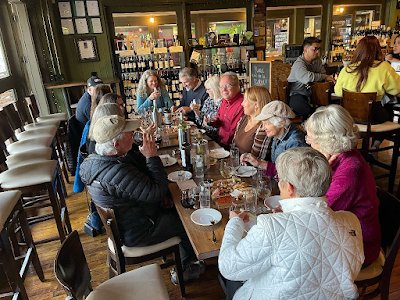
Approaching the event space, the Hanna Center in Sonoma. The patio to the left had places for people to meet and eat, plus tables of vendors around its perimeter. Talks and panels happened in the big room to the right...

...which looked like this. I took this photo first thing in the morning, before it filled in. It's a great space, with some of the smoothest AV and tech crew I've encountered. Food and drink were swell. The conference took good care of us.

An adjoining lounge/green room offered relevant books, including mine, available for a donation to the cause. Organizers bought 25 copies of A Fire Story and by the end of the event were almost sold out. Of course I signed them all, and got a chance to personalize some for people who said it meant a lot to them. That's very gratifying.

Another author present was teenager Leela Bahador, who wrote her children's book Wildfires to Wildflowers following the Pacific Palisades blaze in 2025. We coincidentally wound up sitting at the same table and had a nice conversation about the writer's life. Turns out I'm old. (Photo by Jennifer Gray Thompson)

I spent quite a while talking with a man whose name I didn't catch from an organization called The Foothill Catalog Foundation, which serves survivors of the Altadena and Pacific Palisades fires by presenting them with dozens of pre-approved, ready-to-build house plans that retain the historical architectural aesthetic of the community and are meant to fit onto typical sized lots.

Man, we could have used something like that after our fire! Our rebuild process was absurdly haphazard, and although a few big builders came to community meetings with prospective floorplans, we didn't like any of them (and some of them ultimately turned out to be crooks who took people's money and didn't deliver). If a group like this had come to us and said, "Here are a bunch of designs that will look good in your neighborhood and fit on your lot," it would have made our lives much easier. 

A panel of folks from Lahaina who told very interesting stories about their recovery work to date (with some of us sadly and sympathetically understanding how far they have to go). I don't want to idealize or romanticize anyone, but their focus on history, family and community felt unusually strong.


Tuesday, November 4, 2025

250 Words on Analog Art


[I try to start my day writing 250 words on anything. I’ll post one every Tuesday until I run out of good ones.]

Some cave paintings in Spain may be 64,000 years old. The earliest decorated pottery was made in China and Japan around 18,000 BC.

Meanwhile, somewhere right now, an artist is desperately failing to recover a digital image they stored on a balky computer drive in 2007.

I treasure original art—both cartoons, which are my professional interest, and more generally all of it. It was in the artist’s studio. They touched it. You can see their preliminary layers, study their decisions, grasp their process and mind. I’ve seen fingerprints in 2000-year-old paint. It makes an intimate connection that crosses centuries.

More and more of my cartooning colleagues have transitioned to digital art. They compose on a Cintiq or iPad using programs like Clip Studio or Procreate. I understand. The ease and speed are seductive; so is the “Undo” button. 

I’ll always cartoon with ink on paper. Not that I’m right and they’re wrong. Whatever gets the job done. But I mourn what’s lost.

It’s a broader issue. Historians can research the American Revolution or Civil War by reading period diaries and newspapers. Old ads and posters are a treasure trove. Those media are nearing extinction. In a hundred years, nobody will be able to decode a PDF or JPG. Future historians will see the art and culture of the early 21st century vanish into a black hole. 

Even if digital copies survive, the tangible connection between artist and audience will be gone. No fingerprints. It will be a profound shame. 

* * * 

PLEASE SUBSCRIBE! I am sharing these little "250 Words On" essays via Substack, which will email a new one to your In Box every Tuesday morning. Just follow this link and enter your email address. It's free, and I promise to never use your address for evil purposes.

Wednesday, October 8, 2025

Unhappy Anniversary

The last photo we took of the wall of flame coming over the hills toward us as we evacuated. 

Tonight is a grim anniversary for my family and neighbors: eight years ago (!) in the middle of the night, the Tubbs Fire destroyed about 5600 structures, including ours. It also killed 22 people, and was only one of more than a dozen fires that broke out all over northern California during a freakishly intense and dry easterly wind.

My graphic novel, A Fire Story, says about all I have to say about it. I would only add that, at the time, I thought our fire was one of those once-a-century random disasters that happens sometimes. In the years since, as I've watched the western half of North America erupt into flames and our record of "Most Destructive Wildfire in California History" has been eclipsed again and again and again, I've realized that we were victims of climate change, and my book is an early entry into a growing body of work on what living in a climate-changed world is like. 

The street into my neighborhood. This is the exact spot I wrote about in the book, where I realized the scope of what had happened and uttered several "fucks."

Sometimes it seems like a lifetime ago; other times, like yesterday. Karen and I still look at each other blankly, trying to figure out if we had some item--a bowl, a tool, a piece of clothing--before or after the fire. Random stimuli raise the hairs on the backs of our necks. It changes you forever, I think. Or at least for eight years plus.

It's cool and cloudy in northern California tonight. We expect a little rain tomorrow. There is nothing we appreciate more than rain in early October. 

Our home shortly after sunrise the next morning.


Friday, July 25, 2025

Report from Mill Valley

I had a good time talking A Fire Story at the Mill Valley Public Library last night. Got about three dozen people, which I think is a great turnout for a library talk on a Thursday evening. 

It was also an unusually interested and knowledgeable group, including a retired firefighter with 30 years' experience, a man in the fire prevention business, and a woman who helps evacuate horses from wildfires (a very specialized form of aid in its own). It was great to meet the sister of an old work friend. Librarian Jenn was an excellent host. Best of all, my wife Karen, our two daughters, and their friend Emily all came, and we had a fine dinner afterward. Even sold a few books!

Librarian Jenn warming up the crowd which, as I wrote, numbered about three dozen (this photo only shows a little slice, many more were sitting off to the left). They were very engaged and we had a great Q&A and discussion at the end.

I showed the video of A Fire Story made by PBS station KQED, which I haven't actually watched in quite a while. I looked over at my family to see they all had tears welling up, as did I. That thing deserved its Emmy Award.

A good night with the best company!

Monday, July 21, 2025

Appearance: Mill Valley Public Library


Bay Area (and especially Marin County) Friends! This Thursday, July 24, I'll be talking about "A Fire Story" at the Mill Valley Public Library at 6 p.m. I don't have many public events coming up on my calendar, so if you want to say Howdy this would be a good opportunity! 

Event information is HERE. The library is asking folks to register. I'm sure they'd still let you in if you just showed up, but it'd be polite to give them a head count. Thanks!

Monday, July 14, 2025

Tuesday Zoom: Cape Cod Sierra Club

Here's a Zoom event I'm doing tomorrow afternoon: the Cape Cod Sierra Club is talking about wildfires and I will be one of two speakers. I was invited by my friend Chris Powicki, with whom I did science writing here in California before he moved back east and became one of Massachusetts's go-to experts on ecology and renewable energy. I have a short presentation planned, and then some Q&A. 4 p.m. Pacific/7 p.m. Eastern.

Click on that link above or here to register. It should be good!

Friday, July 11, 2025

Raise the Alarm


Nothing in this article about how Kerr County officials failed to use available alert systems to warn citizens about deadly flooding surprises me, because the same thing happened to us in 2017, Lahaina in 2023, and elsewhere elsewhen. 

The Washington Post reports that Texas emergency managers did not use their IPAWS system, which would have transmitted alerts to cell phones and could sent tailored messages to targeted areas. Kerr County officials haven't yet explained why they didn't push the button. 

In the case of our firestorm, as I wrote in my graphic novel "A Fire Story," they didn't want to cause a panic that might have gridlocked streets and led to a catastrophic death toll. Our county's warning system, called Wireless Emergency Alert (WEA), could have narrowly targeted particular neighborhoods, but local officials later said they didn't know it could do that. So virtually no alerts went out. Most of us were awakened by hot howling winds or the sound of neighbors or firefighters pounding on our doors.


In our fire's aftermath, one county official acknowledged to me that not pushing the button was their biggest mistake. They should have clanged every bell, blared every siren, and buzzed every phone they could, he told me. 

We won't make that mistake again. I am mad and sad to see so many others learning the same lesson the hard way.

Wednesday, May 28, 2025

Comics & Care Collective Event Upcoming


Advance Notice: I'll be doing a Zoom book club event with librarian Jameson Rohrer of the Comics & Care Collective on Monday, June 9 at 7 p.m. Pacific Time! Jameson invited me to discuss A Fire Story in the context of graphic medicine, which intrigues me. For obvious reasons, I almost always give graphic medicine talks about Mom's Cancer, but a big part of A Fire Story is trauma and grief. I think it fits and am interested to see how it goes. 

UPDATE: Unfortunately, this event has been canceled. I hope we can make it up sometime later, I think it would be an interesting discussion!

Thursday, January 9, 2025

Southern California Firestorms

The last picture we took as we evacuated our neighborhood before that
fire in the distance swept through and destroyed it. Tubbs, October 2017.

I thought I had nothing original, constructive or useful to say about the heartbreaking fires in southern California, but several people have asked so here's my input this morning:

IF YOU ARE IN AN EVACUATION ZONE: Take it seriously. Do what you're told. Don't sightsee. Assume you will never see your home again and pack accordingly (if you have time to pack at all). Seven years on, the things we miss most weren't the most valuable in terms of money, but in sentiment: family photos, keepsakes, heirlooms, memories. 

If you didn't prepare a "go bag" (and few do), grab your wallet/purse, birth certificate, passport, deeds, and insurance and other legal papers because you'll need them to rebuild your life. Computers and backups. Prescription meds. Eyeglasses. Charging cords for phones and laptops. Set up a safe meeting spot for everyone to gather. If you can, leave early to avoid the rush.

EDITED TO ADD: Here's a good idea from a Facebook commenter that I wish we'd done: If you have time, go around the inside and outside of your house and take a video of everything. It will help with insurance and other tasks later.

IF YOU HAVE LOST EVERYTHING: Take some time to gather your wits, then make a list. Every day, check things off that list and then, tomorrow, make a new one. 

Contact your insurance company. They probably already have a platoon of representatives in the area who will meet with you and may be able to cut a check on the spot. Register with Red Cross and FEMA. Get a FEMA number: that number will be a key to unlocking many services, resources and discounts. 

Get a P.O. box or ask a trusted friend to handle your mail, and submit a change-of-address form to the post office. 

Look out for scams, especially fake government websites. 

If you can get to your property, take photos of everything from every angle. If you can't get to your property, be patient. This is difficult; you want to go home. But there is really nothing you can do there and the authorities are making sure it's safe, searching for bodies, etc. It may be weeks before you get in. That's OK. 

Be willing to accept help. I can't tell you how many people after our fire said, "I don't need it, give it to someone who needs it more." Today, that someone is you. Take it. 

Don't make any rash decisions. Nothing needs to be done RIGHT NOW. You're in a marathon, not a sprint. Get something accomplished every day, but take it as easy on yourself as you can. 

Finally, I'll recommend three trusted Web resources:

After the Fire USA https://afterthefireusa.org/ is a great clearinghouse for all firestorm-related information and resources. I know the people who run it and they're the best.

United Policyholders https://uphelp.org/ is a nonprofit that can help you understand your insurance situation and fight for your rights to get the service you paid for. 

Cal Fire https://readyforwildfire.org/prepare-for-wildfire/ has excellent advice for both preparing for and preventing wildfires, and what to do afterward.

IF YOU KNOW SOMEONE WHO LOST EVERYTHING: Your friends or loved ones may be out of touch for a while. Don't pester them, they have a lot on their plate. 

Ask them what they need and really listen. They probably don't want piles of clothes, or teddy bears, or pots and pans, or canned food from the back of your pantry. For the next few weeks they'll be living in a motel or a friend's couch and have nowhere to put that stuff.

What we really appreciated were gift cards to big-box stores like Target, Walmart, Safeway (and, later, Home Depot), which allowed us to buy what WE thought we needed. Say what you will about those companies, but they were open and had everything we wanted in one place. When I gave similar advice before, some people commented that "cash is king" and can be spent anywhere for anything. True! That's fine! I still think it's easier to carry a few cards in your pocket than a wad of bills, and safer to mail.

Honestly, Karen and I find it very hard to watch the news because we know what those folks are going through now, and what they'll be going through for the next months and years. It's too much. They'll get through it but it's not an ordeal I'd wish on anyone. 

As for the MAGAs who are gloating, laughing, and mocking fellow Americans without showing an ounce of empathy or compassion--especially the MAGA-in-Chief who's taking the opportunity to spew playground insults and uninformed idiocy--I wish they could take just a moment to reflect on how they became such terrible people. They won't, I know. They think they're the good guys. The worst villains always do. 

Monday, October 7, 2024

250 Words on Closure

[I try to start my day writing 250 words on anything. I’ll post one every Monday until I run out of good ones.]

Seven years ago this week, wildfires throughout California devoured thousands of homes and neighborhoods, including mine. It’s an apt time to reflect.

Seven years can feel like a day or a lifetime ago. Sometimes it’s as if it all happened to somebody else; other times, it’s painfully fresh. Karen and I and our friends, neighbors, and community handle day-to-day life just fine, but the PTSD is real and you never know what’ll set it off. Something as subtle as a rumble in the distance or a warm autumn breeze makes the hairs on the back of your neck rise.

I still walk into rooms and reach for light switches that aren’t there. Karen and I still look at each other blankly and ask, “Do we have that thing, or did we used to have it?”

Sometimes people ask about “closure,” but in my experience there’s no such thing. There’s just your old life that’s gone forever, and your new life that began that day and continues to build. That new life isn’t much support or comfort when you’ve only lived it a few days, but after seven years you’ve built enough new experiences and happy memories that it has some weight to it. A new foundation in a new land.

I’m not even sure closure is something to be sought. The jagged seam where your old and new lives collided will never be smooth. Why should it? We survived a hell of a thing. Now it’s a part of us.

***

SUBSCRIBE! With the encouragement of friends, I am now sharing these little "250 Words On" essays via Substack, which will email a new one to your In Box every Monday morning. Just follow this link and enter your email address. It's free, and I promise to never use your address for evil purposes.

Sunday, March 5, 2023

On the Same Page in Claremont

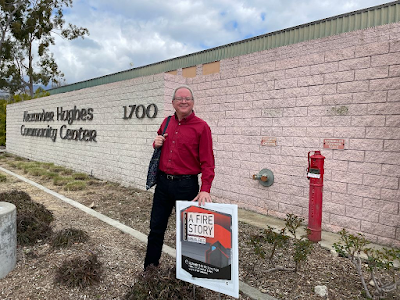
We arrived early, to find lawn signs ringing the community center! Yes, of course I took one (or three) home.

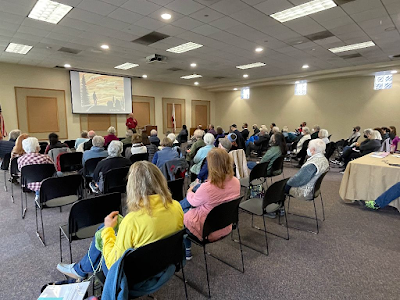
I'd say yesterday's talk and book signing capping off the Claremont (Calif.) Friends of the Library's "On the Same Page" program went great! The Friends chose "A Fire Story" as their community book of the year, and in the past several weeks hosted related events on fire safety and disaster preparedness. About 70 people came out on a lovely southern California Saturday to hear my story. Knowing that this was the first graphic novel many of them had read, I also made my best case for comics as a respectable literary medium. May have made a few converts.

A good overview of the room and crowd as my talk got started.


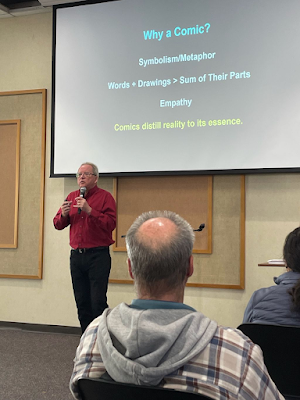
Explaining--maybe even evangelizing--about why on earth someone would tell the story of a firestorm in the form of a comic. I am passionate on the subject.

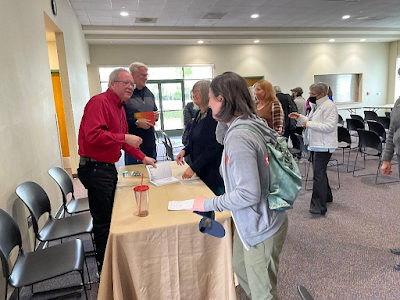
Signing books afterward. The library had distributed dozens of copies throughout the community in advance of my talk, so a lot of people brought theirs along to sign. The Friends also sold a few at the event.

My sisters Brenda and Lis live not too far from Claremont so they got to come, along with Lis's boyfriend Randy, which was very cool. It was also an opportunity to meet some Facebook friends in real life, including Susan Kullmann, who moved to Claremont after losing her home in the same fire I did, and comics writer and editor Barbara Randall Kesel, who I wish I'd had more time to talk shop with. Also got to know Chris Sayler and her husband Dave, who know my Dad! It was Chris who brought my book to the attention of the Claremont folks in the first place. All terrific.

The Friends of the Library seemed satisfied with my efforts and were as welcoming and kind as could be. Their hospitality extended to a wine bar after the event, which was a nice chance to wind down and get better acquainted. There are no better people on the planet than people who love books. Many thanks to them!

Later at the wine bar. A fine opportunity to relax and get to know people. A wonderful group of Friends.


Sunday, September 11, 2022

Made Local


A locally made magazine called "Made Local" interviewed me for an issue on the good and bad aspects of fire, as the five-year anniversary (!) of our firestorm approaches. Editor Jess Taylor and I exchanged questions and answers by e-mail (that's routine these days) and she published my replies like a first-person essay, which is unusual and I like it! Good or bad, what she printed is exactly what I wrote, so I can't complain about the reporting. Plus it's a big, attractive spread. 

Thanks, Jess!

Monday, May 2, 2022

Hood River Reads

Majestic Mount Hood.

Karen and I are home from a very busy, beautiful long weekend in Oregon's Columbia River Gorge as guests of Hood River Reads, an annual program by the Friends of the Hood River County Public Library that encourages the community to read and discuss a book. This year, they chose mine. The group purchased enough copies of A Fire Story--nearly a thousand!--to distribute them free to the middle school, high school, and anybody who asked. Their one condition: I had to come and talk.

In the weeks before I arrived, Hood River Reads had kicked off the campaign with book club readings, mayoral proclamations, a poster contest, and creative classroom assignments built around A Fire Story. By the time I arrived on Friday, pretty much everyone I encountered had read the book. That's . . . unusual. I've never seen anything like it. The beauty of the Columbia River Gorge, the passion and kindness of the Friends of the Library, and the library and town of Hood River itself made for an exhilarating few days.

Here's all you need to know about the place and people: when we arrived, they had a gift box waiting in our hotel room, and among the many books and snacks in the box was a jar of homemade jam. 

The Friends chose A Fire Story partly because the area has faced terrifying wildfires itself, most recently the Eagle Creek Fire which, like our Tubbs Fire, hit in the fall of 2017. We saw its scars on the drive east from Portland. No lives were lost and property damage was light, but the 48,000-acre fire burned for three months. The kids remember it, the adults will never forget it.

I gave three talks on Friday: a workshop for a library full of middle school students, a lecture for an auditorium full (200-plus) of high school students, and a workshop for a combined art and creative-writing class at the high school. My last three talks happened at the downtown library. I gave two on Saturday: a workshop for the community, attended by about 15 prospective (or at least curious) writers and cartoonists, and a community lecture on graphic medicine suggested by a Friend who'd read Mom's Cancer. On Sunday afternoon, I gave a concluding community lecture in which I made the case for literary graphic novels and tied my fire experience to theirs to talk about readiness and resilience.

Six talks in three days is a packed schedule, but between events Karen and I were treated to convivial meals and had time to explore the area, including a drive to the snow at the foot of majestic Mount Hood an hour away. 

As is my way, I'll tell the rest of the story with pictures. Many thanks to our hosts--Laurie, Bonnie, Bill, Helen and others--as well as the librarians, teachers, and spouses involved in making us feel as welcome as could be. They're wonderful book-loving people (the best kind!) who live in a wonderful place. Thank you for inviting us up.

A selfie at historic and scenic Multnomah Falls along the way. Of course we hiked up to that bridge! The volume of water rolling over the rocks into the mighty Columbia everywhere we looked was stunning to these drought-addled Californians.

Karen found this sticker in a copy of A Fire Story: "Please read this book and pass it along or return it to the library." Isn't that terrific?

They were ready for me.

Students at the middle school had drawn pages combining images and quotes from the book that struck them. It was interesting to see what they picked up on. This isn't even half of them; they were all over. Karen took most of these photos while I was talking to people and figuring out how to get projectors working.

It is profoundly surreal to walk into a school hundreds of miles from my home and see an accurate rendering of my backyard. Notice how this artist used quotes from the book as the melted iron bars in the gate. I wish I'd thought of that.

Before we got started, a teacher introduced me to a boy with obvious neurological issues who had drawn a beautiful 12-page comic featuring Dav Pilkey's "Captain Underpants." He had storytelling skills and color sense beyond his years, and I was happy to tell him that. For some people, it's easier to communicate in words plus pictures than words alone, and I'm proud to be part of a medium that offers that outlet.

Rappin' with the yoots. I made them draw some comics themselves.

Talking to a couple hundred high schoolers in their professional-grade theater. Hood River High School is an extraordinarily well-equipped campus, with shop classes (haven't seen those in California since the '70s), a large greenhouse supporting an agricultural program, a student health center, and students who were unfailingly smart and polite. Maybe I just missed the duds, but the kids I met convinced me that the future is all right.

An hour in teacher Matthew Gerlick's art class flashed me back to high school and college. I was not prepared. Paint splattered everywhere, half-finished projects clipped to drawing boards and drying in flat files, silk-screening frames lying in racks, bins of supplies stacked to the ceiling. I felt at home in a way I haven't in decades. Some interesting young writers and artists, too.

The high school students held a Fire Story poster contest. As with the middle schoolers, I was fascinated to see how they processed and interpreted my story.

Many entered, three won. I was very happy I wasn't asked to judge.

Saturday morning I did a writing workshop for a small but motivated group. This is an exercise where I draw an oval with two eyes and a nose, then have brave volunteers come up to add eyebrows, mouths, etc. and ascribe an emotion to the expression they created. The idea is to show the tremendous variety of complex and subtle emotions that can be conveyed with the simplest of graphics. Photo by Bonnie Withers (thanks Bonnie).

Sunday's community lecture in the library's great room, attended by 50 or so. Librarians Rachael and Mo were great and helpful hosts. I'm wearing my red shirt so you know I'm serious.

At liberty on Sunday morning, Karen and I headed south toward Mount Hood for some beautiful scenery and a snowball fight that Karen did not let me start. A shame. It would have been glorious.


Saturday, October 23, 2021

Book in Common at Randolph-Macon

I'm home from Randolph-Macon College, a small liberal arts school in Ashland, Virginia, which chose "A Fire Story" as this year's Honors Program Book in Common and invited me to talk about it, which I did on Thursday (which meant flying to and fro all day Wednesday and Friday). 


One of the entrances to the school, and you'll immediately notice the one feature that delights me every time I travel back east: bricks. We don't have many brick buildings in northern California. Ours all fell down in 1906, and we're not allowed to build them anymore. More than any other indicator, bricks are what tell me I'm in terra incognita.

A "Book in Common" is a book that all the students read--in this case, all the students in the Honors Program, but also many others as I discovered. It often reflects some theme that different classes build the year's curriculum around, in this case "resilience." I feel well-equipped to talk about that. 

My day began with a VIP campus tour (in a solar-powered golf cart!) given by Robert Patterson, the school's director of corporate and foundation relations. I had lunch with three staggeringly smart honors students, spoke to three classes, had a great half-hour chat with Provost Alisa Rosenthal, dinner with a select group of students and faculty, then the Main Event: a community lecture attended in person by about 30 and, due to Covid, another 140 or so watching on Zoom. 

I took this photo of the quad in the center of campus. A professional took the next one that I stole from the Web.

Courtesy of Randolph-Macon College, even though I didn't ask.

During my morning campus tour with Robert Patterson, who's on the right here, I saw this small campus observatory atop a building that looked so much like the small campus observatory I spent countless nights in at UC Davis that I practically begged for a tour. Robert obliged by rousting Physics Dept. Chair Deonna Woolard (left) from her office, and she was kind enough (and had the keys!) to let me in.

The observatory's telescope. This is a real nice set up, much better than the one I had. When Covid abates they'll resume public viewing programs here, which is very near and dear to my heart because I ran the same at Davis. XO

These are honors students Sam, Cara and Trixie, who took me to lunch off campus. They are remarkable young women and fine representatives of their school. Our future's in fine hands.

That's a long whirlwind day, but a really good one.

A word about Randolph-Macon College: I was very impressed. It's a small school, only about 1400 students. As Robert pointed out, many of their students come from high schools bigger than that. It's a beautiful campus established in 1868 (the school was founded elsewhere in Virginia in 1830, and you scholars of U.S. history may infer why it had to relocate in the 1860s). 

One of my big takeaways: an education there would be unusually personal and intimate. Everybody seemed to know everybody else. Classes are small. Faculty wear many hats, and are encouraged to follow their own quirky passions or areas of research and take students along with them.

Another big takeaway: for a small college, they have a very robust offering of majors, including in hard sciences like physics, chemistry, geology, biology. One of the girls who took me to lunch is a neuroscience major. Those sorts of classes require expensive labs and such that other colleges can't afford, but the facilities I saw in my tour looked modern and excellent. Small, but high quality.

One of the classes I spoke with was Dr. Amber Peacock's course on "Discerning Learning and Achievement," which hit the resilience theme hard. Great students and teachers that I didn't get any pictures of. Instead, this was my second class, Drawing, with Prof. Kristen Payton, who's farthest to the right. This was about half the class, the other half was out of frame to the left, with the usual mix of students who are very serious about art and others who just want the general ed credit. A real nice conversation about art, intention, authenticity, finding your own style and voice, etc. 

My third class was Printmaking, also with Prof. Peyton. Just four students, but very sharp and engaged. I said repeatedly, and wasn't joking, that I'd LOVE to take this class. Printmaking is something I'm very interested in and hope to pursue. They're doing it now. 

I went to a big school, the University of California at Davis. I don't know what enrollment was when I went there, but now it's about 30,000 undergrads and probably wasn't much different then. That environment worked for me, I thrived and loved it. But spending a day at Randolph-Macon made me nostalgic for a different education I could have had. I think a student there is very lucky.

A few photos, some of which I nicked from the college website because I didn't have a chance to take many pictures myself. Thanks to Randolph-Macon for choosing my book and inviting me to talk about it, to Dr. April Marchetti for being a great host and guide, and to the students who couldn't have been sharper or more engaged (I joked that they must have told the dolts and duds to stay off campus for the day). Go Yellowjackets!

My host, chemistry professor and head of the Honors Program, April Marchetti. She's great, and I'm not just saying that because she bought me dinner and drove me everywhere.