Showing posts with label Hornet. Show all posts

Thursday, October 22, 2026

Call 'Em Like Museum Podcast with Laura Fies

Proud Dad Warning. Here's a 48-minute podcast/interview with my daughter Laura in her role as the CEO of the USS Hornet Museum in Alameda, Calif. The "Call 'Em Like Museum" podcast looks to be a newish weekly show devoted to the challenges of running all sorts of museums, and this week host Eric Johnson looked at the Hornet. 


As I told Laura after watching it, I was very impressed by how informative, composed and articulate she was for nearly an hour. Having sat through similar interviews myself, I know my brain turns to porridge after 20 minutes or so. I also thought Johnson was a good host who asked smart questions and listened to her answers (surprisingly rare). 

As a parent, this was one of many times I've been reminded that my kids are full-grown independent adult professionals who have knowledge and experience I know nothing about. That's the goal, right?

Wednesday, October 14, 2026

Reflections on Victor Glover


A few days ago, I wrote about getting to see Artemis 2 astronauts Victor Glover, Christina Koch, and Reid Wiseman at a private event aboard the USS Hornet Sea, Air and Space Museum. Because the event felt "off the record," I didn't report on the occasion or their remarks in any detail. 

But Glover said something that stuck with me. He spoke about the profound beauty of watching the Sun eclipsed by the Moon as their spacecraft looped around it, then the wonderment of still being able to see lunar craters, maria and mountains gliding past, lit only by the very dim blue glow of Earthshine--sunlight reflected off the Earth back onto the Moon. You can see Earthshine yourself when the Moon is, say, a crescent, and its shadowed features are faintly visible.  

As dazzling as the view was, Glover realized that it wasn't unique or special in any way. It was a show the universe has put on for billions of years. Routine. Commonplace. The difference was that this time, for a few brief minutes, there were humans in the right place to see it. THAT'S what was unique and special: our presence.  

I've read and seen a lot of interviews with astronauts but never heard one make that particular point, and I'm not sure if it's deeply profound or simplistically obvious. The fact that I'm still mulling it four days later suggests the former to me.

The universe is putting on a spectacular show all the time--not just in the cosmos but in the oceans, in the skies, in the dirt beneath our feet. Maybe our highest calling in life is to stay open to wonder and notice it.


Saturday, October 10, 2026

Lunanauts

Astronaut Reid Wiseman, Volunteer Tour Guide Brian Fies, and Astronaut Victor Glover. One of these things is not like the other. I actually had a few moments for a brief but nice conversation with Wiseman. Cool dude. Photo by my daughter Robin.

A while ago, my daughter Laura told me that Artemis 2 astronaut Victor Glover was scheduled to speak at a private after-hours event aboard her museum ship, the USS Hornet. "Oh, that's nice," I thought. A while later she said, "I think the entire Artemis crew will be there, and you should be too." "I wish I could," I replied in the imaginary conversation I made up for this post, "but I couldn't crash a private event." "You could if you were Hornet staff working it,” she replied. 

So Friday night I volunteered to give tours of the Hornet's Mobile Quarantine Facility (MQF), which was an Airstream trailer modified to quarantine the crews of early Moonlanding missions after their returns to Earth, a subject I actually know a bit about. The Hornet has Apollo 14's MQF. It isn't normally open to the public and we hoped to lure an astronaut inside. Alas, we did not. However, I did have the honor of giving a tour to NASA Lead Flight Director Zeb Scoville, who seemed to appreciate it. 

Welcome to the MQF! Want to tour my custom 1969 Airstream?

A shot of me giving a tour through the window of the MQF. On the Apollo 11 mission, that's the same window through which President Richard Nixon spoke with Armstrong, Aldrin and Collins.

The private event was a "Roll Call," a traditional fighter pilot occasion to reunite, swap stories, give toasts and, in this case, celebrate Glover's recent retirement. Fellow Artemis crewmembers Reid Wiseman and Christina Koch were there; Canadian Jeremy Hansen planned to come but couldn't. All spoke but, given that the event was private, I won't quote them. They're all smart, funny and inspirational. Of course.

It was an extraordinary gathering of extraordinary people, three of whom just flew around the Moon, and I was thrilled to be a fly on the wall. Happy to volunteer anytime! 

Kock, Glover and Wiseman celebrating Glover's career. It was a big night for him. His mother, wife and daughters were all there to witness it.

Wednesday, April 8, 2026

Wednesday on the Hornet

Snapped this photo of Pathfinder 1 with the USS Hornet while Laura and I were walking to lunch. Wish I'd had the timing or presence of mind to be closer to the Hornet; without all the road and fencing in the foreground, it would have been a real postcard photo!

I spent a few hours aboard the USS Hornet  Sea, Air and Space Museum today, consulting on updates they're making to their Apollo exhibits, to which I contributed 14 or so years ago. It was a beautiful day on the Bay, highlighted by a rare appearance by the Pathfinder 1 Zeppelin, the first rigid airship of its type to fly since the Graf Zeppelin II in 1939. 

I've seen plenty of blimps but don't think I've ever seen a real rigid airship before. The Pathfinder is a pet project of billionaire Sergey Brin and is about half the length of the Hindenburg, which must have been extra awesome in its day because Pathfinder was plenty impressive enough.

It felt especially meaningful for me to revisit Hornet's Apollo exhibits as Artemis returns from the Moon (Hornet was the ship that recovered Apollos 11 and 12 from the Pacific in 1969). I worked on my little project, took my museum-CEO daughter to lunch, and headed home, all the time thinking about the Moon and the 57 years between then and now.

Among the Hornet's artifacts are an Apollo command module boilerplate--a prototype used for testing (CM-011 if anyone wants to look it up)--and a Sea King helicopter, the same type used to recover Apollo 11 and 12. The actual helicopter used in those missions crashed in the '70s. This one is the same model that was painted to look like the original for use in the movie "Apollo 13."

The Hornet also as the Mobile Quarantine Facility (i.e., Airstream trailer) used for Apollo 14, as well as one of the Biological Isolation Garments the astronauts donned to protect the Earth from potential Moon germs. (Spoiler alert: there weren't any Moon germs, but they weren't sure of that at the time.)

The Hornet is closed to the public on Wednesdays, but it would be a lie to claim I was alone. There were museum staffers on hand plus two school buses worth of students. However, an aircraft carrier, even an old one like the Hornet, is big enough to swallow a hundred people without a belch, and once in a while you can still get half a hangar deck all to yourself.

San Francisco shining across the Bay, featuring three modes of transportation: rigid airship high in the sky, ferry plying the waters toward Alameda, and, in the distance above the city, a red Coast Guard helicopter.

Saturday, February 14, 2026

Lost and Found on the USS Hornet

Here's a neat TV news story from my daughter Laura's aircraft carrier, the USS Hornet Sea, Air and Space Museum: a museum volunteer poking around some compartments of the ship that have been locked up since the Hornet was decommissioned in 1970 found a sailor's old high school class ring. The ring provided enough clues to identify the sailor and locate his family! 


Aside from the heartwarming story, I love the idea that there are still deep recesses of the ship that have yet to be fully explored. An aircraft carrier, even an old one like the Hornet, really is like a small city at sea.

Friday, August 1, 2025

Savage on the Hornet 4

Former Mythbuster Adam Savage has posted his fourth video exploring my favorite aircraft carrier museum, the USS Hornet - Sea, Air and Space Museum. I believe this is the last one, although who knows? If Mr. Savage's "Tested" crew got enough good footage out of their day aboard ship, they may go on forever. 

This episode focuses on aircraft restoration, most of which is done by a burly crew of gear-head volunteers as well as a neat corps of high school students. As always, I love Adam's enthusiasm, which is well-matched in this video by his guide, Anthony. One thing that's generally true about the Hornet staff: they're passionate about their jobs and their ship!

The Hornet is in the middle of its summer fundraising push and would love it if Adam's 7 million subscribers donated a dollar each. Well, that's not going to happen, but if you watch the video, maybe consider clicking on this link and sending them a few bucks? In addition, here's the Hornet's wish list that Adam and Anthony mentioned. They're a big ship with a small-museum budget and every donation counts. 

Thursday, July 24, 2025

Savage on the Hornet 3

Former Mythbuster Adam Savage posts his third in a series of videos exploring my favorite aircraft carrier museum, the USS Hornet Sea, Air and Space Museum. Again, I love his enthusiasm, especially as this episode focuses on the Hornet's Apollo-related artifacts (the Hornet is the carrier that plucked Apollos 11 and 12 from the Pacific). 

I've poked my head inside that Apollo test capsule (CM-011 for those following along at home) and been inside the Mobile Quarantine Facility (MQF), although the bunks Adam crawls into have always been off-limits. Lucky Adam! I have a story about my personal involvement with an MQF-related artifact that I'll share some other time. 

There are other museum ships and even other museum aircraft carriers, but the Hornet's involvement in the Space Race makes it very special (plus the fact that they employ one of my daughters!). I love seeing Mr. Savage bring it some attention it deserves.

Friday, July 18, 2025

Apollo on the Hornet

EYEWITNESS TO HISTORY! Just in time for the anniversary of Apollo 11, the USS Hornet - Sea, Air and Space Museum has posted never-before-seen home movies of the Hornet's recovery of Apollo 11! The film is from museum volunteer Joe Holt, who in 1969 was a Marine sergeant stationed aboard the Hornet. 

Nobody but Mr. Holt and his family have EVER seen this footage! The first half shows the recovery of Armstrong, Aldrin and Collins and their spacecraft, Columbia, with glimpses of the astronauts inside the Mobile Quarantine Facility (a tricked-out Airstream trailer) and President Richard Nixon. The second half shows the crowd that welcomed the Hornet to Pearl Harbor where they offloaded the MQF, and then quite a survey of other Naval ships in port at the time.

I think eyewitness records like this offer a whole different perspective on historic events from people who played a role in them. Many thanks to Mr. Holt for sharing it with the world.

Friday, July 11, 2025

Savage on the Hornet 2

Another report from Adam Savage aboard the USS Hornet, my favorite former-aircraft-carrier-turned-museum, this one touring the old girl's machine shop. I understand his team produced a total of four videos from his day on the Hornet; this is number two.

As a Mythbusters fan who's kept up with Adam since that program ended, I think his gift as a broadcaster is how he nerds out with unabashed glee and communicates that to the audience. He's so happy and excited he makes us happy and excited, even if the sight of a big lathe or drill press wouldn't normally delight us.

The best broadcasters (or artists or writers or graphic novelists) are the ones who know how to show their authentic selves. Audiences can tell when you're faking it. He isn't.

Wednesday, July 9, 2025

Savage on the Hornet

Mythbuster Adam Savage visited the USS Hornet - Sea, Air and Space Museum recently, and produced this video (with more to come) for his YouTube channel. It's a great piece!

About halfway through the 18-minute video, Adam rides the ship's old aircraft elevator. I have also ridden that elevator, and it is a thrill! As Adam says, it almost feels like freefalling as your eyes adjust from daylight to the dark cavern of the hangar deck in just a few seconds. It's like a portal between worlds.

My daughter Laura, who's the CEO of the Hornet Museum, doesn't appear on camera but did all the contacting and legwork to arrange Adam's visit (and now Laura gets to brag that she's met BOTH Mythbusters!). Adam's guide for most of the video, Russ, is a friend and a great guy whose knowledge and passion are evident. 

Obviously, the Hornet is hoping that Adam's enthusiasm is contagious and that some of his 7 million subscribers will come check it out. I'd encourage them to. I've spent a lot of time aboard the Hornet and love her nearly as much as the people who work there.

EDITED TO ADD: Here's the video I shot of MY elevator ride several years ago. I don't want to keep nattering about the elevator--there's so much more to the ship than that, and they don't routinely run it for visitors--but it was darn cool.

Sunday, March 20, 2016

Willie & Joe & Me

Regular readers know I love the USS Hornet, the aircraft carrier that recovered Apollos 11 and 12, and is now a National Historic Landmark and museum in Alameda, Calif. where my daughter Laura works and my other daughter Robin volunteers from time to time.

Laura helped put together an exhibition on "Cartoons at War" inspired by the recent find of some letters in the archives between a sailor on the Hornet and famous cartoonist Milt Caniff in 1944. Caniff created the comic strips "Terry and the Pirates," and later "Steve Canyon," which both featured a lot of military action. Caniff wanted to get the details right so he regularly corresponded with soldiers and sailors. Full disclosure: I edited the exhibition's text panels for Laura, so I'm invested.

The museum staff asked me to give a talk about Cartoons at War, and I asked Corry Kanzenberg, curator of the Charles M. Schulz Museum and Research Center, if she wanted to do it with me. I was astonished and delighted she agreed. Schulz was a machine gunner in Europe; he drew a lot of sketches while there, and his experience informed his later work in "Peanuts," particularly re: Snoopy and the Red Baron.

So we went and did that Saturday.

Laura, wearing a "Peanuts" hoodie to fit the day's theme, gave us a tour of her "Cartoons at War" exhibition. It's in a space designed for temporary rotating shows, and in fact closes today. Sorry if you missed it!
Wartime art from the Hornet's sister ship Bunker Hill (the Hornet was CV-12).
Disney designed more than 1200 military insignias and patches during the War, including one for the Hornet.
Corry and I are way up on the stage under the giant flag, projecting our slides on the screen at the right. The audience included a good-sized squad (or platoon or whatever) of recruits who spent the weekend training on the Hornet. Karen counted about 60 people in the audience, which I thought was a good turnout.
I presented first, while Corry sat beside me wondering if she'd make a terrible mistake. I gave a real quick history of comics up to World War 2, then, taking my cue from the exhibition, hit superhero comics, Bill Mauldin's "Willie & Joe," Dr. Seuss's political cartoons, Milt Caniff, Roy Crane's "Buz Sawyer," and more, all lavishly illustrated. 
Corry introducing the Schulz Museum. We were speaking on the Main Stage in the Hangar Deck, which extends far to the left and right. At the right side of the photo is a flight simulator ride for entertaining the kiddies. 
Corry's turn to talk. Her presentation was great. Then we talked to each other for five minutes, took a few questions (one boy just had to tell us how much he loved Snoopy), and were done after about 50 minutes.

Immediately afterward I went to a small classroom below decks to do a Girl Scout Comic Artists Badge Workshop for a troop of six scouts. One of their mothers works with Laura on the Hornet (Hi, Chris!) and has wanted to do the workshop for a while, so we figured we'd kill as many birds with as few stones as we could. Attendance at the earlier talk was part of their requirement for earning the badge. It was a great group of girls, lively and attentive in all the right parts. By the end of the workshop everyone knew how comics are made and had drawn a four-panel (at least--some girls did much more) comic strip.

Me up front guiding the troop through some cartooning skills, with Laura looking on from the gangway. Robin came too, but we didn't get photos of her. I really like this shot Karen took because it give a good sense of what it's like to be aboard this giant chutes-and-ladders maze of a ship.
The ship's store stocked my book. We sold and signed a few.
In the Hornet's Apollo Exhibit, inspecting the plastic case I underwrote to properly display these two Space Age artifacts that are, in my opinion, the jewels of the Hornet's collection. I explained the significance of those little wooden signs the first time I actually got to touch them. 

Any day I get to spend aboard the Hornet is a good day for me. Thanks to Heidi and the Hornet staff for inviting me, and huge thanks to Corry for driving all the way down from Santa Rosa to help me out. She was terrific!

Monday, July 27, 2015

Gravity: Not Just a Suggestion, It's the Law

Here's how I got into the lucrative museum display game.

In 2012, I built my first interactive display for a museum. My daughter Laura is on the staff of the USS Hornet Aircraft Carrier Museum in Alameda, Calif. That's the ship that picked up Apollos 11 and 12, so they've got some nifty Space Age artifacts. Laura was redoing the ship's Apollo Exhibit, and I got to build a box comparing gravity on Earth to gravity on the Moon (one-sixth as strong) via the highly scientific means of pulling handles that look like Wile E. Coyote TNT plungers.

If you drop by the USS Hornet, be sure to say "Hi" for me.

It turns out that kids love making a lot of noise banging and clanging things. Who knew?

Enter a gentleman named Ken Winans, who serves on the Hornet's board of directors, has one of the largest private collections of space artifacts, and runs a small storefront museum in Novato, Calif., called the Space Station Museum where Laura worked for a while. Ken recently opened a new room nearly filled by a 9/10th-scale replica of a Lunar Module. A few months ago, Ken contacted me and said, "Hey, what would it take for you to build me one of those boxes?" As it turned out, not much.

So three summers after I built my first "Gravity Box" I built my second in my driveway, and immediately hit a snag. My plans and notes from my first box were lousy. My dimensions weren't clear, my diagrams didn't match the photos; hey, I made it up as I went! So the first thing I did was send Laura up to her Apollo Exhibit to measure the prototype for me and reverse-engineer how I put it together in the first place.

After that, it was a breeze.


The basic frame in 2x4s and pressure-treated 4x4s. More 4x4s were added later. Not all of them were needed structurally--some were just to add weight, so that kids yanking the handles wouldn't nudge it across the floor.

A peek at the guts. The steel pipes of the handles themselves weigh 4 pounds. Add 20 pounds of weight to one of them, and it weighs 24 pounds--six times as much as the other, exactly the difference between Moon gravity and Earth gravity. The pipes pass through holes drilled through two 4x4s. That extra hole at upper left is what we in the museum display racket call "a value-added accessory."  Sounds better than "a mistake."
The cabinet is medium-density fiberboard (MDF), which I like for its smoothness and strength. It's also heavy.
Painting. I offered to make it any color Ken wanted, but he wanted to stick with Hornet Navy Blue.
Gluing on the information panel. This is a poster I designed and had printed by VistaPrint. It's on good thick paper, they do quality work.
Here's what the poster looks like. I cut off the bottom part to glue to the front of the box. Notice the lack of units on the weights: doesn't matter if you're talking pounds, kilograms or troy ounces, the ratio is always six to one.
Almost done. The posters are covered by sheets of acrylic, which are designed for easy replacement if somebody scratches them up. I also built a step, half visible to the left.
Dropped off at the Space Station Museum, next to a Saturn V model and a Soyuz control panel. The best part about making this delivery is that, while the Gravity Box was sitting outside on the sidewalk, two boys came up and began playing with it. Success!
Satisfied customer Ken Winans.

This time I took thorough notes and carefully documented every step in photographs, absolutely guaranteeing that nobody will ever ask me to make another one again.

If you'd like to play with an Original Fies Industries Gravity Box™, visit the USS Hornet anytime OR drop by the free Space Station Museum some weekend. In fact, I'd recommend next weekend because Ken is hosting his annual Novato Space Festival on Saturday, August 1, from 10 a.m. to 4 p.m. You can meet astronauts and NASA scientists there, and see all kinds of cool stuff. Did I say FREE?! 

This was a fun project.


Monday, July 28, 2014

Splashdown!


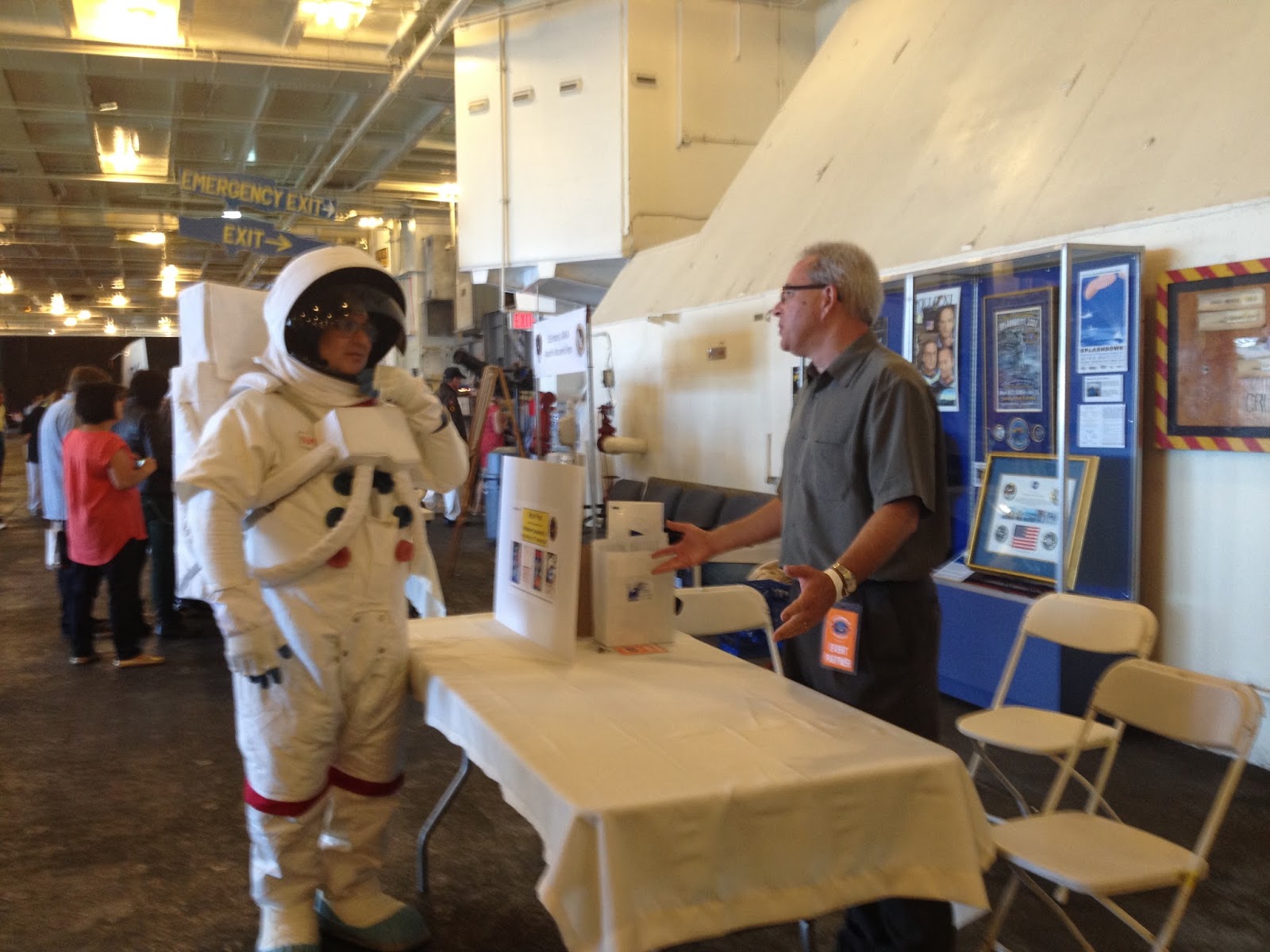
The aircraft carrier USS Hornet was built during World War II, served in the Korean and Vietnam Wars, and recovered Apollo 11 and Apollo 12 from the South Pacific in 1969 before being decommissioned in 1970. She spent a couple of decades in mothballs before becoming a National Landmark and museum now floating in San Francisco Bay at the Alameda pier. As my six regular readers know, my daughter Laura is on the museum staff, and I never tire of telling people that my little girl has the keys to an aircraft carrier.

I think Laura had something to do with me being invited to speak and sign copies of Whatever Happened to the World of Tomorrow at last Saturday's "Splashdown 45" event, marking the 45th anniversary of the flight of Apollo 11. But it wasn't entirely nepotism; I believe that at least some Hornet board members independently knew about my book. Still, I think I owe the kid a lot.

Did I mention that the star of "Splashdown 45" was Apollo 11 astronaut Buzz Aldrin?

That was sufficient motive to rise at the crack of dawn Saturday and leave Comic-Con for a flight to the Bay Area.

Got there on time, thanks to my daughter Robin's airport shuttle service.
Same clothes I wore at Comic-Con; I travel light.

The Hornet is a huge ship that usually swallows crowds with ease, but I've never seen it as packed as it was Saturday. I was talking with the museum CEO and he guessed more than 3500 attended. Buzz Aldrin was scheduled to speak on the big main stage in the Hangar Deck at 1:00. I was slated for the same stage at 11:30, asked to talk on the topic of Space Art and Illustration.

I widened that mandate to include a lot of the themes I worked into WHTTWOT: mainly the idea that the stories we tell about ourselves and our future are as important in shaping that future as the hardware we build. "Beat the Commies to the Moon" is as much an aspirational narrative as "Boldly go where no man has gone before." I focused mostly on art and illustration but also ventured into movies, TV, literature, and tried to tie them all together.

So I took the big stage and gave a 35- or 40-minute talk that in 162 fast-paced slides managed to name-check Galileo, Hevelius, Cassini, Maria Clara Eimmart, John W. Draper (who took the first photograph of the Moon), Gustav Dore, Jules Verne, HG Wells, Angus MacDonall, Scriven Bolton, Lucien Rudaux, Buck Rogers, Flash Gordon, Frank Paul, Will Eisner, Wally Wood, Frank Frazetta, George Melies, Fritz Lang, George Pal, Chesley Bonestell (of course!), Wernher Von Braun, Walt Disney, Charles Schulz, Robert McCall, Ludek Pesek, Don Dixon, William Hartmann, and more.

Just reeling off names like that makes it looks like a random laundry list, but I think I was able to build a theme and make a point that people seemed to get and appreciate. The Hangar Deck was set up with several hundred chairs facing the stage, and projection screens and speakers hanging half the length of the deck. It was obviously rigged that way so that everyone throughout the ship could see and hear Buzz Aldrin, but it worked to my advantage as well!

At the Hornet's book sales tent. One of these things is not like the other. They had about 1000 of Aldrin's books and 50 of mine, plus maybe another dozen in the museum gift shop. I'm very happy with that ratio.
Blah blah blah blah. Why won't this guy shut up? We Want Buzz!
Pulling back a bit, my wife Karen took this shot from the first row of seats. The podium was not initially set up with a monitor for me to see my own slides, which would have been disastrous because a lot of my talk relied on a rapid-fire "bang bang bang" clicking through the pictures. The speaker before me resorted to standing at the back of the stage and watching the rear projection on the big screen. I griped enough to the audio-video team that before I spoke they rewired one of Buzz Aldrin's teleprompters to show me my slides instead. Saved the day. Hope they remembered to re-rewire it for Buzz.
Stepping farther back into the cavernous Hangar Bay to show one of the screens set up to broadcast presentations throughout the deck. There were three of these screens hanging from the ceiling. It's a big ship.

My view from the podium.

From the start I had a pretty big audience, which grew as my talk went on. For a little while I thought I must have been orating better than anyone had ever orated before: more and more people were coming to watch me! Slowly it dawned on me that no, they were just staking out good seats to see Aldrin, who was going on 45 minutes after I finished. Still, it also worked to my advantage. Captive audience or not, I was the only thing on the stage at that moment so they had no choice but to sit and listen.

After my talk I sat at a bank of tables with other speakers and presenters to sign books. That went splendidly! Not everyone who bought a book got it signed or even realized I was there, but I had a steady stream of really nice people come up to chat and get an inscription. Having just left Comic-Con, I couldn't help noticing that Space People are a lot like Comics People but generally brighter (no offense to Comics People but c'mon!).

My book signing set-up amidship.

From time to time I had a little line, but nothing unpleasant. People couldn't have been nicer.
That's my daughter Robin beside me. 


This whole family was terrific. Very enthusiastic about the book and posing for photos with its author.
That doesn't happen to me very often.
I think this guy was hired by the Hornet. I hope this guy was hired by the Hornet.

Aldrin was preceded by a short video highlighting the Apollo 11 mission. I was surprised. I've seen the same old footage so many times I thought I was relatively numb to it, but I got an honest-to-God lump in my throat and tears in my eyes watching that Saturn V blast off into the Florida sky. Man. Aldrin was introduced by astronaut Yvonne Cagle, with whom I once shared a pizza.

At 1 p.m., Buzz Aldrin took the stage. Topic One of every conversation the rest of the day: how does an 84-year-old man do it? He boarded the ship at 9 a.m., did press interviews for three hours, then gave a one-hour speech, then signed books for three hours, then appeared at a reception and dinner in his honor until probably 10 or 11 p.m. Could you do that? I couldn't do that. I guess once you have the Right Stuff, it never really goes away.

Buzz drew a bigger crowd than I did.

Buzz's talk touched on his Air Force and academic career before settling on Apollo 11. I'm sure he's told the same "magnificent desolation" stories 300,000 times before, but he tells them well. Then he segued to his current passion, drumming up popular support for manned exploration of Mars. I wouldn't presume to debate Aldrin on the wisdom of that, but will say that he makes his case convincingly and enthusiastically.

Buzz World
Preparing for "Splashdown," I jokingly told some people I'd be spending the day "hanging with Buzz Aldrin." In fact, one does not hang with Buzz Aldrin. He had a black-shirted security detail of about six persuasive men who kept the respectful mob at bay. He also had one handler whose main job was being the bad guy so Buzz didn't have to. No, you cannot have a private word with him. No, he will not shake your hand. No, he will not sign your photo.

Buzz's book signing was a rapid assembly-line process--necessarily, given the hundreds of people in line. I had no special access, just queued up with everyone else, wondering what I might say to the Great Man when I had the chance. What hasn't he already heard 30 million times before? What could I possibly say that he might chuckle at and remember at the end of the day? Maybe something smart and obscure, a question about orbital rendezvous (the subject of his Ph.D. thesis) or his Gemini 12 mission?

In the moment, I froze up tighter than little Ralphie meeting Santa Claus in "A Christmas Story."

Buzz Aldrin and me.

To be fair, I only had about two seconds to spin around for Karen to snap a photo and spit out my carefully crafted bon mot. I believe I said, "It's a great honor to meet you." He looked up and said, "Thank you." Yeah, I'm pretty sure he's still got that original insight rattling around his brain.

I should have asked him for a Red Ryder BB gun. 

After the day's main public event, Karen and I stayed for a VIP reception. Here, again, you get a unique perspective on spending time in the orbit of one of the most celebrated men in the world. Buzz came to the reception and seemed accessible--he was 10 feet away! Yet actual interaction with him was defined by invisible circles enforced by his polite but firm security team. Only certain people got inside the circles. I wasn't one of them.

Here's what I mean. It appears that I could just walk over to Buzz's table and share a nice drink with him. There he is! Right there! But if I'd taken one more step in his direction, a large man would've gently taken me by the elbow and steered me away.

This is no criticism of Aldrin. I'm sure it's what he has to do to manage the millions of people who "only want a minute of his time" and get through the day. I just found it a fascinating glimpse at what goes into being Buzz. It was impressive and a little sad. I imagine it gets very tiring.

As it was, this was a very special day for me. In addition to spending the day on the Hornet (always fun!) and making such a memorable impression on Buzz Aldrin, I think this was my most successful speaking/book-signing event ever. My talk went very well. The museum sold all of its WHTTWOTs, so that by the end of the day I was doing sketches for disappointed people who hadn't been able to buy my book. That never happens for me.

I opened my talk by saying that if I had a time machine and went back to tell 1969 Brian that someday he'd be standing in that spot, on that ship, speaking on the same stage that Buzz Aldrin would be taking in less than an hour, there's no way I could make him believe it. "Splashdown 45" pushed every emotional button I've cultivated for 45 years.

I was Buzz Aldrin's opening act. Lifetime achievement unlocked.