Showing posts with label Graphic Medicine. Show all posts

Sunday, July 26, 2026

Graphic Medicine 2026: Baltimore!


While many of my cartooning colleagues gathered this weekend in San Diego for Comic-Con International, I was across the country in Baltimore for the 2026 Graphic Medicine Conference. Although I love Comic-Con, I think I got the better end of the deal. 

Graphic medicine is a field of medical humanities where comics intersect healthcare. It’s a big field, from public health to journalism to narratives like my book, Mom's Cancer. It brought close to 200 doctors, nurses, academics, librarians, cartoonists and others to Baltimore to share projects, research, results, stories and ideas.

I signed up for the conference too late to join any panels or workshops, and wasn’t sure I wanted to spend the time and money to fly across the country without a real reason to. Karen convinced me I didn’t need any more reason than wanting to hang out with my friends. “Life's too short. Just go.” 

It was the right call. I did hang out with my friends and also made some new ones. I saw interesting new creative work and am taking home a load of inspiration (and books). I managed to participate in many other ways than sitting on a panel, both within sessions and the perhaps-more-important time outside of them. 

I was also gratified to see that Mom's Cancer is still very relevant and useful to people working in the field, which is nice to know as we release its 20th anniversary edition. Graphic medicine people are the best. 

Photo dump ahoy. Apologies for the high percentage of selfies.


Most of the conference happened on the Johns Hopkins University's Homewood Campus, though we also ventured across town to the famous hospital. I don't know how many campuses Johns Hopkins has in Baltimore--seems like a dozen. This town is peppered with Johns Hopkinses.

A beautiful campus of Federalist-style brick buildings and grassy quads. Because it's summer the campus was pretty dead, except for knots of touring high school students. As I remark every time I travel east, brick architecture enchants me because we have very little of it in northern California. Ours all fell down in 1906.

At the Thursday night reception/social hour with keynote speaker Dr. Nathan Gray and graphic medicine champion Dr. Brian Callendar. Can't swing a dead cat without hitting a doctor.

Also at the reception, I connected with my friend Maia Kobabe, author of the most-banned book in America GenderQueer, and Maia’s collaborator on their new book Breathe, Sarah Peitzmeier. Sarah is the Ph.D. kind of doctor. There were a lot of them, too.

Dr. Nathan Gray gave the opening keynote talk on Friday. He wrote and drew a graphic novel titled The Human Remains (it's a tricky title with multiple meanings) that will be released in November but I have had the pleasure of reading (and blurbing) it already. I think it's a terrific book and Nathan was an excellent speaker about his own experience as a comics-creating physician.

Harvard medical librarian Matthew Noe, cartoonist Ellen Forney (Marbles), and Dr. Michael Green, who's been at the heart of graphic medicine since its beginning. I'd asked them if I could take their picture and they were winding up to pose when I snapped this one, which I thought had a lot more life and personality than the stiffer portrait that followed. Hope they forgive me.

A large atrium space was dedicated to vendors, including my friend, RN, and graphic medicine co-originator MK Czerwiec. Her excellent book Taking Turns is an oral history in comics form of her tenure on an AIDS ward in the 1990s, while her new book, LB & Me, is about her creative connection to cartoonist Lynda Barry. MK also won an Eisner Award for her editorship of the book "Menopause," and did me the favor of writing a new Introduction for the 20th anniversary edition of Mom's Cancer.

Friday night ended with an opera recital inspired by Dana Walrath's graphic novel about her mother's experience with Alzheimer's Disease, Aliceheimers. Dana wrote the libretto; that's her at the music stand, narrating. Music was performed by a pianist, who's obscured by the piano, and a very talented soprano. If I had their names handy I'd give 'em. The performance was held in an auditorium in the hospital that was originally an anatomy theater, with medical students in steeply banked pews looking down at human autopsies. I think the setting enhanced the haunting themes of Dana's opera.

A selfie at one of the sessions on Saturday: Dr. (MD) Alex Thomas, Dr. (Ph.D.) Meredith Li-Vollmer, cartoonist Ellen Forney, and me. You may not know their names but trust me: this is a murderer's row of prodigious graphic medicine work and talent that, in their own ways, have made big differences in a lot of lives. Meredith, who works for Seattle and King County Public Health, gave an excellent day-two keynote. 


Saturday included this panel about the new book Keywords/Keyimages in Graphic Medicine, to which I and 40-some other people contributed essays. Left to right are editors Briana Martino and Lisa Diedrich, then contributors Anna Mukamal, Paul Flippen, A. David Lewis, Maia Kobabe, MK Czerwiec, and Ebru Ustundag. They actually invited me to join the panel before it began but I declined, both because I was unprepared and knew from experience that eight people on one panel was WAY more than enough. It went very well, and I had a chance to say a bit at the end. It's a neat academic book on how graphic medicine works formally, along the lines of Scott McCloud's analysis of comics.

Fulbright scholar Maria Jose Mompeán Mejías came from Spain to study graphic medicine in the U.S. for a year, and is heading back home right about now. Photo by Brian Callendar; Dr. (Ph.D.) A. David Lewis provided the photobomb. Maria Jose said very nice things about Mom's Cancer, which was great but didn't quite register until I sat in on her talk....

....which contained a generous portion of Mom's Cancer. In this photo, I think she's looking over at me to see how I felt about what she was saying. I felt great. She's brilliant. 

I did have a rare "Marshall MacLuhan in Annie Hall" moment on Saturday. I was watching a panel when, during Q&A, one of the speakers referenced a bit from Mom's Cancer. Because it was unplanned and off the top of his head, he didn't quite remember it right. I caught moderator MK Czerwiec's eye; she read my mind and handed me the mic.

"Coincidentally," I said, "I wrote the book you're talking about..." which got a laugh in the room. The speaker had no idea I was there, of course, and he and I had a nice exchange both then and afterward.

The conference ended Saturday night with an event at Red Emma's bookstore and coffeehouse, a Baltimore institution of heroic free expression and literature. This is the bookstore portion of the building....

...and this is the restaurant/bar/coffee house portion, which was huge. Graphic medicine folks took over more than half of it. At left in this photo is a group interview of people who have new books out, available for sale and signing at the counter.

I didn't have much time for sightseeing but did get to the Edgar Allan Poe House and Museum the afternoon of my first day in town. Perhaps fittingly, it is a strange little museum. It's a tiny house with tiny rooms, and you have to reserve a timed ticket because the whole thing can hold maybe a dozen visitors at once. I enjoyed it but would only recommend it for a dedicated Poe fan.

Baltimore's harbor was lovely. In particular, it hosts several historic ships, including a submarine, the last surviving ship from the Pearl Harbor attack, and the sail-powered sloop USS Constellation. I didn't have time to explore them, but it would be a top priority on my next visit.

Thanks and farewell, Graphic Medicine 2026. We'll meet again.


Thursday, April 23, 2026

Speaking at Stanford Med School

Bryant Lin and I before the class started.

I had a terrific time at Stanford University yesterday, talking about Mom's Cancer with a class of mostly medical students at the invitation of Dr. Bryant Lin. 

The class is a speakers series on the broad topic of narrative medicine. Bryant is in the unique position of being both a narrative medicine practitioner--his book Sunshine: An Exploration of Living When You Are Dying, will be published by Penguin Random House later this year--and, as that title hints, a husband and father with Stage Four lung cancer. Bryant is incorporating his diagnosis and treatment into his medical school curriculum. He is his own case study. That's a crazy kind of brave that only a great teacher would attempt.

It was a small class, about 14 students. I love lecturing to medical students because they're all smart, confident, and eager to perform well (having gotten straight A's most of their lives), so they play along with silly workshop exercises that, by the end of the class, have them drawing their own four-panel graphic medicine comic. A few of them really lit up, and I'm often surprised by how thoughtful and touching some of their work is considering that an hour earlier they'd never tried to make a comic. 

I've been a guest lecturer for this class a few years in a row. As I was leaving, Bryant said he was sorry he'd forgotten to bring his copy of The Last Mechanical Monster for me to sign. I replied, "I'll be back next year--and so will you." "Thanks," he said quietly. "That's the plan."

My opening slide, showing the sketch that inspired me to tell our family's story in the form of a comic and later because a page in Mom's Cancer. Photo by the class T.A., Cyril Sebastian.

Friday, January 30, 2026

Keywords/Keyimages

From the mailbag: my copy of a new book titled Keywords/Keyimages in Graphic Medicine, edited by Lisa Diedrich and Briana Martino, which Pennsylvania State University Press was kind enough to send me because I'm one of about 60 cartoonists, professors, and deep-thought-thinkers who helped write it.

This is an academic book, aimed at people teaching or working in the field of graphic medicine. I wrote three essays for it, titled "Metaphor," "Space/Time," and "Subtext," all illustrated with art from Mom's Cancer. 

The assignment, as I understood it, was to take an interesting image from the text and analyze what its intent was and how I used the unique tools and tropes of cartooning to achieve it. Some of the literary analysis dives pretty deep, and it's fascinating to hear cartoonists explain their thinking in their own words. Lisa and Briana have been working on the book for several years, and I think it's a really neat approach to understanding comics in a way that's reminiscent of Scott McCloud's work. 

I'm happy and proud to be a small part of this thing, which I think will be an interesting and useful contribution to the field for a long time.

Sunday, July 17, 2022

Graphic Medicine Chicago 2022

Here's a photo dump from the 2022 Graphic Medicine Conference in Chicago. I haven't made it to the conference every year, but I've been to many since I was invited to the first in London in 2010. Since then, the field has grown enormously--to the point that we OG GMers joke that we don't even know everybody doing it anymore--and the level of academic and creative work being done is impressive. 

These are extraordinary events for me. I love 'em. The talks and panels are always interesting. I took two hands-on workshops--one by Mita Mahato on using color expressively and another by Sarah Leavitt on grief--that will stick with me. 

With all conferences, all the best stuff happens in the hallways between formal events. And immodestly, the number of people who told me they got into graphic medicine because of Mom's Cancer, including a family who started a scholarship in the name of their late son, was large enough to leave me blushing. When you tell a story, you never know the splash and ripples it'll make.

My friend MK Czerwiec, "Comic Nurse," one of the originators of graphic medicine--not just the conferences, but the entire field. She wrote her own graphic novel, "Taking Turns," on her experience in a Chicago AIDS ward, and edited the very well-received anthology "Menopause." Also, MK is not wearing a tiny sideways cap, I just timed our selfie poorly.

Physician Michael Green, British physician and graphic novelist Ian Williams, and a guy without an MD. Ian, with MK, is the other originator of graphic medicine and the inventor of the term. Not surprisingly for a conference with a lot of doctors and nurses, the event is extremely COVID-conscious. Masks always on indoors, and often on outdoors as well.

Four of my favorite people on the planet, truly: artist, author and teacher Mita Mahato; professor Juliet McMullin; graphic novelist and teacher Sarah Leavitt; and public health professional Meredith Li-Vollmer. Together they represent a good cross-section of the types of people and expertise that go to a graphic medicine conference.

The conference is hosted by the University of Chicago, where the library has a very large exhibition dedicated to the history of graphic medicine, of which my work is a small part. In the display case is one of three surviving pages of original art from my book "Mom's Cancer," which I gifted to MK several years ago. It couldn't have a better home.


What a typical panel looks like sitting in the middle of the audience. Dr. Theresa Maatman is in the foreground, and I wish I remembered the name of the guy behind her because I had a couple of nice chats with him, but I don't. Sorry.


The face of conferencing in the modern era. Many, many people participated via Zoom, which introduced some tech problems, especially when presentations had to be shared and so forth. There were some hiccups but on the whole I think it went well. But I really took this photo because the guy at lower left used a page from my book as his digital background, and I was honored.


This large foam-core board was left out all weekend for participants to draw their self-portraits or avatars. I'm at bottom center.

After the last event on Saturday, a small group of us went out to dinner. Clockwise from left: Professor Susan Squier, Dr. Ian Williams, Harvard medical librarian Matthew Noe, professor Shelley Wall, me, and Dr. Michael Green. I include honorifics not to impress but to indicate the breadth of experience and interests people bring to these conferences. It's the best thing about them. Also, most of those people have authored or co-authored books. Photo by Susan's partner Gowen Roper.

After the dinner, we joined others at an outdoor patio for refreshments and happy conversation. A nice wind-down.


I made a little pilgrimage to this statue commemorating the University of Chicago's role in the Nuclear Era. Near this spot in 1942, Enrico Fermi and his team carried out what was surely one of the most reckless and dangerous scientific experiments in history by piling a heap of uranium-laced graphite bricks under the stands of a football stadium, making the world's first nuclear reactor and potential dirty bomb that could have wiped out half of Chicago. It didn't, so 25 years later they built a monument to it.


 I always say I know I'm back east when I see brick buildings. We don't have brick buildings in California. Ours fell down in 1906. I get the willies walking into them.

#graphmed2022

Thursday, March 1, 2018

On Display at the NLM


The National Library of Medicine opened its Graphic Medicine art exhibition today with a panel featuring three smart people I know and like, Michael Green, MK Czerwiec and Ellen Forney. I just learned the panel was webcasted and am sorry I missed it, but it sounds like it was recorded for later viewing.

I found this Twitter feed photo of the event by Samarth Swarup, who I hope won't mind me borrowing it because it shows my stuff. I believe this is one of three pages of original art from Mom's Cancer still in existence; the other two are in friends' good hands. I will get it back someday when the museum is done with it, and my page and I will toast its survival.

Friday, June 30, 2017

Taking Turns by MK Czerwiec


I like it when friends write good, interesting, even important books. It removes any awkwardness from your next meeting when they ask you what you thought and you can honestly say it was great.

Taking Turns: Stories from HIV/AIDS Care Unit 371 is by my friend MK Czerwiec, who as "Comic Nurse" is a ringleader of the Graphic Medicine community. It's the story of her experience as a nurse on a pioneering hospital unit through the 1990s, from the early days of a mysterious deadly disease to the day AIDS treatment became so effective that Unit 371 closed and MK was the last one left to turn off the lights.

Done as a graphic novel, Taking Turns is part memoir, part oral history, and mostly journalism. It's deeply personal. MK writes about her struggles as a young nurse learning the job and finding her place, the panic of an accidental needle-stick, and the challenge of maintaining professional distance--or even knowing if she should maintain professional distance. Doctors, nurses and volunteers broke some rules getting close to patients who were mostly going to die, and while none of them seem to regret it, it took its toll.


A two-page sequence with MK (in the pink shirt) and Tim, a patient and artist whom MK got to know away from Unit 371. Tim's experience is a major arc through the book, and must represent the fate of dozens of patients MK cared for. The first panel also touches on the motif of stars, to which MK returns throughout the book. Pay no mind to the dark bands on these pages. I scanned them myself and didn't want to break the book's spine to lay it flat on the scanner, so they curved a bit. 

I know from talking to MK while she worked on her book that Taking Turns is primarily intended as an oral history of Unit 371 and the AIDS crisis, captured while memories are still fresh but with the perspective of time. MK needed to record these stories before they faded away. At that, she succeeds tremendously.

MK credits fellow Chicagoan Studs Turkel as one of her influences, and I see that. What strikes me as unusual and ambitious, though, is that MK isn't writing about individual people or even an entire generation, as Turkel might have. Although the story is set in a particular time and place, they aren't her true subjects. There's not much that specifically pins her story to the 1990s, and little that requires it to be in this hospital in this city rather than Miami or Baltimore or San Francisco. Her story, and the stories of all the people she interviewed for Taking Turns, focus on what it felt like to do this job. They were eyewitnesses to history. In that respect, I see Taking Turns foremost as first-person journalism.

A watercolor by MK illustrating how HIV destroys the immune system.
Parts of MK's interviews with the two physicians who started Unit 371. Text-heavy pages like this are interspersed throughout the book, separated by other multi-panel pages that often have little or no text. MK's not afraid of white space and silence. Taking Turns is dense in parts but doesn't feel heavy as a whole. Again, ignore the dark stripe on the left caused by my scan.

Let's talk about the art. The excerpts above are representative; that's how it looks. For some comics readers, MK's style would be a barrier. I like it. Her drawings provide all the information needed and tell her story clearly. I know that she put great thought into her color palette and the deliberate decision to use flat tones rather than all the gradients and flashy flair that are only a Photoshop click away. It's a "just the facts" approach to comics and, again, journalism that suits the topic. MK is a documentarian whose camera is locked on its tripod and pointed directly at its subject. I respect her choice. It works for me.

A close childhood friend of mine died of AIDS in his early thirties. I don't claim any special insight from that, except that I was there and aware during the time MK wrote about. I think she gets it right, providing the unique perspective of someone working on the side we don't often hear about. Her observations have the types of detail and truth that only an eyewitness would know. I'd like to think and hope that my friend Jim had a nurse like MK looking after him. What I appreciate about Taking Turns is that MK helps me understand what it was like to care for hundreds of Jims during a time of tragedy and hope that shouldn't be forgotten.

Taking Turns is published by Pennsylvania State University Press as part of a Graphic Medicine series that's on its way to becoming an impressive library. Other recent titles in the series include My Degeneration by Peter Dunlap-Shohl and The Bad Doctor by Ian Williams. Penn State is building a special and unique body of work that's worth supporting. Keep an eye on it.

A truly terrible selfie I took with MK in Seattle two weeks ago. Apologies.

Monday, June 19, 2017

Graphic Medicine: Seattle

I did not have to go out of my way to find Starbucks in Seattle. However, I understand that the one at top left is the original coffee shop that built an empire, which would explain the constant scrum of pilgrims snaking out the door and down the block.

There've been eight international Graphic Medicine Conferences since 2010. I've been to six of them. We've developed some traditions, one of which is that I always write a long and windy blog post when I get home. Another tradition, as explained by graphic medicine (GM) guru Ian Williams, is that if I don't proclaim every conference "the best one ever," they'll know they've failed.

Luckily, this was the best one ever.

Comics and medicine seems like an odd combination, but it works. Patients make comics about being patients, doctors and nurses make comics about being doctors and nurses. Comics teach kids how to use inhalers, encourage Australian aborigines to use public health clinics, and get informed consent from hospitalized children. In addition to tons of graphic memoirs that touch on medical topics (mine, Epileptic, Cancer Made Me a Shallower Person, Pedro & Me, Special Exits, Hyperbole and a Half, Can't We Talk About Something More Pleasant?, Tangles, Marbles, Psychiatric Tales and many many more), people find myriad fascinating ways to work comics into healthcare themes or practice.

Professors, students, doctors, nurses, writers, artists, cartoonists and others get together at these conferences to meet and compare notes. People come from all over North America, Europe, Australia, Japan and more. It's a big tent.

In every previous conference, I've done some sort of talk or workshop. It took me this long to figure out I could just go to the thing without doing all that work. I recommend it!

Some people who'll show up in the photos below:
  • The aforementioned Ian Williams, one of two proprietors of the GM website, coiner of the term "graphic medicine," a British M.D., author of The Bad Doctor graphic novel, co-author of The Graphic Medicine Manifesto, and recent first-time father.
  • "Comic Nurse" MK Czerwiec, the other proprietor of the website, a Chicago nurse and teacher, another co-author of The Graphic Medicine Manifesto, and author of the new graphic novel Taking Turns about her experience on an early AIDS ward.
  • Mita Mahato, an associate professor of English and cartoonist who does beautiful cut-paper art, has a book of poetry coming out in the fall, and was the on-the-ground lead for the Seattle conference.
  • Susan Squier, professor of English and Women's, Gender and Sexuality Studies at Penn State University, yet another co-author of The Graphic Medicine Manifesto, and part of the organizing committee.
  • Michael Green, an M.D. and bioethicist at Penn State University, yet another co-author of The Graphic Medicine Manifesto, and part of the organizing committee.
  • Juliet McMullin, a cultural and medical anthropologist at UC Riverside, who led the organizing for 2015's conference in Riverside, Calif.
I hope I got all that right. I'll introduce others as they come up. Assume every name I mention is preceded by the words "my friend." Pictures (most of which were taken on an iPhone in poor lighting) to prove it happened:

The conference was held at the main Seattle Public Library, a modern steel and glass building with a strange fourth floor, where some of our sessions were held. The whole level was painted red, with intense spotlighting and twisting, rounded walls. It felt like being inside a living heart and was a little unnerving.

The fourth floor. Lub-dub, lub-dub, lub-dub, redrum.

Ian Williams and MK Czerwiec, photobombed by Mita Mahato. I love this picture.

Smart and talented Shelley Wall and Dana Walrath have been important parts of these conferences. Shelley organized the Toronto conference in 2012 and helped organize this one; Dana authored a book titled Aliceheimer's and presented on her latest project in Seattle.

Tangles cartoonist Sarah Leavitt, MK, and Marbles cartoonist Ellen Forney pretend to peruse an anthology of comics produced for the conference because they saw my camera and wanted to look impressive.

"So four doctors and a lawyer walk into a bar . . ." In front, cartoonist-physicians Ian Williams, cartoonist-physician Theresa Maatman, and non-cartoonist physician Michael Green. Behind, professor and attorney Dan Bustillos and Australian psychiatrist-cartoonist Neil Phillips.

A few interesting themes spontaneously emerged over the weekend. One concerned the growth and spread of the GM concept. I heard a lot about Graphic Anthropology--not sure what it is or who does it, though I suspect Juliet McMullin is a ringleader. Professor-lawyer Dan Bustillos, whose classes I occasionally crash via Skype, introduced me to Graphic Justice, which is what happens when comics meet law. There were a lot of young first-timers at this conference, and, it seemed to me, a real explosion of recent books that fit under the GM umbrella. When I did Mom's Cancer there were maybe one or two dozen in the canon; now it seems like there are hundreds.

An overview of the big, main auditorium where the keynote speeches and some of the panels took place. Other panels were in rooms on the red fourth floor (shudder) upstairs.
The Seattle Public Library pulled several GM comics from their shelves for display and browsing, and provided reading lists for dozens more. The white sheets of paper on the wall were taped up for people to draw on.

Conference co-planner Meredith Li-Vollmer, Eisner-winning cartoonist David Lasky, and Nikki Eller talk about public health comics they've made for King County (Wash.) that have been translated into two dozen languages. Behind them is original art for a silent auction. 

Juliet McMullin on "Accessing Land-Based Health with Indigenous Graphic Narratives."

Courtney Donovan of San Francisco State University on "Graphic Narratives and Nomadic Subjectivities."

Susan Squier moderating a panel in one of the smaller rooms.
Juliet McMullin, Amerisa Waters (who's working toward her PhD in Medical Humanities), and Neil Phillips.
Journalist-comedian-cartoonist Aaron Freeman and Mita Mahato.

Ian Williams illustrated a wry and dry progress report on his next book with a drawing of his family.

Michael Green has medical students make comics about the hardships of medical school. The results are enlightening.
Dan Bustillos is a strong, dynamic speaker. I'll bet he's a good teacher. That's Michael Green raising his hand.

Some people told me how much they appreciated Mom's Cancer, and many cited it in their talks or said they teach it in their classes, which is a deeply gratifying legacy. The conference ended with a marketplace for people to sell their stuff. I'd brought a pretty big stack of cash to spend, but still ran out of money--and, more importantly, space in my carry-on luggage--before I hit all the tables. Sorry, I did my best.

Peter Dunlap-Shohl (My Degeneration), MK Czerwiec and Ian Williams selling well at the marketplace. All three are published by Penn State University Press, whose Graphic Medicine Series is growing into an impressive and important library.

Kurt Shaffert (second from left) and James Sturm (right) from the Center for Cartoon Studies have committed to hosting the next GM Conference in White River Junction, Vermont. Fools. Mark your calendar for August 16-18, 2018.

My haul from the marketplace. I'm looking forward to reading it all.

Mild Night Life
Both nights of the conference were capped with extracurriculars. After the first full day, many attendees made the long trek south to the Fantgraphics Bookstore and Gallery, which for fans of sophisticated comics literature is a bit like a pilgrimage to Mecca. It's a small space packed with terrific stuff. After the second day, we adjourned to the Raygun Lounge, another funky space providing beverages, gaming tables, and vintage pinball machines.

Fantagraphics Bookstore and Gallery

One little wing of the Fantagraphics store.

As I wrote on Facebook, what I really love about these GM conferences is the improbable confluence of events that would put cartoonists Ellen Forney, David Lasky and me talking shop in a corner of the Fantagraphics bookstore. Before that moment, I wouldn't have bet those odds.
Another selfie, this one the next day with MK at the Raygun Lounge.

You can tell these people are artists because they all have their heads down drawing instead of drinking, talking, brawling, or dancing on the table.

A second table at the Raygun covered with butcher paper for art, with Neil Phillips at the head and our wonderful final keynote speaker Rupert Kinnard to Neil's left (your right). Do yourself a favor and click the link on Rupert's name; his life and work cover a lot of struggle and history. I'd been sitting in that empty space along the window and did that black scribble that I'll show you after I explain something . . .

One interesting theme that emerged through the conference was "catharsis." More than one presenter talked about how making comics about illness and medical care isn't really cathartic at all: it's too hard, too slow, and doesn't accomplish the "expelling and healing" that catharsis implies. So some of us were sitting around near the end of the last day agreeing that that was a good point when Rupert Kinnard talked for an hour about comics as catharsis and introduced the humorous past-tense verb "catharted."  Rupert confused and unconvinced me.

So later at the Raygun I did a doodle of my Last Mechanical Monster and the Cosmic Kid, to which my friend Mita Mahato added the red word balloons "I Catharted" and "Um...I know." And then we just doodled together while we talked, adding a mountain landscape, UFOs, and a little outhouse on the Moon in a way I haven't since my kids and I drew on restaurant placemats when they were toddlers. I highly recommend it.

Seattle
Seattle is a good city for hosting an event like this. Its core is very walkable, public transit is convenient and not too hard to figure out, and its setting is beautiful. The vagaries of flight schedules made it best for me to arrive a day early and fly home a day late, immediately after a reading and signing for MK's book Taking Turns at a local bookstore.

Of course I walked the waterfront and Pike Place Market. With time to kill and a passion for World's Fairs of the past, I also visited the site of the 1962 World's Fair, riding the monorail built for the event to its centerpiece, the Space Needle. Imagine my astonishment finding the Museum of Pop Culture (MoPOP) right next door, then my giggling delight at finding it had a wing dedicated to "Star Trek."

A. Star. Trek. Museum.

The 1962 ALWEG monorail, built by the same folks who did Disneyland's. Retro cool transportation of the past future. Or the future past. Whichever.

An angle on the Space Needle shot through some floral metal sculptures (hard to tell from this angle, but the flowers are about the height of light posts).
Seattle from the tippy-top.
The Space Needle does that thing where they have visitors stand in front of a green screen to be superimposed onto different backgrounds (it's free, which it isn't most places). Since I was alone and didn't care, I asked the photographer if I could do something odd. She was game. Later, when scrolling through possible backgrounds, I saw this one, guffawed, and knew I'd found my match. You take one wrong step . . .

The monorail track ends in this Frank Gehry building that houses the MoPOP.
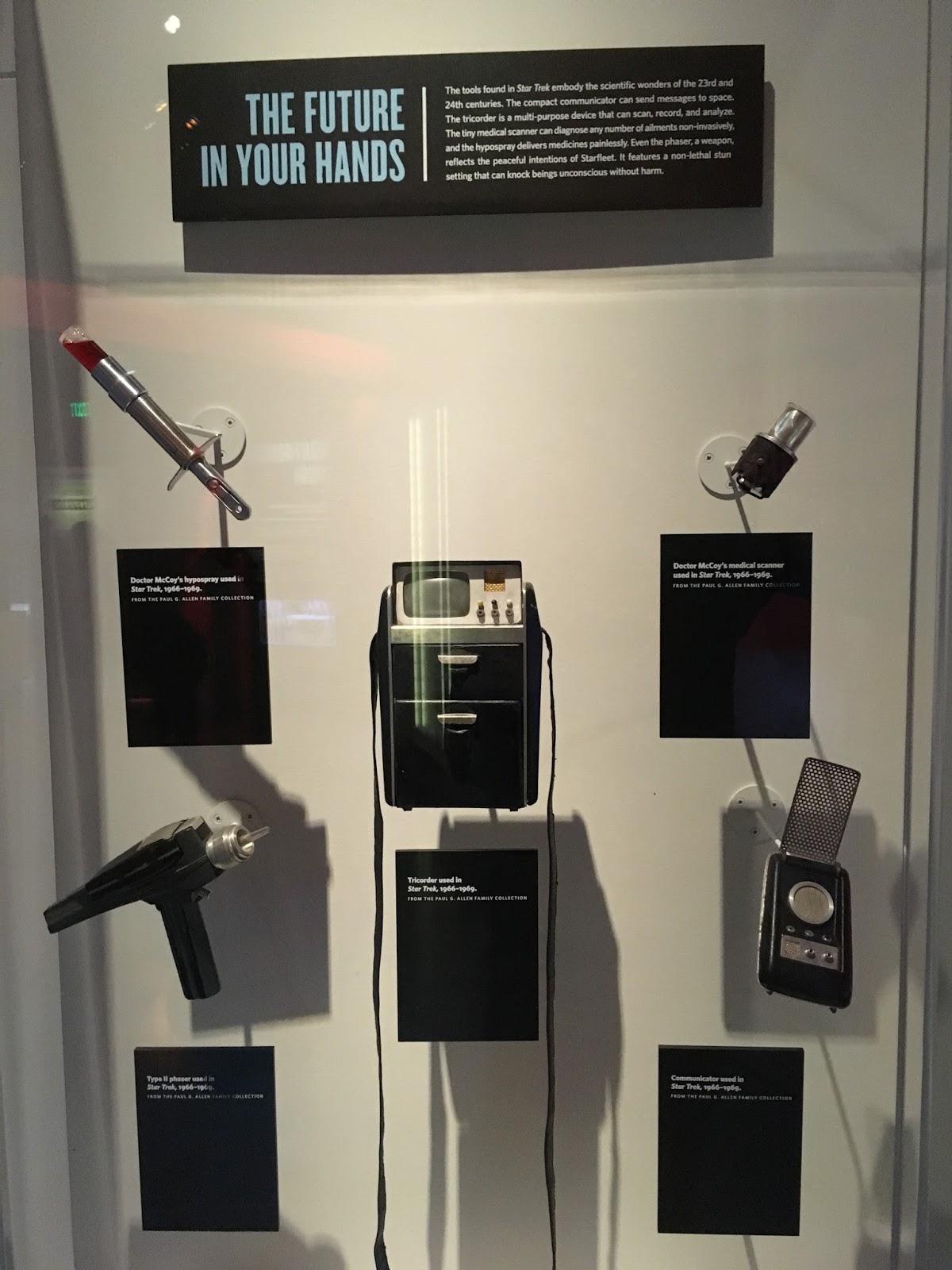
Ohmygod. It's Captain Kirk's actual chair, and Sulu and Chekov's actual console. And Kirk's actual tunic. And Uhura's actual dress.

Ohmygod ohmygod! And actual phasers and tricorders and communicators and hyposprays!

OHMYGOD OHMYGOD OHMYG---

The MoPOP also has these guys . . .

. . . and those guys . . .
Plus a special exhibition on these guys . . 

. . . and those guys . . .

. . . and all the other pop culture, rock-and-roll, and show business artifacts that Microsoft money could buy. I really enjoyed MoPOP, all the more because I didn't know it was there and just stumbled onto it. What a discovery.

Going Home
My flight home was one of the best I've had in years. The plane was only about a quarter full and took off due south at sunset, giving us wonderful views of the snowcapped Cascades. I took a few photos out the window, knowing that they never capture one-tenth the beauty you see by eye.

Mount St. Helens in the foreground, Mount Adams in the background. Notice the shadow of St. Helens stretching off to the upper right behind it. Neat!

Crater Lake National Park, Oregon.

What a wonderful trip. As I told several people during the conference, I always go home from a big comics convention, such as the San Diego Comic-Con, feeling tired and beaten. I always go home from a GM conference feeling energized and inspired. Today at lunch, Karen asked me why that was.

I really think people at a GM conference, besides just being generally smarter (face it, they're mostly RNs, MDs, MAs, and PhDs), are more deeply interested in the potential of comics as a medium--and stretching the boundaries of that medium---than your typical comics fan. Some of them are trying to make comics do things they've never done before. I went away with ten new approaches to think about and five new ideas I'm just going to outright steal.

The best conference yet. And not entirely because I found a "Star Trek" museum.

Out there. Thataway. Dork Factor 5.*


*Not THE actual chair.