Sunday, July 27, 2014

Comic-Con 2014


I arrived home safe and footsore from Comic-Con International in San Diego last night. Hard for me to believe, but I haven't attended since 2010. Things have changed a bit, in ways I'm not sure improved the experience for me (I'm trying to say that nicely). By and large, for an event that tries to safely entertain 150,000 people for four days, the organizers pull off a miracle, and they were very kind and helpful to me.

I attended Thursday afternoon and Friday. The best part for me was seeing many friends, and meeting some people who until now have only been Facebook or e-mail acquaintances. Also, a teaser: I know the two nicest people in the world. I'll tell you their names at the end, but just wanted to let you know now that if you've been searching for the two nicest people in the world, call it off because I've found them.

This report is a photo essay, punctuated with bits and bites of notes. IMPORTANT QUALITY CONTROL NOTE: Many of these photos are blurry/hazy because I didn't notice until I got home that my camera lens had a greasy fingerprint smeared across it. Sorry; no do-overs.

Thursday began at the tiny Charles M. Schulz Sonoma County Airport. I didn't catch a plane here; I caught a bus to a bigger airport two hours away. I just wanted to show what your local airport looks like when they name it after a cartoonist. Seemed an appropriate launching point for a trip to Comic-Con.

Approaching the venue. My impression: a bit less street theater than at past Cons, and maybe fewer costumes. I talked later with comics journalist Heidi MacDonald and she thought there was less activity in the blocks around the convention center because people who owned vacant lots and parking lots that in the past had hosted events had raised their rates too high. Could be. But the center itself, and the sidewalks around it, were jammed.

Spiders and Turtles, oh my! I only include this photo because I read today that Daniel Radcliffe (Harry Potter) had attended Comic-Con disguised as Spider-Man, so maybe that's him. Or he could have been one of the 75 other Spider-Men. Hard to say.

Cartoonist Todd Clark ("Lola"), writer/cartoonist Ces Marciuliano ("Sally Forth," "Medium Large"), and comics podcaster/journalist Tom Racine. Tom was one of those Internet friends I'd never met in person, so this was neat. Ces I met once seven years ago, an event he pretended to remember and then mixed me up with someone else and apologized for it every time I saw him. Todd I just met 20 seconds before taking this photo.

My pal Otis Frampton, whose "Oddly Normal" series has just been picked up by Image Comics. Couldn't happen to a nicer, harder-working guy. 

Apparently there's some movie coming out about Hobbits and a dragon?

I loved the get-up of this lady, who was kind enough to let me take her photo. She dressed up her wheelchair as the Star Tours ride at Disneyland! What a concept! One of the best costumes-slash-vehicles I saw the whole time I was there.

My pal Lex Fajardo ("Kid Beowulf" and the Schulz Studio) drew sketches to support the Cartoon Art Museum in San Francisco. People could pay $10 and have an artist draw whatever the customer wanted. I did this for an hour on Friday, and drew a 1940's-style Wonder Woman, the Punisher's skull logo, a mermaid, and Chewbacca playing basketball. Chewbacca is hard to draw. I also had a chance to talk to the museum's Andrew Farago about the joys of new fatherhood. He still seems dazed.

Original comic strip art by cartooning great Bill Watterson and some guy named Pastis, which is currently being auctioned to raise funds for Team Cul de Sac and Parkinson's Disease research. 

The comic book without which none of us would have been there this weekend.

I took this photo for my daughters: a sort of steampunk/superhero mash-up. If there's one theme I noticed emerging in cosplay, it was the mash-up: My Little Pony Hulk and so forth. Anyway, here are some ideas that might inspire someone. 

My editor at Abrams, Charlie Kochman, introduced me to "Family Circus" cartoonist Jeff Keane. We also talked with "Luann" creators Greg Evans and his daughter Karen, standing behind Jeff. Greg pretended to be insulted when I said I thought Karen's contributions had made his comic strip a lot sharper. Or maybe he wasn't pretending.
At the National Cartoonists Society (NCS) booth: Greg Evans and master MAD caricaturist Tom Richmond. 
For the first time at any Comic-Con, I ventured into the Pro Lounge. What wonders awaited within? What sparkling wit, reminiscent of the Algonquin Round Table, would I overhear amid the tables piled high with fine pastries and exotic sliced meats and cheeses? Steeling my courage, I timidly flashed my badge at the door and entered the sanctum sanctorum of comics' elite.

I found a water cooler and plastic cups. But they were a professional water cooler and plastic cups, with ice, so take that, plebes.
Back in the streets, the Assassin's Creed video game people were letting folks run through an obstacle course. Because swinging from a rope in San Diego is totally the same as jumping across rooftops in Renaissance Florence.

What's nice about San Diego is that the whole city gets into the Comic-Con spirit. Wherever you go, retailers and service people at restaurants, shops and hotels decorate and dress for it. My hotel had a bellhop in a Superman cape. Here's the municipal trolley cars advertising the "Agents of SHIELD" series.

"Excuse me, can you tell me where to find Nickelodeon? I heard it was around here somewhere, but can't seem to find it. They should do something to make themselves more visible."

Well done.

Actual costumes from all the modern Batman movies were on display.

Wandering the aisles, I heard a woman's voice calling out "Free Science Comics!" Those being my three favorite words, I stopped to talk. Turns out she's a cartoonist with a Ph.D. in physics making comic books via the American Physical Society. When I mentioned that I'd majored in physics, her eyes lit up. I'd said the magic word. "Oh, we have something special for people who say they're in physics!" And now I have this pin.
I sought out and introduced myself to Tom Bancroft, who does an online comic I like called "Outnumbered."
That "Comic Code Authority" t-shirt I'm wearing was one of my few con purchases for myself. 
Tom was there with his brother Tony, who among his other accomplishments directed Disney's "Mulan."
They both have terrific-looking books available. Very nice guys, I was happy to meet and talk with them for a few minutes.

A little slice of home at the Peanuts booth, which was popular. Schulz Museum Curator Corry Kanzenberg is mugging for the camera, but I think her expression reflects genuine overwhelmedness as well.

I caught up with Keith Knight and his son, and bought Keith's latest collection. Kid has a lot of energy.

Pal Justin Thompson ("Mythtickle," the Schulz Studio) was at the GoComics.com booth signing nice little prints for passersby. Justin is one of the coolest people I know if only because of his previous jobs: Renaissance Faire jouster and theme-park stunt-show Batman. I envy him his resume. 

This boy had a great Ant Man costume. You probably haven't heard of Ant Man yet, but just wait'll the Marvel movie comes out in a couple of years.

Quicksilver, Hawkgirl, and Magneto mix up their comic book franchises.

In this selfie I reconnected with Eisner-winning cartoonist David Lasky, whom I met at the Baltimore Comics & Medicine Conference several weeks ago. He did a couple of panels, including....

...one on the fairly loose theme of making a living from your passions, or something like that. I didn't understand it and neither did the panelists, but it was a nice conversation. It was moderated by comic book writer Mark Waid, who's standing in this photo. I either saved or nearly ended the life of Mr. Waid, I'm not sure which. After the panel I approached the podium to introduce myself, because I'd been told he'd seen and liked "Last Mechanical Monster." He smiled, extended his hand to shake, and took one step toward me right off the edge of the two-foot high platform. He sort of fell, I sort of caught him, the audience gasped, and he leaped up like a Russian gymnast with a jaunty "I'm all right!" Close call.

I took this photo because five minutes earlier I'd seen the terrifying Klingon on the left sitting at his table with a small make-up mirror applying his eyeliner. Q'aplah!

Batman and the Joker. Honestly, looking at this photo, I don't understand why the Joker doesn't win every time.

Friday night, pre-Eisner Awards, Tom Racine hosted a drop-in "Drink and Doodle" gathering at the hotel bar. That's Justin Thompson, me and Tom.
As part of the "Drink and Doodle," Tom passed out blank sheets and asked everyone to for their take on the theme "75 Years of Batman" (this is his anniversary). This was my contribution.  

Drink and Doodle. Some great people came and went, including cartoonist Rina Piccolo, Ces Marcuiliano (in the back right of this photo), and cartoonist Frank Jordan.The right-most guy in this photo is Disney storyboard artist Jeffrey Ranjo, who shared some stories about "Frozen." Also at the Drink and Doodle, I gave Tom Racine 10-to-1 odds that I was going to lose the Eisner Award. He took my bet, and gave me $1 against $11 I  would owe him if I won. 
Also in the "Drink and Doodle" photo are my sisters, Brenda and Lis, who drove down just to surprise me and show their support at the Eisners. Which is where we are headed here, dressed so nicely.

With Jason Walz and Kathy Bottarini. Jason wrote a great Eisner-nominated book called "Homesick" and we've corresponded; one of the highlights of Comic-Con was finally meeting him and his wife Emily. Kathy was one of this year's Eisner judges and also runs a comic shop not too far from my town. Jason and I were grateful to her.

The Nicest People in the World
I promised to divulge the names of the two nicest people in the world, and now it can be told. For nearly 40 years, Richard and Wendy Pini have created and nurtured the universe of "Elfquest," a pioneering work of fantasy comics and literature. Aside from "Lord of the Rings," I'm hard-pressed to think of any body of work that's had a bigger influence in that field. Anyone attempting to make a comic touching on the lore of elves has to deal with the groundwork already long laid by Tolkien and the Pinis.

Richard is an astronomy buff who contacted me when Whatever Happened to the World of Tomorrow came out. We've corresponded, and he's kept up with (and often commented on) The Last Mechanical Monster. On Friday he told me he'd just caught up with Mom's Cancer, and we talked a bit about our families.

And then he pulled out a big box, and said nice things and something like: you may not leave here with an Eisner Award, but I had to make sure you didn't go home empty-handed, and unwrapped this:

The placard reads: "Illudium 2014 Award.
Best Webcomic: The Last Mechanical Monster.
Accept No Substitutes."

Richard built me a trophy himself, from a tapered silvery base topped by an actual gold-tinted radio vacuum tube, exactly like those that power the Robot in my webcomic. Wendy had tears in her eyes; mine may have moistened a bit too. This is the most unexpected, thoughtful, nicest thing anybody's done for me in a long time. I just have such respect for them and their work, and to turn around now and have them do something like this for me.... Holy Moley!

Wendy, Richard, me, and my Major Award.

My Major Award at home atop my drawing desk.

I think I'm pretty good with words, but I can't even tell you what that means to me.

Later this happened:


I just want it on the record that I picked it. I also got to keep Tom Racine's dollar, so that eased the sting.

Next morning I got up very early and flew back to the Bay Area for another important engagement. That's the topic of my next blog post.

Saturday, July 26, 2014

Bookmaking

I wrote this post eight days ago but embargoed it until certain announcements could be made today at Comic-Con International in San Diego (where last night I either won or lost an Eisner Award, I didn't know which when I was composing this last Friday and I think I just blew my mind).

Last week my editor at Abrams, Charlie Kochman, spent several days in my hometown with photographer Geoff Spear, who did a little shooting for my book Whatever Happened to the World of Tomorrow, and designer/editor/writer Chip Kidd. They didn't come to see me, but rather a humble little museum down the street dedicated to the work of "Peanuts" cartoonist Charles M. Schulz. As was just announced at Comic-Con, Abrams is doing a new book on Schulz's art. I got to tag along while they worked on it.

(Some of this I hinted at on Facebook at the time. I probably shouldn't have done that.)

All these photos are by my wife Karen unless she's in them.

BBQ chicken dinner at my house. That's me, Chip, Geoff and Charlie. I don't know why the latter two drank Cokes, I offered them the good stuff.
Chip found one of his books on my shelves and graciously offered to sign it, but pouted when he saw the sticker indicating I'd bought it on clearance. After peeling off the sticker, he signed it anyway. 
Backstage at the Schulz Museum, Geoff lines up a shot of the original art for a "Peanuts" Sunday strip. At the table behind him is Maggie from the museum's staff. They treat original Schulzes like Fort Knox treats gold bars (as well they should). Generally, only museum staff touched the artwork, and there were two or three of them on hand at all times. 
Geoff snapping a photo, digital of course. Geoff is well-known and well-regarded for capturing all the lumps, bumps and texture of the objects he photographs. They look real on the page. Tactile. He achieves that by using a single bright light source at a low angle and shooting a range of time exposures, which he combines in Photoshop to even out their brightness. It's clever yet simple; elegant.
Geoff, Chip and Charlie discussing the size of a piece of art and how it might be reproduced. It was interesting to watch them work and construct the book. Chip and Charlie came in basically knowing what they were looking for, but every newly opened box turned up Schulz treasures that'd never been seen before. Many decisions were made on the fly.
Maggie at left, wearing her nitrile gloves. Chip and Charlie are taking reference snapshots of a particularly good piece that Geoff is getting ready to shoot.
Wine Country dinner Thursday night. There's Karen! We tried to make our guests feel at home.

This was neat. I think the guys got more than they expected and everything they needed to produce an exceptional book of Schulz art. I got to spend some time with my pals. We ate well. Good days.

Look for the book, title to be determined, next year.


Friday, July 18, 2014

Chalk Talk

I posted this on Facebook yesterday, but wanted to give it a more permanent home here (the attention span of Facebook being about 5 hours...).

A couple of days ago I did something very cool and new for me: a comics "chalk talk" at our county children's home arranged by my wife Karen. We had about a dozen kids ranging from 7 to 17: foster youth, youth taken from their homes for one reason or another, but not bad kids. This place is a refuge, not juvenile hall.

Starting a page of faces, showing the wide variety of expressions you can convey with just two eyes, eyebrows and a mouth.
The little redheaded boy in front loved the fact that the Cosmic Kid was a redhead, too.

I don't have much experience drawing and talking at the same time, and none doing so with kids, but they were great and it went well. A highlight for me was making two comics with them in which I drew something and asked them, "And then what happened?" and drew that, and whatever happened after that, and after that. They got into it and created two pretty good comics. 

Another nice moment: as we were leaving after the talk, a too-cool-for-school teenage girl came up and shyly asked me if I could draw Iron Man for her. I sent that off with Karen the next morning.

Ol' Shellhead, with the girl's name cropped.

Given their circumstances, I also talked about comics as a good way to tell their own personal stories, using "Mom's Cancer" as an example (I left my books for the facility's library). It was a special evening.


Wednesday, July 16, 2014

The Ridiculous Wondrous Diversity of Online Comics

I've been waiting for this: today's announcement of the 2014 Harvey Award nominees for Best Online Comics Work.

No, I'm not one of them, and didn't submit for it, and I'll explain why below. Just let me list the webcomic titles nominated for major U.S. comics awards--the Harveys, Eisners, and National Cartoonist Society (NCS) Division Awards--then I'll make my point:

Harvey for Best Online Comics Work:
Battlepug
The Dreamer
Gunnerkrigg Court
JL8
Table Titans

Eisner for Best Digital/Webcomic
As the Crow Flies
Failing Sky
High Crimes
The Oatmeal
The Last Mechanical Monster

NCS for Online Comics-Long Form
Dicebox
Family Man
Red's Planet
Tuki (the winner)

NCS for Online Comics-Short Form
Watson
Buni (the winner)
New Yorker Online

See a pattern? Because I sure don't. There isn't one comic title that appears more than once! Unlike any medium I can think of (TV, movies, books), there seems to be no public or critical consensus on what constitutes the best work. Even in print comics and graphic novels, there are typically a few 800-pound gorillas that everyone agrees are good and which win all the awards. Not so in webcomics.

That's kind of astonishing, yet I also kind of expected it. What's it mean?

Primarily, I think it means there are a lot of webcomics, and a lot of good webcomics, out there. There's a wealth to choose from.

I think the webcomic audience is more specialized and fragmented. Whatever you're into, there's a webcomic for it, and you may think it's the best webcomic in the world. And it may be, even if nobody else knows about it. Webcomics are like cable TV with 300,000 channels. Even a well-read webcomics lover would probably look at that list and say, "I've never heard of half of those."

I think different awards have different tones and philosophies. Different judges have different tastes. Similarly, judges can only consider what's in front of them, and different cartoonists may only focus on certain opportunities (for example, I think many webcartoonists overlook the NCS Awards).

My story:

I submitted my webcomic for Eisner Award consideration. Nominees were chosen by a panel of judges with a broad comics, academic and critical background, and mine was selected.

I also submitted my webcomic for NCS Division Award consideration. Nominees were chosen by a panel of NCS working cartoonists (who in contrast to the Eisner judges only focus on their one award, not ALL of them), and mine was not selected. I've got no beef with that, especially looking at the very strong ones that were.

I did not submit my webcomic for Harvey Award consideration, because the nominees are chosen by popular vote rather than judges. Whichever five comics get the most votes go on the list. Nominations favor those able to rally their troops. I've seen my visitor stats (who knew they could register negative numbers?) and knew my obscure little webcomic had no chance.

I don't spend a lot of time thinking about this, and don't want to make too much of it. As long-time Friend O' The Blog Mike Peterson says, "plaques are for hacks," and I almost believe him.

I just think it's an interesting insight into the webcomics field at this early time in its development. I was waiting for today's announcement of Harvey nominations almost giddily hoping they'd be totally different from the others.

They did not disappoint.

The nice thing about a lack of 800-pound gorillas is that it gives a few macaques a chance to bask in the sun. Congratulations to the nominees, best of luck to you all.


Wednesday, July 9, 2014

2014 Comic-Con: How It's Gonna Go Down

Comic-Con International returns to San Diego in two weeks, and my Internet haunts are roiling up to a frenzy. I'll be there Thursday afternoon (July 24) and Friday (July 25), attend Friday night's Eisner Awards where my Last Mechanical Monster is nominated for Best Digital Comic, then jet back to the Bay Area for another commitment first thing Saturday.

I'm looking forward to seeing friends, catching panels, maybe even buying some comics or art. I'll be supporting the San Francisco Cartoon Art Museum (and new parents Shaenon Garrity and Andrew Farago, huzzah!) by sketching commissions at their table Friday from 2 to 3 p.m. I may also get to talk a little business.

Based on past cons, I expect to have warm reunions with 10 or 15 people I haven't seen in a while, meet 5 or 10 people who until now have only been Web bylines or e-mail addresses to me, and be introduced to at least one venerable comics veteran who will leave me tongue-tied until the next day, when I'll remember a project of theirs I loved and always wanted to ask them about but by then it'll be too late.

What I won't be doing is expecting to win an Eisner Award.

That's not false modesty. I have a very good record for predicting the outcome of awards for which I'm nominated, calculating the odds with the cold, steely, unsentimental squint of an insurance actuary. Here's how it's gonna go down:

Besides me, the Best Digital Comic nominees are As the Crow Flies by Melanie Gillman, Failing Sky by Dax Tran-Caffee, High Crimes by Christopher Sebela and Ibrahim Moustafa, and The Oatmeal by Matthew Inman.

The Oatmeal gets 6 or 7 million visitors per month. More people visit The Oatmeal each day than will see my webcomic in a year. Everybody on Facebook has read an Oatmeal comic, probably the one about the dog. It's a simple numbers game. Even if only a tiny percentage of Oatmeal fans are Eisner voters, a tiny percentage of a very big number is still a big number. The Oatmeal is going to win.

However, I see a sliver of an opportunity here, in that I sense The Oatmeal isn't universally respected and beloved among comics professionals. The public, sure, by the millions. But Eisner votes are cast by pros, and I've seen enough critical posts and articles, including some arguing that The Oatmeal doesn't meet the Eisners' own eligibility criteria (primarily that it be a long-form comic that tells a continuing story rather than individual gags), that I've deluded myself into thinking I may have a chance.

Making no quality or value judgments about the other nominees, with which I'm not deeply familiar, if The Oatmeal doesn't win I think I have a shot.

However, The Oatmeal is totally going to win.

But it might not.

Saying "the nomination's the honor" is usually a platitude, but in this case I'm sincere. The nomination is fantastic! What it means to me is that six experts in comics and literature judged that my Last Mechanical Monster was one of the five best webcomics they saw among the candidates in front of them on that particular day. I don't know why mine was chosen while others were passed over. I was surprised by some omissions, too. Not my department. Don't blame me.

Those people liked these comics on that day.

That's all it means. But that's a lot!

For those of you laying down Vegas money on the outcome, I peg my odds of winning at 11%--a long shot paying out about 9 to 1. Wager accordingly.

I have no Comic-Con booth or table. If someone really wants to connect with me, I'd suggest finding me at the CAM table (#1930) between 2 and 3 p.m. on Friday or leaving a note at the Abrams booth (#1216), which I'll strafe from time to time.

Comic-Con will be a wild, worthwhile experience regardless of Friday night's results. I'm looking forward to it. Photos and stories will follow!


Thursday, July 3, 2014

Happy Independence Eve

I'm really enjoying this series of Web commercials for Newcastle Brown Ale, asking us to imagine how great America would be if the British had won. I've been known to reassure Brits that I bear no hard feelings about "that whole Revolutionary War thing," so this is right up my alley.

Clearly the ad makers are hoping the videos will go viral. I don't know if they have, but they worked for me. Maybe I'll even try their beer. A few of my favorites:


Happy Independence Eve, which is totally not a holiday they made up to try to sell more beer.

Tuesday, July 1, 2014

Self-Dissection

As I mentioned yesterday, the point of my 90-minute "See One, Do One, Teach One" workshop at the Baltimore Comics & Medicine Conference was to give participants the confidence to go out and make their own comics, and perhaps teach other people to do the same. The four dozen people who did the workshop played along gamely; I thought it was only fair to do the same.

I opened the workshop by asking them to write down a short anecdote about something that'd happened to them recently. Funny, frustrating, sad. To prompt them, I suggested making it the first thing they'd tell someone when they called home that night. "Hey, you won't believe what happened to me...." I didn't play coy; I warned them they'd be drawing it later.

After talking about some theories of character design, I asked them to draw their own cartoon self-portrait, as well as one of the other characters in their story (if there were any). I only gave them a few minutes, so they had to be spontaneous and messy.

Later still, after going over some of the iconography and structure (i.e., panels, balloons) of comics, I asked them to make a comic of their stories. I gave them four blank panels as a jump start, but emphasized they didn't need to use all or any of them. I then asked for brave volunteers to share their work with the group. Several did. The results were some remarkably good comics!

While the participants were doing my exercises, so was I. In fairness, since I knew the questions were coming, I had some time to think and prepare. But I didn't cheat much. An event happened to me and I thought, "That's funny! That's what I'll make my comic about." However, I didn't script or sketch it out beforehand. I wrote and drew it in the same seven or eight minutes everyone else got.

Here's mine, which is more or less a true story:

Panel 1: Yesterday. "Twelve hours on a plane...One hour til the conference..."
Panel 2: "I need a shower and a quick nap." NOK NOK. "Maintenance."
Panel 3: "There's a leak in your ceiling." "Only take an hour to fix. Do you mind?"
Panel 4: "Well...." "Just don't use the shower..."

What I'd planned to do in the workshop was analyze and critique my own comic as I (gently) did theirs, to explain what I'd been thinking and maybe should have done differently. In the moment, I thought that looking at the participants' comics was going so well, and they were so eager to share, that we ran out of time for me to critique my own (although I did show it). Here's what I would have said.

Panel 1

Omniscient narrator captions can be a crutch, but saying "Yesterday" gives us important information we couldn't get any other way. Just don't overuse them to explain action your characters should be doing. Show, don't tell.

This panel shows the exterior of my hotel, helpfully labeled. In film terms it's an "establishing shot." Now we know when and where we are. We don't know who's saying the dialog but we don't need to yet, as long as the next panel makes it clear. In fact, the uncertainty kind of urges us on to find out.

Panel 2.

I made a small mistake and a big mistake in this panel. The small mistake was that, after emphasizing to the workshop participants that they must place the words on the page before the art, I didn't plan ahead for the word "Maintenance." The big mistake was drawing myself shirtless (BTW, my actual physique is much less lumpy). That gives away the gag to come in Panel 4. I should have obscured it by perhaps drawing a close-up of my face, or otherwise hiding my state of undress.

Panel 3.

I could have drawn a door frame to make it clear that they're the ones who knocked. I made an effort with the two handymen to contrast their physical design and attitudes. One is burly and gruff, the other is small and apologetic. That's an exaggeration of the actual handymen, but essentially true. I think I did a good job designing these guys. Readers of my "Last Mechanical Monster" webcomic may notice that the big one looks like my character Ted the bus driver. In real life, I noticed that he sort of did! A lot of cartoonists have a repertory company of stock characters to draw on, and since I've been drawing Ted for more than a year now, I drafted him for this demo.

Panel 4.

If I hadn't telegraphed the gag in Panel 2, I'd be real happy with this towel-wrapped payoff in Panel 4. However, aside from obviously rewriting the dialog on the fly, I made a mistake in this panel that I consider serious: I switched the positions of the handymen. A moment ago, Burly Guy was on the left, now he's on the right. If I'd done that on a real project, I'd redraw it.

This is how I think when I'm drawing thumbnail sketches and laying out a page. These are basic elements of Storytelling that make creating comics different from drawing pretty pin-up pictures. If you're reading a comic and don't ever have to stop and think about what order you should read the panels in, where the action is taking place, which character is which, what the characters are doing, or how they got from here in Panel 2 to there in Panel 3, the cartoonist is doing a good job.

Which is to say: in my philosophy (which not everyone shares), the best cartooning is the cartooning you don't notice at all.

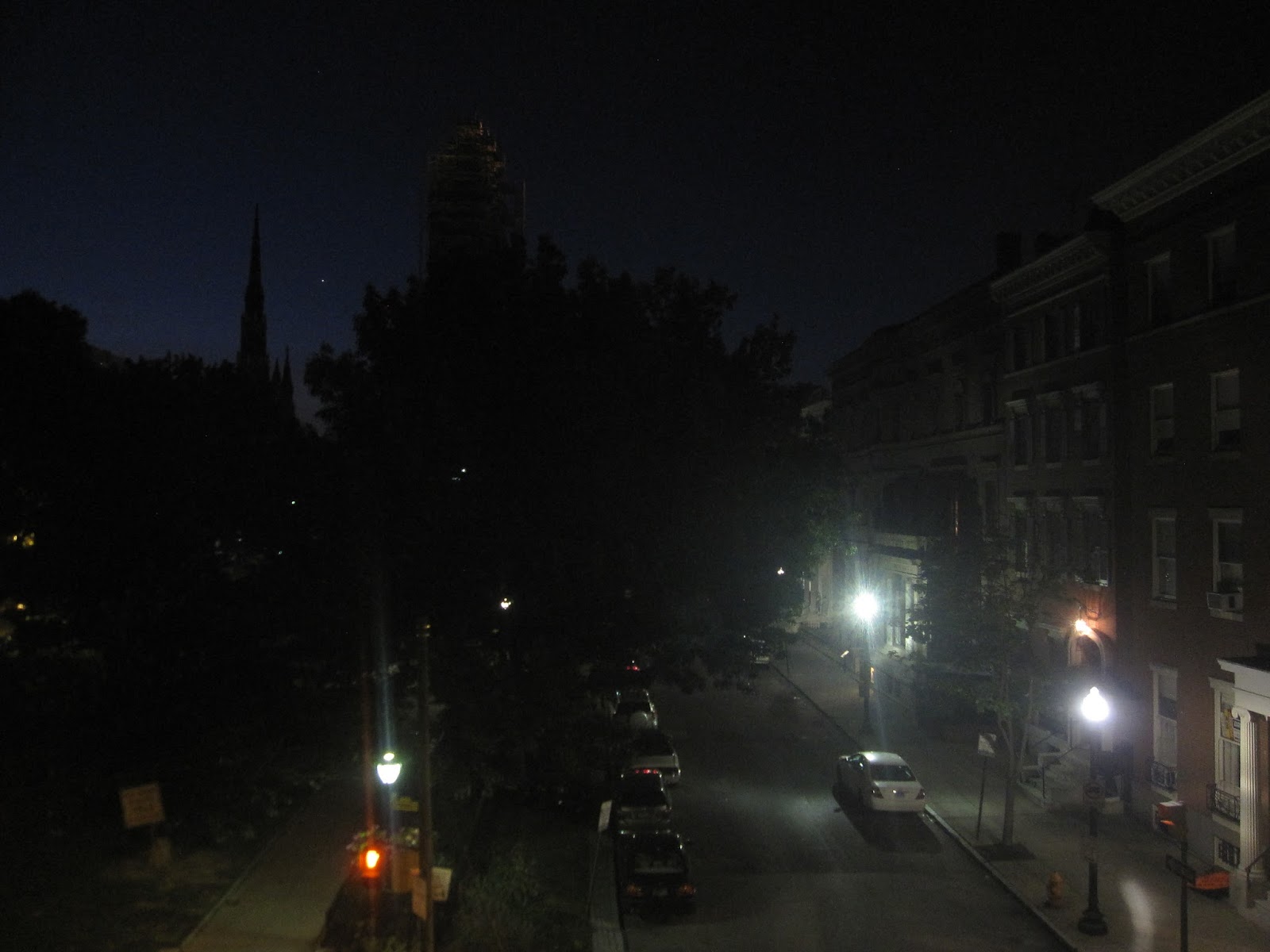
I neglected to post this yesterday: my farewell to Baltimore, Sunday 5 a.m., rising early to get to the airport. Quiet streets, with Venus gleaming brightly just to the right of the cathedral steeple. 


Happy July Birthdays!

I'm looking at you, America.


Monday, June 30, 2014

Baltimore Comics & Medicine 2014


Experience after previous Comics & Medicine conferences has taught me that if I start writing about it, I'll never shut up. It works better to do a photo essay and let the pictures do my talking. Suffice it to say that I returned home from this year's Baltimore conference more excited about the field and the people involved in it than ever.

Graphic Medicine puzzles people ("healthcare and . . . comics?!") and they usually need to see a few examples before they get it. Mom's Cancer is one example, but only one; the reasons people do graphic medicine include storytelling, memoir, therapy, education, and public health. Some still don't get it, but many are quickly converted. As I've often said, one of the things I like best is gathering doctors, nurses, professors, students, writers and cartoonists--groups you might not expect to have much in common--to talk about interesting ideas and projects as equals. It's very cool.

Pictures or it didn't happen.

My midnight flight from San Francisco to Baltimore was an adventure. A two-hour fog delay at SFO made me miss my connecting plane in Chicago. The airline was great about getting me on the next flight, but by the time I arrived I'd been sitting on aircraft or in airports for about 12 hours. Then I had to get to a reception and help open the conference as the last of eight 5-minute "lightning" speakers.

Approaching Baltimore, which is somewhere on the horizon there. As a Californian used to ocher-brown hills, I was impressed by the lush summertime greenness. 
Johns Hopkins Medical School hosted the conference in this building, which was less imposing in person than it may look in this photo. Not actually an impregnable brick fortress. 
The building had three large auditoriums plus a smaller classroom and cafe we used. Out back was an outdoor courtyard for breaks and lunch. Good space.

My lightning talk was on "Practicing Graphic Medicine," which I've been doing since I first put Mom's Cancer online 10 years ago. I hoped to provide some context for the conference: before I started the webcomic, only a few people knew my family's story, which wasn't really a story at all because nobody was telling it. I put Mom's Cancer on the Web, and that expanded the story's reach. It was published as a book, which further expanded its reach. In 2010, I was asked to speak at the first Graphic Medicine conference in London, followed by more conferences. I think Graphic Medicine embraces all means of storytelling: oral, web, print; intimate and immediate in the case of the Web, distant and permanent in the case of print. Now it's a Graphic Medicine community. It's a niche field with enormous potential, and it makes a real difference in people's lives.

My pal "Comic Nurse" MK Czerwiec took this photo of the start of my talk.
Audience for the opening night intro and lightning talks. About 200-230 people came to the conference, which I think is more than ever. That's MK in the blue shirt  up front, sitting next to San Francisco State University professor Courtney Donovan in yellow. 

After the opening hullabaloo, some of us met for dinner at a terrific Afghan restaurant in Baltimore's historic Mount Vernon district, where most of us stayed. Good food and company, but you can imagine how fresh and witty I felt after coming in on the red-eye and being shot out of a magnetic rail-gun to give a 5-minute hyperspeed lecture.

Friday
I didn't take many photos the next day because I kept pretty busy. I gave a 90-minute workshop titled "See One, Do One, Teach One," which applied that old medical school mantra to cartooning. I thought a conference dedicated to comics needed a place where you'd actually learn to make one. The idea was to take people who'd maybe never done so--maybe never even drawn since they put down crayons in the fourth grade--and send them into the world with the knowledge and confidence to not only create their own comics but teach others to create theirs.

If not for MK Czerwiec, I'd have no proof I accomplished anything in Baltimore at all. Thanks again for the photo, MK! Me and my workshop. This room was set up a bit oddly, with the computer and projector in the center so I had my back to about a quarter of the participants. Nobody seemed to mind. Although all speakers' PowerPoint presentations were pre-loaded on the facility's computers, I brought my own laptop to this workshop so I could toggle between my PowerPoint slides and my laptop's on-board video camera to project the participants' drawings (purely voluntary of course) on the screen for everyone to see. The comic on screen there is actually one I drew as I worked through the exercises with them. I'll dissect that comic in my next blog post. 

I ran out of the 40 little packets I'd made up for workshop participants, so I'd guess I had about four dozen people in a small classroom. Standing room only! I've done variations of this workshop a few times, and how it goes really depends on how willing the participants are to dig in and share their work, which I acknowledge takes guts to do. These guys were tremendous. They made some excellent short comics that really seemed to apply what I aimed to teach, and I hope/think everyone had a good time doing it.

Immediately after my workshop, I moderated a panel of three presentations on the topic of "Private Lives, Public Health." Moderating is usually light duty: introduce everyone, keep them on time, give them a 1-minute warning when they're running out, field some questions. All went well until near the end of the first speaker's talk, when a booming Voice of God blasted from the auditorium's sound system. First thought: the speaker's presentation had an audio file embedded in it. No, she looked puzzled, too. Second thought: the computer had fritzed and begun playing some other file. Nope. As a few of us gathered around the podium and the voice continued to boom, we figured out we were picking up a wireless microphone from another auditorium and eavesdropping on someone else's lecture. We managed to kill the entire audio system but then couldn't get it back up, so the remaining two presenters had to orate the old-fashioned way. Luckily they were game, and good speakers. I still feel bad for the first.

Nobody prepared me for that in moderator school.

Also, the series "House of Cards" was evidently shooting scenes across the street from my hotel.
Alas, no Kevin Spacey or Robin Wright (sigh) sightings from my window.

Saturday
The next day, my responsibilities were done and I could relax. I tried to take more photos.

Continental breakfast in the cafe before starting the day.
The other half of the cafe was a greenhouse where a silent auction was held for participants' artwork, mostly good-quality prints.
I ate lunch with two of our keynote speakers: Carol Tilley from the University of Illinois Urbana-Champaign, who gave a great lecture on psychiatrist Frederick Wertham, who in the 1950s convinced the American people and Congress that comics were evil and almost destroyed the industry; and Arthur Frank, professor emeritus in Sociology from the University of Calgary, who is a scholar on illness memoir and gave a brilliant talk. I just met Carol at this conference but knew Art from a similar event at UC Riverside last year, where he gave a different but also brilliant talk. Fine dining.
Here's an example of Graphic Medicine in action: Gary Ashwal and Dr. Alex Thomas created Booster Shot Comics to help teach sick kids about their diseases, including a comic book series titled "Iggy and the Inhalers" for children with asthma. During their presentation, they showed data that kids who'd read their comics had much greater understanding of their illness and treatment. I liked this presentation because I remember seeing Alex and Gary a few years ago when they were just getting going, and it's neat to see how much they've accomplished.
As part of the same panel, Laura Ruth Venable and MK Czerwiec talked about creating a comic to help clinic patients in Chicago transition from one primary care provider to another. They had results showing that while patients tended to forget or ignore letters informing them of care changes, they paid more attention to and remembered comics conveying the same information. 
Group discussion at the end of the same panel (from left): Laura Ruth, MK, Gary, Alex, and Leah Eisenberg. Leah talked about developing comics to help gain children's informed consent for medical procedures.

Following a keynote speech by Ellen Forney, the day and the conference were capped by a Marketplace similar to a comic convention dealers' room, where participants could sell their own books, prints, whatevers. Local comics shop Atomic Books was on hand to sell several related books, including Mom's Cancer. (Atomic Books also hosted a post-conference event Friday night, Laydeez Do Comics, which I didn't attend.) In addition to sales tables, a signing table was set up so Ellen, conference co-organizer Dr. Ian William, and I could sign our books.

Also attending was artist David Lasky, whose book Don't Forget The Song (written by Frank Young) was put out by my publisher Abrams and won a 2013 Eisner Award. He was at the conference because he recently illustrated a comic on the 1918 flu pandemic for Seattle & King County Public Health that aims to inform the public on handling future epidemics or pandemics. We compared notes on our mutual editor Charlie Kochman. Look out, Charlie.
A portion of the Marketplace. I think 18 or so people had tables in the relatively small cafe. There's some excellent work out there.
Another portion of the Marketplace. Those people all facing left in front of the yellow wall are lined up to see . . . 
. . . me! Well, also my friend Ian Williams, whose debut graphic novel The Bad Doctor is getting excellent reviews, and the conference's concluding keynoter Ellen Forney, author of the NY Times Bestseller Marbles: Mania, Depression, Michelangelo, and Me. I think Atomic Comics sold out of all of our books.

And now a series of photos which on Facebook I titled "Brian Awkwardly Hugging People Who Were Too Slow to Escape":

My friend Mita Mahato, professor of English at the University of Puget Sound, and I being expertly photobombed by MK Czerwiec. Mita led a fun workshop on making and binding zines--small homemade comics whose handcrafted quality is a big part of the appeal. She does beautiful paper cutout work that I like a lot. MK is short.
Cartoonist Joe Sutliff attended because he did a comic for the Fairfax County (Virginia) Health Department on mosquitoes and ticks that's been adopted by other health agencies around the country. But I was especially happy to meet Joe because we both contributed drawings to the Team Cul de Sac book raising funds for Parkinson's Disease research. He totally made my day by pulling out his copy of the book and asking me to sign it. A couple of other people also made me very happy by saying nice things about Whatever Happened to the World of Tomorrow, which I wouldn't expect anyone in this context to know or care about. Very cool.
Dan Bustillos is an assistant professor of Healthcare Ethics at St. Louis University, whose class I recently spoke to via Skype but had never met in person. Good guy with a great fashion sense. I had a couple of opportunities to place faces to people I'd only known as e-mail or Web presences, which is always fun.
With the bad doctor, Ian Williams. Sorry, I meant The Bad Doctor. Italics change everything.
Eating Afghan with Art Frank.

There were a lot of neat people in Baltimore, including some friends, that I didn't happen to get photos of. Michael Green, Susan Squier, Shelley Wall. If I start listing them, I won't be able to stop. However, I need to mention three: Lydia Gregg, a medical illustrator at Johns Hopkins, did an excellent job of organizing the conference, which unwound with clockwork discipline (but in a nice way). She worked very hard and pulled it off. Also, I was very happy to see Juliet McMullin from UC Riverside, who organized the conference I spoke at last year, in Baltimore with her daughter Sheila, with whom I had a very nice conversation over dinner Saturday.

We have a joke in my family that I head off to each Comics & Medicine Conference swearing that it's going to be my last one, and coming home too excited to wait for the next one. It's not my place to make any announcements, but it looks like next year's conference could be relatively close to home; if so, I think I kinda need to be there. These are my people.

Wednesday, June 25, 2014

Lyric Critic Clinic

I should be working right now.

Instead, I woke up thinking about the best bad rhymes in songs: lyrics that scan so poorly they're almost admirable in their audacity. These are a few I came up with. Feel free to add your own.


4. "Wreck of the Edmund Fitzgerald," Gordon Lightfoot.

The ship was the pride of the American side
Coming back from some mill in Wisconsin.
As the big freighters go it was bigger than most
With a crew and good captain well-seasoned.

All that "Wisconsin" and "well-seasoned" have in common is they both begin with "W" and have two "S" sounds in the middle. To be fair, Lightfoot was retelling a true story, and so was stuck with the unpoetic "Wisconsin." However, I think a little dramatic license could've fixed him right up:

...and the brave captain knew that he hadda
Get that ship and crew outta Nevada.

3. "Take the Money and Run," Steve Miller

Billy Mack is a detective down in Texas
You know he knows just exactly what the facts is

Ignoring the egregious "Texas" and "facts is" for a moment, that second line is more padded than a fifth grader's essay when he's 40 words shy of 100.


Remember, I should be working right now.


2. "Hey Jude," John Lennon and Paul McCartney (but really just Paul)

Hey Jude, don't make it bad
Take a sad song and make it better.
Remember to let her into your heart
Then you can start to make it better.

"Better" does rhyme with "better," I'll give Paul that. But I probably wouldn't have thought of this song if not for this:

So let it out and let it in, hey Jude, begin
You're waiting for someone to perform with.
And don't you know that it's just you, hey Jude, you'll do
The movement you need is on your shoulder.

"Shoulder?" It works better than you'd expect because it mirrors a "shoulder" and "colder" pair earlier in the song. But what I love about it in this verse, where it doesn't rhyme at all, is the story that goes with it. As I heard it, Paul was writing the song and threw in that last line as a placeholder. "I'll tidy that up later," he thought in his adorable Liverpool accent. But John heard it and said "That's perfect!" Paul shrugged and left it. What makes this bad rhyme one of the best is that The Beatles were so huge and confident that they just didn't have to give a flyin' fig anymore.

1. "Ode to Joy," Beethoven's Ninth Symphony; music by Ludwig van Beethoven, lyrics by Friedrich Schiller.

Freude Schöner Götterfunken 
Tochter aus Elysium,
Wir betreten feuertrunken,
Himmlische, dein Heiligtum.

"Elysium" and "Heiligtum" both have three syllables and end with an "um." That's it. Might as well have gone with "radium."

If "Ode to Joy" had been done by Herman's Hermits, I'd let it pass (though note that "Henry the Eighth" rhymes excellently throughout, as long as "Hen-er-y" has three syllables). But Ludwig, Fred . . . guys . . . you're supposed to be better than that.


Now what else can I do besides work?


Tuesday, June 24, 2014

Medically Graphic

Tomorrow night I'm catching a red-eye flight from San Francisco to Baltimore (via Chicago) for the Fifth Annual International Comics & Medicine Conference. I attended the first, helped organize the second and third, and missed the fourth. Now it's off to Johns Hopkins to reunite with old friends and, I'm sure, make a few new ones.

These conferences are terrific! Here's a link to some posts about my previous trips to London, Chicago and Toronto, plus another conference organized by a different group last year in Riverside, Calif. Doctors, nurses, professors, students, and cartoonists get together and actually have a lot to talk about--using comics to tell patients' stories, caregivers' stories, medical professionals' stories . . . convey public health information . . . relate experiences in ways other media can't. 

"Graphic medicine" is a small niche of comics and a small niche of medicine, but it's getting more attention in both realms, including articles in prestigious medical journals. It's been extraordinarily gratifying to be in on the ground floor of it.

I'm scheduled to give a 5-minute "lightning talk" on "Ten Years of Mom's Cancer," then a 90-minute hands-on workshop titled "See One, Do One, Teach One" to show people how to make comics. I'll also be moderating one panel discussion because nobody better was available. 

Looking forward to the conference; not looking forward to the flight. Lots of photos and probably a couple of stories when I get back.

Saturday, June 21, 2014

The Great 3-D War

Bust out your red and blue 3-D specs. (If you're one of the 50 people who bought my limited-edition zine a couple of years ago, you already have a pair!).

Sometime in the past couple of days, some Facebook friend of mine posted something about World War I. That's about as specific as I can be. Facebook ephemera flits, floats, and quickly fades. But this one stuck a little because it reminded me of something I've meant to try.

I've mentioned before that I collect stereocards. They're basically Victorian Viewmasters, popular in parlors around the turn of the last century. Two photos shot simultaneously a few inches apart from each other are mounted on a heavy card and viewed through a stereoscope, which merges the images into a 3-D scene. It's easy to understand why these were so popular. They were often published in series with a theme: world travel, religious tableau, slice of life, natural wonders. Stereocards offered a startling "you are there" experience for people who'd never have a chance to see such sights in real life.

A stereoscope with a stereocard loaded for viewing. This isn't mine, but looks a lot like it.

It's an affordable hobby. Stereocards are common, and are typically found in antiques stores for a few bucks each, depending on quality. The most I've paid for one is $20, but it was exceptional. I'm sure that in 1900 a well-appointed parlor could have hundreds of cards. I've got a few dozen.

Pulling today's themes together: what I've wanted to try, and my friend's Facebook post prodded me to do, is convert some old stereocards so their images could be viewed with modern red-blue 3-D glasses. It's easy in theory: since the photos are already black and white, just use Photoshop to convert the left eye into the proper blue color, the right eye into the proper red color, and overlap them.

Turns out it's pretty easy in practice, as well!

Here are two of my stereocards shot in the trenches of World War I.

BTW, the bottom one is the one I paid $20 for. I give it free to you.
Photoshopping them as described produces these:


I'm moderately happy with the results. I think some detail is lost in converting the images to red and blue, especially in dim areas. In person, these views really pop! But I'm calling this experiment a success.

I've got a lot of these cards. Maybe when I get a little time, I'll convert some more of my favorites.