"David Wasting Paper" is a blog by a self-described geek who asks cartoonists both famous and obscure the same set of questions and then posts their answers. The list of respondents is impressive, including Bill Griffith, Dan Piraro, Rick Geary, Bob Staake, Tom Richmond, Shary Flenniken, Ann Telnaes, and 105 others before he got around to me.
If you want to know whether I have any pre-drawing rituals, what I collect, which animated cartoon character I'd be, or my advice to someone interested in a cartooning career, here you go! Many thanks to David for the fun questions and the opportunity to be Number 113.
.
Wednesday, April 21, 2010

Friday, April 16, 2010
Aunt Fritzi is a Fan!
All right, this is one of the Top Five Coolest Things that's ever resulted from my semi-career in comics: cartoonist Guy Gilchrist, who currently does the classic comic strip "Nancy," gave my new book a shout-out in today's strip! In the final panel, Nancy's Aunt Fritzi (who became quite a fox sometime in the past 70 or so years) is reading a book whose title rang a bell:

I met Guy in 2007 when I went back east for the opening of an exhibition of original comic art (including mine) at the Norman Rockwell Museum in Stockbridge, Mass. We'd become acquainted online but weren't really pals when I called and asked if Karen and I could drop by his studio/academy in Connecticut. He said sure, we did, he ordered pizzas, and I had a couple of the best, most hospitable hours I've ever experienced as a cartoonist. He's a great storyteller, knows everyone in the business (especially the old guard), and couldn't have been nicer or more generous. I blogged about that visit here. Guy has since left New England to pursue his passion for country music, so I was lucky to catch him when I did.
What Guy couldn't possibly have known is that today is my birthday. I didn't intend to mention it, but when a birthday gift like that turns up, well . . . that's pretty darn cool. Sorry, Karen, I don't see how you're gonna top that. Although I'm sure the cake you spent all evening baking will be delicious.
I've already written to thank him personally, but I'll also do it publicly and add that Guy is one of the good guys. Many thanks to him!
.
I met Guy in 2007 when I went back east for the opening of an exhibition of original comic art (including mine) at the Norman Rockwell Museum in Stockbridge, Mass. We'd become acquainted online but weren't really pals when I called and asked if Karen and I could drop by his studio/academy in Connecticut. He said sure, we did, he ordered pizzas, and I had a couple of the best, most hospitable hours I've ever experienced as a cartoonist. He's a great storyteller, knows everyone in the business (especially the old guard), and couldn't have been nicer or more generous. I blogged about that visit here. Guy has since left New England to pursue his passion for country music, so I was lucky to catch him when I did.
What Guy couldn't possibly have known is that today is my birthday. I didn't intend to mention it, but when a birthday gift like that turns up, well . . . that's pretty darn cool. Sorry, Karen, I don't see how you're gonna top that. Although I'm sure the cake you spent all evening baking will be delicious.
I've already written to thank him personally, but I'll also do it publicly and add that Guy is one of the good guys. Many thanks to him!
.
Wednesday, April 14, 2010
Bill Griffith's 40 Best Tips
Pal Mike Lynch pointed me toward a blog post by Sherm Cohen that offers "Griffy's Top 40 List on Comics and Their Creation" by "Zippy" creator Bill Griffith (follow all that?). Griffith's list is a nice mix of plainly practical--such as a shopping list of his favorite art supplies or advice on protecting your rights--philosophical, and funny. I like pretty much every point, and he says some things that I've tried to say much better than I did. A few of my favorites:
9. The eyes are the gateway to the cartoon character's soul. Make sure pupil placement is where you need it to be.
10. Cartoon characters have souls.
22. When doing full-page comics, think of each page as a self-contained entity. Also think of each two-page spread as a graphic unit. Compose pages with clear narrative flow in mind, but use "tricks of the trade" to add interest (borderless panels, circular panels, L-shaped panels). use these sparingly and for story-telling effect, not as "eye candy." Never say "eye candy."
23. Comics can tell any kind of story. They're infinitely flexible. Comics will never disappear. New media do not replace existing media. "New" form free up existing forms, allowing them to do more interesting, less commercially driven things.
32. Don't reach out all the way to the reader--don't worry about being "obscure" or ambiguous--if you're sure of what you're doing, ask the reader to meet you halfway.
36. Manga is really great--to make fun of. [Griffith also wrote the same of superheroes and Disney so don't feel persecuted, manga fans.]
39. Don't just look at comics for inspiration and education. Look at great drawing wherever it appears . . .
40. Last but not least: Never listen to anyone else's advice on cartooning.
Good stuff consistent with my approach and experience. If you want to cartoon, check it out.
9. The eyes are the gateway to the cartoon character's soul. Make sure pupil placement is where you need it to be.
10. Cartoon characters have souls.
22. When doing full-page comics, think of each page as a self-contained entity. Also think of each two-page spread as a graphic unit. Compose pages with clear narrative flow in mind, but use "tricks of the trade" to add interest (borderless panels, circular panels, L-shaped panels). use these sparingly and for story-telling effect, not as "eye candy." Never say "eye candy."
23. Comics can tell any kind of story. They're infinitely flexible. Comics will never disappear. New media do not replace existing media. "New" form free up existing forms, allowing them to do more interesting, less commercially driven things.
32. Don't reach out all the way to the reader--don't worry about being "obscure" or ambiguous--if you're sure of what you're doing, ask the reader to meet you halfway.
36. Manga is really great--to make fun of. [Griffith also wrote the same of superheroes and Disney so don't feel persecuted, manga fans.]
39. Don't just look at comics for inspiration and education. Look at great drawing wherever it appears . . .
40. Last but not least: Never listen to anyone else's advice on cartooning.
Good stuff consistent with my approach and experience. If you want to cartoon, check it out.
Monday, April 12, 2010
Comics Coast to Coast Podcast
The hosts of the venerable Comics Coast to Coast podcast--Brian Dunaway, John Sanford, and Justin Thompson--just posted an hour-plus interview with yours truly. We did it last Thursday, right after the 2010 Eisner nominations were announced, so we had that news to talk about, plus much more about my life and work that somebody with 1:07:23 to kill might find interesting.
I really enjoyed our conversation and hope that comes across. I was also fighting off a cold, which is why my voice gets a little croaky toward the end. Talking with these guys felt a little like falling into a radio "Morning Zoo" crew, with laughter and digressions. They're all cartoonists themselves, which I think adds some good texture and energy. We started the interview talking about local bookstores and ended it with renewable power. In between, we spent the first half on Mom's Cancer and the second on WHTTWOT.
Many thanks to the Comics Coast to Coast guys! If you do visit their site, check out the long list of podcasts they've done with other cartooning type people. It's pretty impressive.
.
I really enjoyed our conversation and hope that comes across. I was also fighting off a cold, which is why my voice gets a little croaky toward the end. Talking with these guys felt a little like falling into a radio "Morning Zoo" crew, with laughter and digressions. They're all cartoonists themselves, which I think adds some good texture and energy. We started the interview talking about local bookstores and ended it with renewable power. In between, we spent the first half on Mom's Cancer and the second on WHTTWOT.
Many thanks to the Comics Coast to Coast guys! If you do visit their site, check out the long list of podcasts they've done with other cartooning type people. It's pretty impressive.
.
Thursday, April 8, 2010
2010 Eisner Award Nominations--Wait, WHAT TH-?
Nominations for the 2010 Eisner Awards (the Oscars of the comics business) were announced this afternoon and, well, it looks like I'm up for two of them. After I just got done posting about how I didn't foresee getting back to the San Diego ComicCon anytime soon, they figured out a way to pull me back in. Brilliant.
Whatever Happened to the World of Tomorrow? is nominated in two categories: Best Lettering, and Best Publication Design (with Abrams designer Neil Egan). I heard about this a few days ago but had to keep mum until the announcement. It's a genuine surprise, and I mean that with all the sincerity I can muster. I didn't know I was in the running. This is one of those times when it truly is an honor just to be nominated.
I imagine some people reading the list will get to my name and say, "Huh?" They might even shout it so loudly they startle their neighbor's napping shih-tzu. I sympathize.
I think the Best Publication Design nomination recognizes the work Designer Neil, Editor Charlie Kochman and I did to make WHTTWOT not just the best book we could but a special physical object: the die-cut jacket, the different textures and glosses on the cover treatments, the different types of paper used for the four internal "comic book" inserts. That's the kind of detail Abrams prides itself on and a big reason I'm happy they're my publisher.
Front to back, from placement of page numbers to layout to incidental art and photography, we worked hard to give the book a thoughtful, interesting look that most importantly supported the story. I'm especially happy to see Neil earn this notice; he's a life-long comics fan who put a lot of heart, care and effort into getting WHTTWOT right. To have the results of his work vying for comics' highest award must be pretty sweet icing on the cake.
Lettering is an important aspect of the heart, care and effort that I put into the book. I'm especially surprised by the Best Lettering nomination because I honestly had no idea anyone noticed.
Most of the lettering in WHTTWOT is my own hand-printed font, sampled from the lettering I did for Mom's Cancer. I've never pretended my own lettering is professional-grade but it is very personal, which is why I chose it (and why I think it works) for that purpose. A person's handwriting is intimate. The reader and I are having a conversation. The lettering in the "Space Age Adventures" comic books within WHTTWOT is a very different commercial font deliberately cleaner and slicker, and it gets more sophisticated through the decades. For example, in the earlier comics, emphasis is indicated via bold face; in later years, it's indicated via bold italics. I hoped to suggest--through the lettering as well as the writing, artwork, characterizations, "print quality," etc.--that my pretend "Space Age Adventures" series was published by a small off-brand publisher whose little corps of anonymous creators gradually got better at their craft.
Yet a third font is used in the final chapter: not as classically "comic-booky" as the second (e.g., it employs lower-case letters), meant to suggest a progressive melding of the two earlier fonts and, perhaps, a different reality than the others. Still more fonts were used throughout the book to provide era-appropriate comic book indicia and mock advertisements. I put a lot of thought into how lettering could convey meaning--not just through the words the letters spelled, but the very form of the letters themselves.
At best, I hoped the reader might pick up some of that detail subliminally--good lettering, like good special effects, does it best work unnoticed. I'm not claiming it all worked like I wanted, but I was thinking about it.
I imagine I'll have some more thoughts on the Eisner Awards in weeks to come and will leave it at that for now. What a great, gratifying treat! All my thanks to Abrams and the Eisner judging panel. This acknowledgement means a lot.
.
Whatever Happened to the World of Tomorrow? is nominated in two categories: Best Lettering, and Best Publication Design (with Abrams designer Neil Egan). I heard about this a few days ago but had to keep mum until the announcement. It's a genuine surprise, and I mean that with all the sincerity I can muster. I didn't know I was in the running. This is one of those times when it truly is an honor just to be nominated.
I imagine some people reading the list will get to my name and say, "Huh?" They might even shout it so loudly they startle their neighbor's napping shih-tzu. I sympathize.
I think the Best Publication Design nomination recognizes the work Designer Neil, Editor Charlie Kochman and I did to make WHTTWOT not just the best book we could but a special physical object: the die-cut jacket, the different textures and glosses on the cover treatments, the different types of paper used for the four internal "comic book" inserts. That's the kind of detail Abrams prides itself on and a big reason I'm happy they're my publisher.
Front to back, from placement of page numbers to layout to incidental art and photography, we worked hard to give the book a thoughtful, interesting look that most importantly supported the story. I'm especially happy to see Neil earn this notice; he's a life-long comics fan who put a lot of heart, care and effort into getting WHTTWOT right. To have the results of his work vying for comics' highest award must be pretty sweet icing on the cake.
Lettering is an important aspect of the heart, care and effort that I put into the book. I'm especially surprised by the Best Lettering nomination because I honestly had no idea anyone noticed.
Most of the lettering in WHTTWOT is my own hand-printed font, sampled from the lettering I did for Mom's Cancer. I've never pretended my own lettering is professional-grade but it is very personal, which is why I chose it (and why I think it works) for that purpose. A person's handwriting is intimate. The reader and I are having a conversation. The lettering in the "Space Age Adventures" comic books within WHTTWOT is a very different commercial font deliberately cleaner and slicker, and it gets more sophisticated through the decades. For example, in the earlier comics, emphasis is indicated via bold face; in later years, it's indicated via bold italics. I hoped to suggest--through the lettering as well as the writing, artwork, characterizations, "print quality," etc.--that my pretend "Space Age Adventures" series was published by a small off-brand publisher whose little corps of anonymous creators gradually got better at their craft.
Yet a third font is used in the final chapter: not as classically "comic-booky" as the second (e.g., it employs lower-case letters), meant to suggest a progressive melding of the two earlier fonts and, perhaps, a different reality than the others. Still more fonts were used throughout the book to provide era-appropriate comic book indicia and mock advertisements. I put a lot of thought into how lettering could convey meaning--not just through the words the letters spelled, but the very form of the letters themselves.
At best, I hoped the reader might pick up some of that detail subliminally--good lettering, like good special effects, does it best work unnoticed. I'm not claiming it all worked like I wanted, but I was thinking about it.
I imagine I'll have some more thoughts on the Eisner Awards in weeks to come and will leave it at that for now. What a great, gratifying treat! All my thanks to Abrams and the Eisner judging panel. This acknowledgement means a lot.
.
Saturday, April 3, 2010
WonderCon 2010
My two girls and I had a great time at WonderCon 2010 in San Francisco yesterday. As I'd hoped, it was a smaller, more humane version of the big San Diego ComicCon International, which as I wrote a few posts ago is run by the same group but has gotten so big, difficult and expensive that I'm not sure when I'll be going again. WonderCon proved to be a nicely scaled nearby alternative, definitely scratching my comics convention itch and providing the types of nice moments I've often found at its big brother.
It rained in San Francisco Friday, which was the only damper in driving, parking and getting through the front door of the Moscone Center. Can't blame the Con for the weather. The venue had plenty of space for the event, which to my eye took up maybe one-third to one-half the floorspace of the San Diego ComicCon--which still made it plenty big.
 Big Enough.
My girls are more interested in manga and anime, while I'd rather prowl the aisles ogling old comic books and original art, but there was enough of both to keep us all happy. My only small complaint concerned the programming of speakers and panels and such. One, they were hard to find, set in conference rooms on a mezzanine accessed by escalators tucked into distant corners. I think that alone kept the audiences smaller than I expected to find when I poked my head into a couple. Two, there was nothing I really needed to see. Some of that's my fault, some a function of it being a Friday with the good stuff saved for the weekend. That's really less a gripe than a note. Otherwise, no complaints at all.
Two of the first people I ran into were Richard and Wendy Pini, the husband and wife team that created the pioneering "ElfQuest" series and continues to do great work. Richard and I began corresponding after he read Whatever Happened to the World of Tomorrow and loved it. I don't mean to brag, but he's a fan. OK, I'm bragging a little. Anyway, I'd never met Richard in person, he had no idea I'd be there, and we had a really nice "reunion." They're terrifically kind and talented people I was proud to introduce to my kids.
 The Pinis humor a geek.
It rained in San Francisco Friday, which was the only damper in driving, parking and getting through the front door of the Moscone Center. Can't blame the Con for the weather. The venue had plenty of space for the event, which to my eye took up maybe one-third to one-half the floorspace of the San Diego ComicCon--which still made it plenty big.
Big Enough.My girls are more interested in manga and anime, while I'd rather prowl the aisles ogling old comic books and original art, but there was enough of both to keep us all happy. My only small complaint concerned the programming of speakers and panels and such. One, they were hard to find, set in conference rooms on a mezzanine accessed by escalators tucked into distant corners. I think that alone kept the audiences smaller than I expected to find when I poked my head into a couple. Two, there was nothing I really needed to see. Some of that's my fault, some a function of it being a Friday with the good stuff saved for the weekend. That's really less a gripe than a note. Otherwise, no complaints at all.
Two of the first people I ran into were Richard and Wendy Pini, the husband and wife team that created the pioneering "ElfQuest" series and continues to do great work. Richard and I began corresponding after he read Whatever Happened to the World of Tomorrow and loved it. I don't mean to brag, but he's a fan. OK, I'm bragging a little. Anyway, I'd never met Richard in person, he had no idea I'd be there, and we had a really nice "reunion." They're terrifically kind and talented people I was proud to introduce to my kids.
The Pinis humor a geek.So I'm standing there talking with Richard and Wendy when a man walks up and greets them as old friends. He looks familiar; I glance at his name tag: David Gerrold, science-fiction author and writer of the Star Trek episode "The Trouble with Tribbles." I begged a quick introduction from Richard and scored several Cool Dad Points when I was able to introduce Laura and Robin to the man who wrote their favorite Trek episode (because I raised them right). I'd read a couple of his books and so was able, for the first time in my life, to have an intelligent conversation with a creative-person-I-unexpectedly-met about his work (those types of meetings don't always go well for me).
 David Gerrold. Cool beans.
The nice coda to the Gerrold story is that later, when my girls and I split up to do our own things, Robin and Laura were at a table shopping for tribbles when they looked up to see Gerrold talking with the vendor. (And I have to wonder what that would be like for him, to see critters he created 43 years ago for sale at a con . . .) Anyway, Gerrold recognized my girls, nodded to the shopkeeper and said, "Take care of these two. They're friends of mine." Which, you know, is pretty all right.
I was able to reconnect with a bunch of cartoonist-types I'd met before, including Shaenon Garrity ("Narbonic") and her husband Andrew Farago, who curates the San Francisco Cartoon Art Museum, Justin Thompson ("Mythtickle"), and Alexis Fajardo ("Kid Beowulf"). The latter two have new books out I was happy to pick up.
WonderCon also drew a nice mix of TV and movie celebrities. The Bionic Woman (Lindsay Wagner) sat next to Supergirl (Helen Slater). Funny moment: shortly after arriving, we saw Lou Ferigno (TV's "Hulk") sitting at a table. This is not remarkable. Mr. Ferigno has had a table at every comic-book-type event I've ever been to. You can't toss a light saber at a con without hitting Lou Ferigno. So I'm explaining this to my girls and then start to say, "I'm just surprised we haven't stumbled across Peter Mayhew yet," because if anyone's more ubiquitous at comics conventions than Ferigno, it's the tall Brit who played Chewbacca. And just as I'm saying it, right across the row from Ferigno, we see . . . Mayhew. That's what passes for hilarity inside my head.
I didn't meet Mr. Ferigno or Mr. Mayhew yesterday. Here's the deal with celebrities at cons: they're there to make money. I'm sure they genuinely enjoy meeting fans as well, but I don't think they'd appear if there weren't people willing to pay $20 or more for an autograph or photo. Thing is, I don't want their autographs or photos. What would I do with them? When I see someone whose work I've genuinely enjoyed, what I'd rather do is tell them that, say something nice and hopefully knowledgeable about their career, shake their hand, and thank them for being there. That moment means more to me than a signature pushed across a table. On the other hand, I understand and respect the fact that they're not making a dime from it, so I try to make sure I don't take up too much time or chase off paying customers. You'd be surprised how often you can catch a semi-famous person sitting at a table alone.
 So I was delighted yesterday to have such moments with actors Erin Gray ("Buck Rogers"), Malachi Throne ("Star Trek" and a ton of stuff in the '60s and '70s), and Lee Meriwether (ditto). I also got to meet comic book writer Steve Englehart, who wrote some of my favorite comics when I was a kid.
 Erin Gray, then and nowish (I didn't take the photo on the right, but that's about how she looked yesterday. Which there was nothing wrong with.)
Bought some books, met some people, made some friends. To me, that's a successful convention and a really nice day. I expect I'll be a WonderCon regular.
Monday, March 29, 2010
Wish I'd Thought of It First
As usual, I'm probably the last person with an Internet connection to discover something keen, in this case a webcomic called
"Axe Cop." "Axe Cop" began when a 29-year-old comic book artist actually listened to the endless, pointless, nonsensical stories his 5-year-old brother made up and set out to illustrate them as real comics. There's a load of patience and a touch of genius in how artist Ethan Nicolle (29) perfectly captures the loopy head-chopping adventures of Axe Cop and his partner Avocado Soldier (formerly Dinosaur Soldier, who was formerly Flute Cop) spun by writer Malachai Nicolle (5 when they started, now 6).
 Anybody who's ever spent quality time with a child knows how this story goes. It has no beginning, no end, no structure, no exposition or explanation or consequences. Things just happen and then lead into other things that also just happen. Pure undisciplined imagination. When my girls were very young, the stories we acted out typically involved the fateful meeting of Captain Picard and the much-too-tall-for-him Barbie as they beamed down to the Lego fortress of the evil Spider-Man and his tiger minions. It's fun for a few minutes, sort of interesting after that, and then--and believe me, I love my kids--exhausting. So Ethan's got my respect for not just hanging in there, but actually making something of it. "Axe Cop" isn't for everyone, but I'm a fan.
What I'm Up To
I haven't said much lately about how I'm spending my time. First, my day job has been very busy and looks to continue that way for a while. I don't mind; for the self-employed, "too busy" is always way better than "not busy enough."
But I'm also doing some good writing and drawing for Mystery Project X That I Hope Will Be My Next Book. (Some of it's good. Some of it convinces me I've forgotten what little I ever knew about writing and drawing, and should never attempt it again.) No commitments from my publisher yet--the last time Editor Charlie and I spoke about it, we agreed it needed more work before it was ready. I think I'll have more-better to show him soon. We'll see.
Karen and I went to see the "Diary of a Wimpy Kid" movie yesterday as an infinitesimal show of support for my pal Jeff Kinney. It's getting good reviews and making decent money, including our $15 (matinee prices--sorry, Jeff). We were the only adults in the theater unaccompanied by minors, which seemed to amuse the girl at the ticket window. While it's obviously not our usual fare, we enjoyed it. It's better than it needed to be. The movie retained a lot of the book's whimsy and charm, and I think surmounted the challenge of turning Jeff's simple line art into a real world. I liked the casting, notably the boys who played Rowley and especially the weird red-headed Fregly, who stole every scene he was in. On a personal note, I just remember how excited Jeff was when he showed me photos from the set on his iPhone, and I loved seeing his characters come to life. I even liked how they used his hand-written font in the credits. I just don't know how they're going to make a sequel; those kids are going to grow up fast.
"Axe Cop." "Axe Cop" began when a 29-year-old comic book artist actually listened to the endless, pointless, nonsensical stories his 5-year-old brother made up and set out to illustrate them as real comics. There's a load of patience and a touch of genius in how artist Ethan Nicolle (29) perfectly captures the loopy head-chopping adventures of Axe Cop and his partner Avocado Soldier (formerly Dinosaur Soldier, who was formerly Flute Cop) spun by writer Malachai Nicolle (5 when they started, now 6).
Anybody who's ever spent quality time with a child knows how this story goes. It has no beginning, no end, no structure, no exposition or explanation or consequences. Things just happen and then lead into other things that also just happen. Pure undisciplined imagination. When my girls were very young, the stories we acted out typically involved the fateful meeting of Captain Picard and the much-too-tall-for-him Barbie as they beamed down to the Lego fortress of the evil Spider-Man and his tiger minions. It's fun for a few minutes, sort of interesting after that, and then--and believe me, I love my kids--exhausting. So Ethan's got my respect for not just hanging in there, but actually making something of it. "Axe Cop" isn't for everyone, but I'm a fan.What I'm Up To
I haven't said much lately about how I'm spending my time. First, my day job has been very busy and looks to continue that way for a while. I don't mind; for the self-employed, "too busy" is always way better than "not busy enough."
But I'm also doing some good writing and drawing for Mystery Project X That I Hope Will Be My Next Book. (Some of it's good. Some of it convinces me I've forgotten what little I ever knew about writing and drawing, and should never attempt it again.) No commitments from my publisher yet--the last time Editor Charlie and I spoke about it, we agreed it needed more work before it was ready. I think I'll have more-better to show him soon. We'll see.
Karen and I went to see the "Diary of a Wimpy Kid" movie yesterday as an infinitesimal show of support for my pal Jeff Kinney. It's getting good reviews and making decent money, including our $15 (matinee prices--sorry, Jeff). We were the only adults in the theater unaccompanied by minors, which seemed to amuse the girl at the ticket window. While it's obviously not our usual fare, we enjoyed it. It's better than it needed to be. The movie retained a lot of the book's whimsy and charm, and I think surmounted the challenge of turning Jeff's simple line art into a real world. I liked the casting, notably the boys who played Rowley and especially the weird red-headed Fregly, who stole every scene he was in. On a personal note, I just remember how excited Jeff was when he showed me photos from the set on his iPhone, and I loved seeing his characters come to life. I even liked how they used his hand-written font in the credits. I just don't know how they're going to make a sequel; those kids are going to grow up fast.
Friday, March 26, 2010
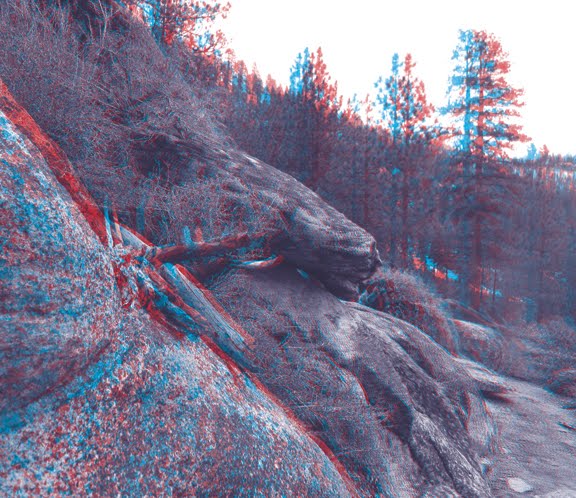
Taking 3-D for Granite
Got a couple more blue-red anaglyphs for you today--not particularly clever, artistic, whimsical or anything, just more in a series of on-going experiments. These were shot last weekend on the Nevada side of Lake Tahoe, where we spent a nice couple of days with friends who have a home there. Bust out your ol' 3-D specs and play along. And if we don't talk before the weekend, have a good one.
.


.

Thursday, March 25, 2010
Tres Tapas, Por Favor
Three bite-sized bits that floated to the top of my brain today . . .
Yesterday was Karen's and my twenty-mfmmfpth anniversary, which we celebrated by taking our girls into San Francisco to see a matinee of "Wicked" followed by a nice dinner. My mini-review of the play: a spectacular production with some very good songs and singers, terrific characters, interesting and funny twists on the "Oz" story everyone knows so well (which is to say the Judy Garland version), and some surprising and occasionally ridiculous plot twists. I was a little amazed to find myself truly moved by the plight of a misunderstood green witch fighting for animal rights. I also don't think I'd ever been inside San Francisco's Orpheum Theater before, and it's a beauty. Good play.
Anyway, Happy Anniversary, Sweetie. I think it was a fine one.


Yesterday was Karen's and my twenty-mfmmfpth anniversary, which we celebrated by taking our girls into San Francisco to see a matinee of "Wicked" followed by a nice dinner. My mini-review of the play: a spectacular production with some very good songs and singers, terrific characters, interesting and funny twists on the "Oz" story everyone knows so well (which is to say the Judy Garland version), and some surprising and occasionally ridiculous plot twists. I was a little amazed to find myself truly moved by the plight of a misunderstood green witch fighting for animal rights. I also don't think I'd ever been inside San Francisco's Orpheum Theater before, and it's a beauty. Good play.
Anyway, Happy Anniversary, Sweetie. I think it was a fine one.
* * *
.
I got up this morning thinking of all the things I do that would've been unimaginable to 99% of humans living throughout 99% of history. Not the obvious stuff, like flying in airplanes, but the little stuff: Taking a hot shower. Using a flush toilet. Brushing my teeth. Deciding from among many pants and shirts which I wanted to wear. Pouring a glass of cold orange juice from a pitcher in the fridge. Feeding my cats store-bought food from a can. That's six things I did this morning that would've been utterly alien to most people until very recently--still hard to find in a lot of places--and I hadn't even sat down at my computer yet.
As a wicked witch once said: What a world, what a world.
As a wicked witch once said: What a world, what a world.
.
* * *
I'll be going to WonderCon in San Francicso on Friday, April 2. Just as a fan, not a panelist or anything. Despite its proximity, I've never been to WonderCon before. It's run by the same people who do the big ComicCon in San Diego, and I understand it's more like ComicCon used to be: smaller, gentler, quieter, and more focused on comics than movies and video games.
I feel very lucky to have made it to the San Diego ComicCon the times I did, as an Eisner nominee (and winner!), panelist and guest. Unless I have a specific business reason to go, I don't expect to attend in the future. It's an expensive trip, and tickets and especially lodging are just too hard to get. As Yogi Berra probably never said of his favorite restaurant, "Nobody goes there anymore, it's too crowded." I'm hoping WonderCon is a nice, nearby alternative that lets me get my convention fix with less hassle and cost. I'll let you know.
* * *
One more added later: Actor Robert Culp died yesterday. I always liked his work and screen persona, and had a chance to talk to him briefly at last year's San Diego ComicCon, where he was signing photos. I didn't want his autograph--they don't really have a lot of meaning or value to me--but there wasn't anyone in line and we spoke for a minute. I told him I appreciated his work and asked if he had something new in the works. He said he did, and seemed excited about it, but declined to spill details. I looked forward to finding out; sounds like I never will. It's sad to lose him but he had a fine life and career.

Thursday, March 18, 2010
My Giant Melon Head
My recent experiments making 3-D photos inspired me to go for the ultimate: a person. Since the only person hanging around my office/studio/spare bedroom 97% of the day is me, that's who you get. Break out your red-blue glasses and don't be frightened by my enormous grinning moonface.


.

To make this anaglyph, I rested the camera atop my computer monitor, shot a photo, slid it two inches over, and shot another while holding perrrrrfectly still. The fine print on my 3-D specs reads "This Is It" because they're the free glasses Target gave away to watch the Michael Jackson Grammy tribute with. Any port in a storm.
And then, amazingly, a split second later, I heard a thundering whoosh as something flew past my left ear. Luckily, the camera captured the moment:


.
Wednesday, March 17, 2010
Busiek (and Me) on Breaking In
Comic book writer Kurt Busiek penned a great essay on breaking into the writing business. His main point is that most successful people make their own paths without following the rules, many of which (like submission guidelines and such) exist to weed out people rather than usher in new ones. Also, that "overnight successes" usually aren't. He writes:
You don't need a map. You need to figure out what you've got and capitalize on that. Instead of bemoaning the fact that you can't mail in something that a publisher wasn't going to read and wasn't going to buy, try to figure out something else, something that builds off your skills or knowledge or contacts or whatever . . . Make comics, not just proposals—even making crappy comics that convince you that you never want to draw another background again in your life will teach you more about telling a story in pictures on paper than a zillion proposals in the slush pile.
Kurt's a zillion times more experienced and successful than I, but my observations match his. He offers examples of how colleagues of his got published--each unique, none following any formula. Same for the writers I know. When people ask me for advice, I sincerely don't know what to say. I can describe how I did it, but that's nearly useless because it's not replicable for anyone else in any other place or time. I'm reminded of Carl Sagan's line, "If you wish to make an apple pie from scratch, you must first invent the universe." If you want to do it my way, you're starting 30 years too late.
All I can suggest is: First, do the work. It's surprising how many "writers" never actually write and how many "artists" never draw. Having an idea for a thing is not the same as sitting down and creating 20 or 200 pages of an actual thing! The latter is orders of magnitude harder. Then get it out into the world any way you can. Print it up, show it to people, send it to editors, put it on a website. Find communities of people doing the same thing--easier than ever on the Internet--and share work with them. One of those people in your favorite web forum could be looking for a writing partner or content provider five years from now. Plant a hundred seeds and two or three will bloom--and they'll probably be the ones you least expect.
Also, don't take without giving back in return. Don't expect or demand favors. No one owes you anything. Few people are as tiresome as a newbie who pops up to announce, "Hey, everyone look at my great stuff," argues with well-intentioned critiques, insults pros whose work is obviously worse than theirs, and then vanishes into a billowing cloud of entitlement. Bad form, and people have long memories. If you're polite, thoughtful, professional, and take the time to show others you care about their work, some will bend over backwards to help you.
While determination is important and admirable, I'm not a huge proponent of the "winners never quit" school of success. Busiek writes about a guy he sees at every convention who's been trying to break in for decades and will simply never be good enough to make it. I know people like that. I've also had times when I've wondered if I'm that guy. It's a fine line, deciding whether to keep slugging away versus recognizing that maybe that brick wall isn't budging and you're better off trying another angle or something else entirely.
My criterion is external evidence of progress. At first, probably no one will respond to your stuff at all. Then maybe you'll get a nice note from a stranger. Then maybe some encouragement from a pro. Then maybe an editor invites you to send some material. You sell a little thing to a little client, then parlay that into selling a bigger thing to a bigger client. Look for signs of advancing toward a goal rather than running in place.
The last time I touched on this, Friend-of-the-Blog Mike Peterson replied with a quote by Mark Twain that I can't top (and Twain's entire essay on the subject of advice for aspiring writers is funny and worth reading):
Write without pay until somebody offers pay. If nobody offers pay within three years, the candidate may look upon this circumstance with the most implicit confidence as the sign that sawing wood is what he was intended for.
You don't need a map. You need to figure out what you've got and capitalize on that. Instead of bemoaning the fact that you can't mail in something that a publisher wasn't going to read and wasn't going to buy, try to figure out something else, something that builds off your skills or knowledge or contacts or whatever . . . Make comics, not just proposals—even making crappy comics that convince you that you never want to draw another background again in your life will teach you more about telling a story in pictures on paper than a zillion proposals in the slush pile.
Kurt's a zillion times more experienced and successful than I, but my observations match his. He offers examples of how colleagues of his got published--each unique, none following any formula. Same for the writers I know. When people ask me for advice, I sincerely don't know what to say. I can describe how I did it, but that's nearly useless because it's not replicable for anyone else in any other place or time. I'm reminded of Carl Sagan's line, "If you wish to make an apple pie from scratch, you must first invent the universe." If you want to do it my way, you're starting 30 years too late.
All I can suggest is: First, do the work. It's surprising how many "writers" never actually write and how many "artists" never draw. Having an idea for a thing is not the same as sitting down and creating 20 or 200 pages of an actual thing! The latter is orders of magnitude harder. Then get it out into the world any way you can. Print it up, show it to people, send it to editors, put it on a website. Find communities of people doing the same thing--easier than ever on the Internet--and share work with them. One of those people in your favorite web forum could be looking for a writing partner or content provider five years from now. Plant a hundred seeds and two or three will bloom--and they'll probably be the ones you least expect.
Also, don't take without giving back in return. Don't expect or demand favors. No one owes you anything. Few people are as tiresome as a newbie who pops up to announce, "Hey, everyone look at my great stuff," argues with well-intentioned critiques, insults pros whose work is obviously worse than theirs, and then vanishes into a billowing cloud of entitlement. Bad form, and people have long memories. If you're polite, thoughtful, professional, and take the time to show others you care about their work, some will bend over backwards to help you.
While determination is important and admirable, I'm not a huge proponent of the "winners never quit" school of success. Busiek writes about a guy he sees at every convention who's been trying to break in for decades and will simply never be good enough to make it. I know people like that. I've also had times when I've wondered if I'm that guy. It's a fine line, deciding whether to keep slugging away versus recognizing that maybe that brick wall isn't budging and you're better off trying another angle or something else entirely.
My criterion is external evidence of progress. At first, probably no one will respond to your stuff at all. Then maybe you'll get a nice note from a stranger. Then maybe some encouragement from a pro. Then maybe an editor invites you to send some material. You sell a little thing to a little client, then parlay that into selling a bigger thing to a bigger client. Look for signs of advancing toward a goal rather than running in place.
The last time I touched on this, Friend-of-the-Blog Mike Peterson replied with a quote by Mark Twain that I can't top (and Twain's entire essay on the subject of advice for aspiring writers is funny and worth reading):
Write without pay until somebody offers pay. If nobody offers pay within three years, the candidate may look upon this circumstance with the most implicit confidence as the sign that sawing wood is what he was intended for.
Tuesday, March 16, 2010
Fat Cat in Favorite Chair
Another anaglyph experiment for the viewing pleasure of those of you with red-cyan 3-D glasses (mostly my girls, to whom I delivered such specs yesterday):
 That's our alpha cat Rose, whiling away her afternoon in a chair four feet from mine. Luckily, convincing her to hold absolutely still between the two camera shots was not a problem. Sometimes I think cats know everything important there is to know about life.
That's our alpha cat Rose, whiling away her afternoon in a chair four feet from mine. Luckily, convincing her to hold absolutely still between the two camera shots was not a problem. Sometimes I think cats know everything important there is to know about life.
Chicago in April, London in June
On Sunday, April 25, I'll be in Chicago for the 55th Annual Convention of the International Reading Association (IRA). Technically, I'll be there before the convention, which formally starts Monday. As part of the program, the IRA hosts all-day pre-conference "Institutes" that allow groups of presenters to treat single topics in depth. I'll be a panelist on the topic of "Teaching Reading With Graphic Novels: Building on IRA's Definition of ELA as Visualizing and Visually Representing." I understand the first five words of that title; after that I get a little woozy.
This institute was organized by Dr. Katie Monnin, an assistant professor of literacy at the University of North Florida as well as
an author and comics lover who's become an Internet buddy of mine (I drew the caricature of her at that second link, by the way). The annual IRA conference is a big deal in the book world, and I'm honored to participate in my small way. Given the topic, I think I can draw on both Mom's Cancer and Whatever Happened to the World of Tomorrow to talk about graphic novels and literacy, and how
Words + Pictures can sometimes provide a richer reading and learning experience than words alone.
Then on June 17, I'll be in London for a one-day conference on "Graphic Medicine" organized by Dr. Ian Williams. Now this is going to be really something! I'll be one of three keynote speakers talking to a group of about 75 medical professionals, sharing whatever insights I can offer as a result of my experience with Mom's Cancer. Ian has gone to a great deal of trouble to get me there, and I'm determined to make it worth his while. Plus I've never been to London, so Karen is coming along and we'll make a little vacation of it.
One of the most rewarding things I've ever done was a talk I gave to a group of healthcare professionals in Tucson a few years ago. Some of them came up afterward and said they were going to change the way they did their jobs as a result. Wow. Of course I can't expect to get that kind of reaction in London, but having a chance to tell Mom's story to a group of people who can actually apply it to patient care is a very powerful legacy. It would have meant a lot to her.
In anticipation of that conference, this week's issue of the British Medical Journal features a cover story on "The Use of Comics in Medical Education and Patient Care" by Michael Green and Kimberly Myers of the Penn State College of Medicine. The article, which highlights Mom's Cancer, isn't available online and I can't reprint it here, but the abstract will give you some flavor. What a wonderful coincidence (?) that every physician in the UK is reading that article just three months before a conference on the subject. (That question mark means that I truly don't know whether it's a coincidence. If it is, it's a good one.)
A friend recently e-mailed to ask some sincere questions about what it's like to be published and get a little recognition for it. Like everything, it has its pros and cons. Doing events like these is a big pro.
This institute was organized by Dr. Katie Monnin, an assistant professor of literacy at the University of North Florida as well as
an author and comics lover who's become an Internet buddy of mine (I drew the caricature of her at that second link, by the way). The annual IRA conference is a big deal in the book world, and I'm honored to participate in my small way. Given the topic, I think I can draw on both Mom's Cancer and Whatever Happened to the World of Tomorrow to talk about graphic novels and literacy, and how
Words + Pictures can sometimes provide a richer reading and learning experience than words alone.
Then on June 17, I'll be in London for a one-day conference on "Graphic Medicine" organized by Dr. Ian Williams. Now this is going to be really something! I'll be one of three keynote speakers talking to a group of about 75 medical professionals, sharing whatever insights I can offer as a result of my experience with Mom's Cancer. Ian has gone to a great deal of trouble to get me there, and I'm determined to make it worth his while. Plus I've never been to London, so Karen is coming along and we'll make a little vacation of it.
One of the most rewarding things I've ever done was a talk I gave to a group of healthcare professionals in Tucson a few years ago. Some of them came up afterward and said they were going to change the way they did their jobs as a result. Wow. Of course I can't expect to get that kind of reaction in London, but having a chance to tell Mom's story to a group of people who can actually apply it to patient care is a very powerful legacy. It would have meant a lot to her.
In anticipation of that conference, this week's issue of the British Medical Journal features a cover story on "The Use of Comics in Medical Education and Patient Care" by Michael Green and Kimberly Myers of the Penn State College of Medicine. The article, which highlights Mom's Cancer, isn't available online and I can't reprint it here, but the abstract will give you some flavor. What a wonderful coincidence (?) that every physician in the UK is reading that article just three months before a conference on the subject. (That question mark means that I truly don't know whether it's a coincidence. If it is, it's a good one.)
A friend recently e-mailed to ask some sincere questions about what it's like to be published and get a little recognition for it. Like everything, it has its pros and cons. Doing events like these is a big pro.
Subscribe to:
Posts (Atom)