As I mentioned yesterday, the point of my 90-minute "See One, Do One, Teach One" workshop at the Baltimore Comics & Medicine Conference was to give participants the confidence to go out and make their own comics, and perhaps teach other people to do the same. The four dozen people who did the workshop played along gamely; I thought it was only fair to do the same.
I opened the workshop by asking them to write down a short anecdote about something that'd happened to them recently. Funny, frustrating, sad. To prompt them, I suggested making it the first thing they'd tell someone when they called home that night. "Hey, you won't believe what happened to me...." I didn't play coy; I warned them they'd be drawing it later.
After talking about some theories of character design, I asked them to draw their own cartoon self-portrait, as well as one of the other characters in their story (if there were any). I only gave them a few minutes, so they had to be spontaneous and messy.
Later still, after going over some of the iconography and structure (i.e., panels, balloons) of comics, I asked them to make a comic of their stories. I gave them four blank panels as a jump start, but emphasized they didn't need to use all or any of them. I then asked for brave volunteers to share their work with the group. Several did. The results were some remarkably good comics!
While the participants were doing my exercises, so was I. In fairness, since I knew the questions were coming, I had some time to think and prepare. But I didn't cheat much. An event happened to me and I thought, "That's funny! That's what I'll make my comic about." However, I didn't script or sketch it out beforehand. I wrote and drew it in the same seven or eight minutes everyone else got.
Here's mine, which is more or less a true story:
What I'd planned to do in the workshop was analyze and critique my own comic as I (gently) did theirs, to explain what I'd been thinking and maybe should have done differently. In the moment, I thought that looking at the participants' comics was going so well, and they were so eager to share, that we ran out of time for me to critique my own (although I did show it). Here's what I would have said.
Panel 1
Omniscient narrator captions can be a crutch, but saying "Yesterday" gives us important information we couldn't get any other way. Just don't overuse them to explain action your characters should be doing. Show, don't tell.
This panel shows the exterior of my hotel, helpfully labeled. In film terms it's an "establishing shot." Now we know when and where we are. We don't know who's saying the dialog but we don't need to yet, as long as the next panel makes it clear. In fact, the uncertainty kind of urges us on to find out.
Panel 2.
I made a small mistake and a big mistake in this panel. The small mistake was that, after emphasizing to the workshop participants that they must place the words on the page before the art, I didn't plan ahead for the word "Maintenance." The big mistake was drawing myself shirtless (BTW, my actual physique is much less lumpy). That gives away the gag to come in Panel 4. I should have obscured it by perhaps drawing a close-up of my face, or otherwise hiding my state of undress.
Panel 3.
I could have drawn a door frame to make it clear that they're the ones who knocked. I made an effort with the two handymen to contrast their physical design and attitudes. One is burly and gruff, the other is small and apologetic. That's an exaggeration of the actual handymen, but essentially true. I think I did a good job designing these guys. Readers of my "Last Mechanical Monster" webcomic may notice that the big one looks like my character Ted the bus driver. In real life, I noticed that he sort of did! A lot of cartoonists have a repertory company of stock characters to draw on, and since I've been drawing Ted for more than a year now, I drafted him for this demo.
Panel 4.
If I hadn't telegraphed the gag in Panel 2, I'd be real happy with this towel-wrapped payoff in Panel 4. However, aside from obviously rewriting the dialog on the fly, I made a mistake in this panel that I consider serious: I switched the positions of the handymen. A moment ago, Burly Guy was on the left, now he's on the right. If I'd done that on a real project, I'd redraw it.
This is how I think when I'm drawing thumbnail sketches and laying out a page. These are basic elements of Storytelling that make creating comics different from drawing pretty pin-up pictures. If you're reading a comic and don't ever have to stop and think about what order you should read the panels in, where the action is taking place, which character is which, what the characters are doing, or how they got from here in Panel 2 to there in Panel 3, the cartoonist is doing a good job.
Which is to say: in my philosophy (which not everyone shares), the best cartooning is the cartooning you don't notice at all.
The Last Mechanical Monster. A Fire Story. Whatever Happened to the World of Tomorrow? Mom's Cancer.
Tuesday, July 1, 2014
Monday, June 30, 2014
Baltimore Comics & Medicine 2014
Experience after previous Comics & Medicine conferences has taught me that if I start writing about it, I'll never shut up. It works better to do a photo essay and let the pictures do my talking. Suffice it to say that I returned home from this year's Baltimore conference more excited about the field and the people involved in it than ever.
Graphic Medicine puzzles people ("healthcare and . . . comics?!") and they usually need to see a few examples before they get it. Mom's Cancer is one example, but only one; the reasons people do graphic medicine include storytelling, memoir, therapy, education, and public health. Some still don't get it, but many are quickly converted. As I've often said, one of the things I like best is gathering doctors, nurses, professors, students, writers and cartoonists--groups you might not expect to have much in common--to talk about interesting ideas and projects as equals. It's very cool.
Pictures or it didn't happen.
My midnight flight from San Francisco to Baltimore was an adventure. A two-hour fog delay at SFO made me miss my connecting plane in Chicago. The airline was great about getting me on the next flight, but by the time I arrived I'd been sitting on aircraft or in airports for about 12 hours. Then I had to get to a reception and help open the conference as the last of eight 5-minute "lightning" speakers.
| Approaching Baltimore, which is somewhere on the horizon there. As a Californian used to ocher-brown hills, I was impressed by the lush summertime greenness. |
| Johns Hopkins Medical School hosted the conference in this building, which was less imposing in person than it may look in this photo. Not actually an impregnable brick fortress. |
| The building had three large auditoriums plus a smaller classroom and cafe we used. Out back was an outdoor courtyard for breaks and lunch. Good space. |
My lightning talk was on "Practicing Graphic Medicine," which I've been doing since I first put Mom's Cancer online 10 years ago. I hoped to provide some context for the conference: before I started the webcomic, only a few people knew my family's story, which wasn't really a story at all because nobody was telling it. I put Mom's Cancer on the Web, and that expanded the story's reach. It was published as a book, which further expanded its reach. In 2010, I was asked to speak at the first Graphic Medicine conference in London, followed by more conferences. I think Graphic Medicine embraces all means of storytelling: oral, web, print; intimate and immediate in the case of the Web, distant and permanent in the case of print. Now it's a Graphic Medicine community. It's a niche field with enormous potential, and it makes a real difference in people's lives.
After the opening hullabaloo, some of us met for dinner at a terrific Afghan restaurant in Baltimore's historic Mount Vernon district, where most of us stayed. Good food and company, but you can imagine how fresh and witty I felt after coming in on the red-eye and being shot out of a magnetic rail-gun to give a 5-minute hyperspeed lecture.
Friday
I didn't take many photos the next day because I kept pretty busy. I gave a 90-minute workshop titled "See One, Do One, Teach One," which applied that old medical school mantra to cartooning. I thought a conference dedicated to comics needed a place where you'd actually learn to make one. The idea was to take people who'd maybe never done so--maybe never even drawn since they put down crayons in the fourth grade--and send them into the world with the knowledge and confidence to not only create their own comics but teach others to create theirs.
I ran out of the 40 little packets I'd made up for workshop participants, so I'd guess I had about four dozen people in a small classroom. Standing room only! I've done variations of this workshop a few times, and how it goes really depends on how willing the participants are to dig in and share their work, which I acknowledge takes guts to do. These guys were tremendous. They made some excellent short comics that really seemed to apply what I aimed to teach, and I hope/think everyone had a good time doing it.
Immediately after my workshop, I moderated a panel of three presentations on the topic of "Private Lives, Public Health." Moderating is usually light duty: introduce everyone, keep them on time, give them a 1-minute warning when they're running out, field some questions. All went well until near the end of the first speaker's talk, when a booming Voice of God blasted from the auditorium's sound system. First thought: the speaker's presentation had an audio file embedded in it. No, she looked puzzled, too. Second thought: the computer had fritzed and begun playing some other file. Nope. As a few of us gathered around the podium and the voice continued to boom, we figured out we were picking up a wireless microphone from another auditorium and eavesdropping on someone else's lecture. We managed to kill the entire audio system but then couldn't get it back up, so the remaining two presenters had to orate the old-fashioned way. Luckily they were game, and good speakers. I still feel bad for the first.
Nobody prepared me for that in moderator school.
Saturday
The next day, my responsibilities were done and I could relax. I tried to take more photos.
Following a keynote speech by Ellen Forney, the day and the conference were capped by a Marketplace similar to a comic convention dealers' room, where participants could sell their own books, prints, whatevers. Local comics shop Atomic Books was on hand to sell several related books, including Mom's Cancer. (Atomic Books also hosted a post-conference event Friday night, Laydeez Do Comics, which I didn't attend.) In addition to sales tables, a signing table was set up so Ellen, conference co-organizer Dr. Ian William, and I could sign our books.
And now a series of photos which on Facebook I titled "Brian Awkwardly Hugging People Who Were Too Slow to Escape":
There were a lot of neat people in Baltimore, including some friends, that I didn't happen to get photos of. Michael Green, Susan Squier, Shelley Wall. If I start listing them, I won't be able to stop. However, I need to mention three: Lydia Gregg, a medical illustrator at Johns Hopkins, did an excellent job of organizing the conference, which unwound with clockwork discipline (but in a nice way). She worked very hard and pulled it off. Also, I was very happy to see Juliet McMullin from UC Riverside, who organized the conference I spoke at last year, in Baltimore with her daughter Sheila, with whom I had a very nice conversation over dinner Saturday.
We have a joke in my family that I head off to each Comics & Medicine Conference swearing that it's going to be my last one, and coming home too excited to wait for the next one. It's not my place to make any announcements, but it looks like next year's conference could be relatively close to home; if so, I think I kinda need to be there. These are my people.
![]() |
| My pal "Comic Nurse" MK Czerwiec took this photo of the start of my talk. |
After the opening hullabaloo, some of us met for dinner at a terrific Afghan restaurant in Baltimore's historic Mount Vernon district, where most of us stayed. Good food and company, but you can imagine how fresh and witty I felt after coming in on the red-eye and being shot out of a magnetic rail-gun to give a 5-minute hyperspeed lecture.
Friday
I didn't take many photos the next day because I kept pretty busy. I gave a 90-minute workshop titled "See One, Do One, Teach One," which applied that old medical school mantra to cartooning. I thought a conference dedicated to comics needed a place where you'd actually learn to make one. The idea was to take people who'd maybe never done so--maybe never even drawn since they put down crayons in the fourth grade--and send them into the world with the knowledge and confidence to not only create their own comics but teach others to create theirs.
I ran out of the 40 little packets I'd made up for workshop participants, so I'd guess I had about four dozen people in a small classroom. Standing room only! I've done variations of this workshop a few times, and how it goes really depends on how willing the participants are to dig in and share their work, which I acknowledge takes guts to do. These guys were tremendous. They made some excellent short comics that really seemed to apply what I aimed to teach, and I hope/think everyone had a good time doing it.
Immediately after my workshop, I moderated a panel of three presentations on the topic of "Private Lives, Public Health." Moderating is usually light duty: introduce everyone, keep them on time, give them a 1-minute warning when they're running out, field some questions. All went well until near the end of the first speaker's talk, when a booming Voice of God blasted from the auditorium's sound system. First thought: the speaker's presentation had an audio file embedded in it. No, she looked puzzled, too. Second thought: the computer had fritzed and begun playing some other file. Nope. As a few of us gathered around the podium and the voice continued to boom, we figured out we were picking up a wireless microphone from another auditorium and eavesdropping on someone else's lecture. We managed to kill the entire audio system but then couldn't get it back up, so the remaining two presenters had to orate the old-fashioned way. Luckily they were game, and good speakers. I still feel bad for the first.
Nobody prepared me for that in moderator school.
| Also, the series "House of Cards" was evidently shooting scenes across the street from my hotel. Alas, no Kevin Spacey or Robin Wright (sigh) sightings from my window. |
Saturday
The next day, my responsibilities were done and I could relax. I tried to take more photos.
| Continental breakfast in the cafe before starting the day. |
| The other half of the cafe was a greenhouse where a silent auction was held for participants' artwork, mostly good-quality prints. |
| Here's an example of Graphic Medicine in action: Gary Ashwal and Dr. Alex Thomas created Booster Shot Comics to help teach sick kids about their diseases, including a comic book series titled "Iggy and the Inhalers" for children with asthma. During their presentation, they showed data that kids who'd read their comics had much greater understanding of their illness and treatment. I liked this presentation because I remember seeing Alex and Gary a few years ago when they were just getting going, and it's neat to see how much they've accomplished. |
Following a keynote speech by Ellen Forney, the day and the conference were capped by a Marketplace similar to a comic convention dealers' room, where participants could sell their own books, prints, whatevers. Local comics shop Atomic Books was on hand to sell several related books, including Mom's Cancer. (Atomic Books also hosted a post-conference event Friday night, Laydeez Do Comics, which I didn't attend.) In addition to sales tables, a signing table was set up so Ellen, conference co-organizer Dr. Ian William, and I could sign our books.
| A portion of the Marketplace. I think 18 or so people had tables in the relatively small cafe. There's some excellent work out there. |
| Another portion of the Marketplace. Those people all facing left in front of the yellow wall are lined up to see . . . |
And now a series of photos which on Facebook I titled "Brian Awkwardly Hugging People Who Were Too Slow to Escape":
| Cartoonist Joe Sutliff attended because he did a comic for the Fairfax County (Virginia) Health Department on mosquitoes and ticks that's been adopted by other health agencies around the country. But I was especially happy to meet Joe because we both contributed drawings to the Team Cul de Sac book raising funds for Parkinson's Disease research. He totally made my day by pulling out his copy of the book and asking me to sign it. A couple of other people also made me very happy by saying nice things about Whatever Happened to the World of Tomorrow, which I wouldn't expect anyone in this context to know or care about. Very cool. |
| With the bad doctor, Ian Williams. Sorry, I meant The Bad Doctor. Italics change everything. |
| Eating Afghan with Art Frank. |
There were a lot of neat people in Baltimore, including some friends, that I didn't happen to get photos of. Michael Green, Susan Squier, Shelley Wall. If I start listing them, I won't be able to stop. However, I need to mention three: Lydia Gregg, a medical illustrator at Johns Hopkins, did an excellent job of organizing the conference, which unwound with clockwork discipline (but in a nice way). She worked very hard and pulled it off. Also, I was very happy to see Juliet McMullin from UC Riverside, who organized the conference I spoke at last year, in Baltimore with her daughter Sheila, with whom I had a very nice conversation over dinner Saturday.
We have a joke in my family that I head off to each Comics & Medicine Conference swearing that it's going to be my last one, and coming home too excited to wait for the next one. It's not my place to make any announcements, but it looks like next year's conference could be relatively close to home; if so, I think I kinda need to be there. These are my people.
Wednesday, June 25, 2014
Lyric Critic Clinic
I should be working right now.
Instead, I woke up thinking about the best bad rhymes in songs: lyrics that scan so poorly they're almost admirable in their audacity. These are a few I came up with. Feel free to add your own.
4. "Wreck of the Edmund Fitzgerald," Gordon Lightfoot.
The ship was the pride of the American side
Coming back from some mill in Wisconsin.
As the big freighters go it was bigger than most
With a crew and good captain well-seasoned.
All that "Wisconsin" and "well-seasoned" have in common is they both begin with "W" and have two "S" sounds in the middle. To be fair, Lightfoot was retelling a true story, and so was stuck with the unpoetic "Wisconsin." However, I think a little dramatic license could've fixed him right up:
...and the brave captain knew that he hadda
Get that ship and crew outta Nevada.
3. "Take the Money and Run," Steve Miller
Billy Mack is a detective down in Texas
You know he knows just exactly what the facts is
Ignoring the egregious "Texas" and "facts is" for a moment, that second line is more padded than a fifth grader's essay when he's 40 words shy of 100.
Remember, I should be working right now.
2. "Hey Jude," John Lennon and Paul McCartney (but really just Paul)
Hey Jude, don't make it bad
Take a sad song and make it better.
Remember to let her into your heart
Then you can start to make it better.
"Better" does rhyme with "better," I'll give Paul that. But I probably wouldn't have thought of this song if not for this:
So let it out and let it in, hey Jude, begin
You're waiting for someone to perform with.
And don't you know that it's just you, hey Jude, you'll do
The movement you need is on your shoulder.
"Shoulder?" It works better than you'd expect because it mirrors a "shoulder" and "colder" pair earlier in the song. But what I love about it in this verse, where it doesn't rhyme at all, is the story that goes with it. As I heard it, Paul was writing the song and threw in that last line as a placeholder. "I'll tidy that up later," he thought in his adorable Liverpool accent. But John heard it and said "That's perfect!" Paul shrugged and left it. What makes this bad rhyme one of the best is that The Beatles were so huge and confident that they just didn't have to give a flyin' fig anymore.
1. "Ode to Joy," Beethoven's Ninth Symphony; music by Ludwig van Beethoven, lyrics by Friedrich Schiller.
Freude Schöner Götterfunken
Tochter aus Elysium,
Wir betreten feuertrunken,
Himmlische, dein Heiligtum.
"Elysium" and "Heiligtum" both have three syllables and end with an "um." That's it. Might as well have gone with "radium."
If "Ode to Joy" had been done by Herman's Hermits, I'd let it pass (though note that "Henry the Eighth" rhymes excellently throughout, as long as "Hen-er-y" has three syllables). But Ludwig, Fred . . . guys . . . you're supposed to be better than that.
Now what else can I do besides work?
Instead, I woke up thinking about the best bad rhymes in songs: lyrics that scan so poorly they're almost admirable in their audacity. These are a few I came up with. Feel free to add your own.
4. "Wreck of the Edmund Fitzgerald," Gordon Lightfoot.
The ship was the pride of the American side
Coming back from some mill in Wisconsin.
As the big freighters go it was bigger than most
With a crew and good captain well-seasoned.
All that "Wisconsin" and "well-seasoned" have in common is they both begin with "W" and have two "S" sounds in the middle. To be fair, Lightfoot was retelling a true story, and so was stuck with the unpoetic "Wisconsin." However, I think a little dramatic license could've fixed him right up:
...and the brave captain knew that he hadda
Get that ship and crew outta Nevada.
3. "Take the Money and Run," Steve Miller
Billy Mack is a detective down in Texas
You know he knows just exactly what the facts is
Ignoring the egregious "Texas" and "facts is" for a moment, that second line is more padded than a fifth grader's essay when he's 40 words shy of 100.
Remember, I should be working right now.
2. "Hey Jude," John Lennon and Paul McCartney (but really just Paul)
Hey Jude, don't make it bad
Take a sad song and make it better.
Remember to let her into your heart
Then you can start to make it better.
"Better" does rhyme with "better," I'll give Paul that. But I probably wouldn't have thought of this song if not for this:
So let it out and let it in, hey Jude, begin
You're waiting for someone to perform with.
And don't you know that it's just you, hey Jude, you'll do
The movement you need is on your shoulder.
"Shoulder?" It works better than you'd expect because it mirrors a "shoulder" and "colder" pair earlier in the song. But what I love about it in this verse, where it doesn't rhyme at all, is the story that goes with it. As I heard it, Paul was writing the song and threw in that last line as a placeholder. "I'll tidy that up later," he thought in his adorable Liverpool accent. But John heard it and said "That's perfect!" Paul shrugged and left it. What makes this bad rhyme one of the best is that The Beatles were so huge and confident that they just didn't have to give a flyin' fig anymore.
1. "Ode to Joy," Beethoven's Ninth Symphony; music by Ludwig van Beethoven, lyrics by Friedrich Schiller.
Freude Schöner Götterfunken
Tochter aus Elysium,
Wir betreten feuertrunken,
Himmlische, dein Heiligtum.
"Elysium" and "Heiligtum" both have three syllables and end with an "um." That's it. Might as well have gone with "radium."
If "Ode to Joy" had been done by Herman's Hermits, I'd let it pass (though note that "Henry the Eighth" rhymes excellently throughout, as long as "Hen-er-y" has three syllables). But Ludwig, Fred . . . guys . . . you're supposed to be better than that.
Now what else can I do besides work?
Tuesday, June 24, 2014
Medically Graphic
Tomorrow night I'm catching a red-eye flight from San Francisco to Baltimore (via Chicago) for the Fifth Annual International Comics & Medicine Conference. I attended the first, helped organize the second and third, and missed the fourth. Now it's off to Johns Hopkins to reunite with old friends and, I'm sure, make a few new ones.
These conferences are terrific! Here's a link to some posts about my previous trips to London, Chicago and Toronto, plus another conference organized by a different group last year in Riverside, Calif. Doctors, nurses, professors, students, and cartoonists get together and actually have a lot to talk about--using comics to tell patients' stories, caregivers' stories, medical professionals' stories . . . convey public health information . . . relate experiences in ways other media can't.
"Graphic medicine" is a small niche of comics and a small niche of medicine, but it's getting more attention in both realms, including articles in prestigious medical journals. It's been extraordinarily gratifying to be in on the ground floor of it.
I'm scheduled to give a 5-minute "lightning talk" on "Ten Years of Mom's Cancer," then a 90-minute hands-on workshop titled "See One, Do One, Teach One" to show people how to make comics. I'll also be moderating one panel discussion because nobody better was available.
Looking forward to the conference; not looking forward to the flight. Lots of photos and probably a couple of stories when I get back.
Saturday, June 21, 2014
The Great 3-D War
Bust out your red and blue 3-D specs. (If you're one of the 50 people who bought my limited-edition zine a couple of years ago, you already have a pair!).
Sometime in the past couple of days, some Facebook friend of mine posted something about World War I. That's about as specific as I can be. Facebook ephemera flits, floats, and quickly fades. But this one stuck a little because it reminded me of something I've meant to try.
I've mentioned before that I collect stereocards. They're basically Victorian Viewmasters, popular in parlors around the turn of the last century. Two photos shot simultaneously a few inches apart from each other are mounted on a heavy card and viewed through a stereoscope, which merges the images into a 3-D scene. It's easy to understand why these were so popular. They were often published in series with a theme: world travel, religious tableau, slice of life, natural wonders. Stereocards offered a startling "you are there" experience for people who'd never have a chance to see such sights in real life.
It's an affordable hobby. Stereocards are common, and are typically found in antiques stores for a few bucks each, depending on quality. The most I've paid for one is $20, but it was exceptional. I'm sure that in 1900 a well-appointed parlor could have hundreds of cards. I've got a few dozen.
Pulling today's themes together: what I've wanted to try, and my friend's Facebook post prodded me to do, is convert some old stereocards so their images could be viewed with modern red-blue 3-D glasses. It's easy in theory: since the photos are already black and white, just use Photoshop to convert the left eye into the proper blue color, the right eye into the proper red color, and overlap them.
Turns out it's pretty easy in practice, as well!
Here are two of my stereocards shot in the trenches of World War I.
Photoshopping them as described produces these:
I'm moderately happy with the results. I think some detail is lost in converting the images to red and blue, especially in dim areas. In person, these views really pop! But I'm calling this experiment a success.
I've got a lot of these cards. Maybe when I get a little time, I'll convert some more of my favorites.
Sometime in the past couple of days, some Facebook friend of mine posted something about World War I. That's about as specific as I can be. Facebook ephemera flits, floats, and quickly fades. But this one stuck a little because it reminded me of something I've meant to try.
I've mentioned before that I collect stereocards. They're basically Victorian Viewmasters, popular in parlors around the turn of the last century. Two photos shot simultaneously a few inches apart from each other are mounted on a heavy card and viewed through a stereoscope, which merges the images into a 3-D scene. It's easy to understand why these were so popular. They were often published in series with a theme: world travel, religious tableau, slice of life, natural wonders. Stereocards offered a startling "you are there" experience for people who'd never have a chance to see such sights in real life.
![]() |
| A stereoscope with a stereocard loaded for viewing. This isn't mine, but looks a lot like it. |
It's an affordable hobby. Stereocards are common, and are typically found in antiques stores for a few bucks each, depending on quality. The most I've paid for one is $20, but it was exceptional. I'm sure that in 1900 a well-appointed parlor could have hundreds of cards. I've got a few dozen.
Pulling today's themes together: what I've wanted to try, and my friend's Facebook post prodded me to do, is convert some old stereocards so their images could be viewed with modern red-blue 3-D glasses. It's easy in theory: since the photos are already black and white, just use Photoshop to convert the left eye into the proper blue color, the right eye into the proper red color, and overlap them.
Turns out it's pretty easy in practice, as well!
Here are two of my stereocards shot in the trenches of World War I.
![]() |
| BTW, the bottom one is the one I paid $20 for. I give it free to you. |
I'm moderately happy with the results. I think some detail is lost in converting the images to red and blue, especially in dim areas. In person, these views really pop! But I'm calling this experiment a success.
I've got a lot of these cards. Maybe when I get a little time, I'll convert some more of my favorites.
Tuesday, June 10, 2014
Time to Buy More Paper
![]() |
| 27 x 42 cm. |
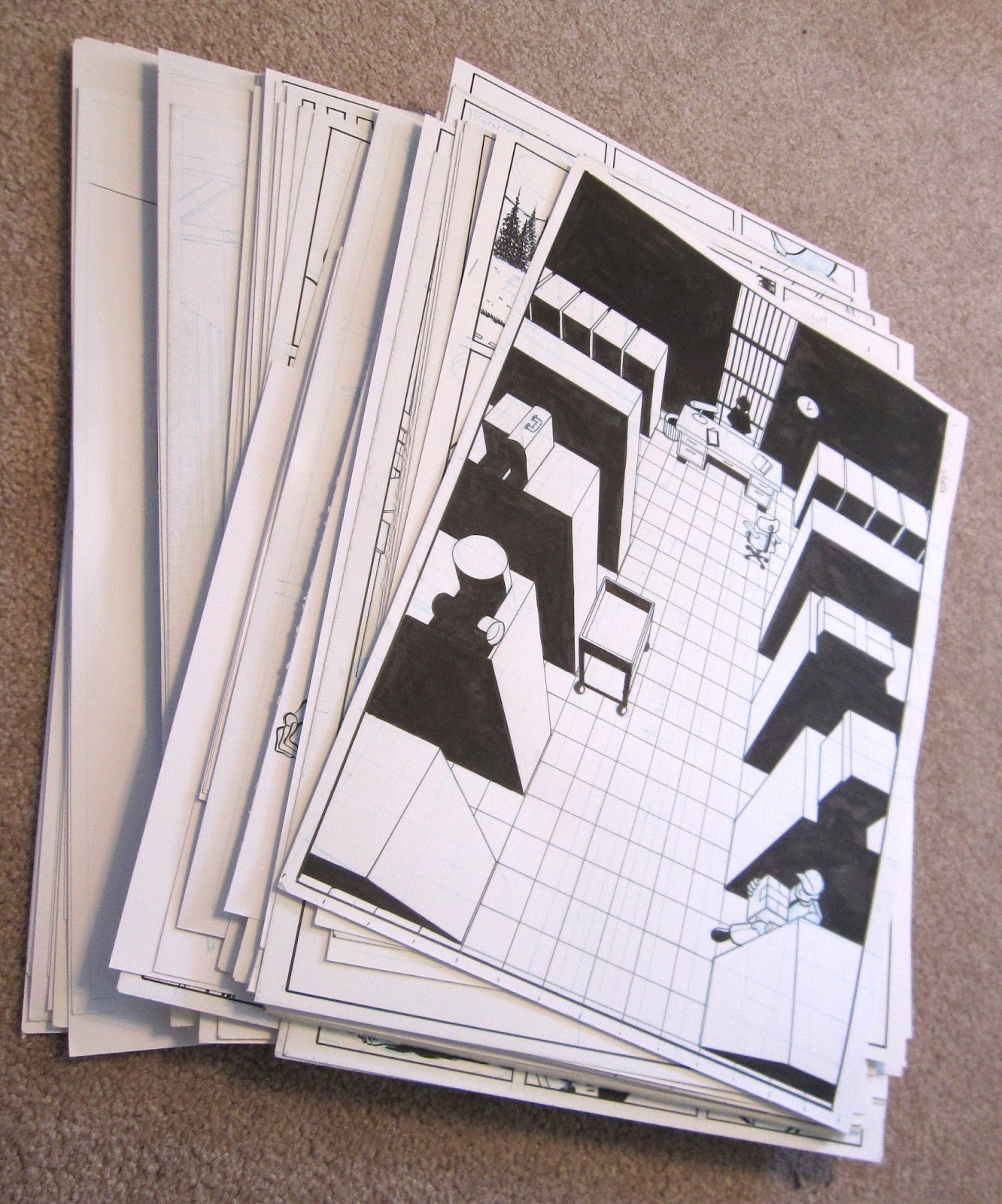
When I started my "Last Mechanical Monster" webcomic late last year, I described how this story emerged from a different story with the same characters that I'd been working on for a couple of years. In 2012 I began penciling the pages of that earlier version and drew more than 100 pages before realizing, a year later, that it wasn't really the story I wanted to tell.
How hard was it to develop a story for two-plus years, draw 100 pages of it, screech to a halt, turn on a dime, and start over in an entirely different direction? Surprisingly easy. I loved the new idea--the webcomic I hope you're reading now--and what had become a tough boring slog through characters and plot points I didn't enjoy turned into an exciting fresh reset. The project went from work to fun, and has mostly stayed fun since.
I'd penciled the original story on sheets of 2-ply Bristol board, a heavy paper with a little texture that takes ink well. It's also not cheap. Faced with the prospect of starting over from scratch, I grabbed a page from the old story's stack, turned it over, and drew Page 1 of the new-and-improved story on its blank side. Verso became recto, and I created Version 2.0 literally on the back of Version 1.0.
Now, more than a year after I began, I've just about run out of paper.
That's a milestone for me! Not only have I surpassed my effort on V1.0, I've basically doubled it, since this time I'm both penciling and inking the pages as I go.
My original V1.0 scheme was to write the entire story first, then pencil the entire story, then ink the entire story. It seemed like a good idea at the time. I thought that process would help me maintain a consistent art style throughout, and give me some flexibility to change the story as I went. For example, if I thought of a great bit while working on Page 100 that required something to be set up on Page 20, I could go back and do that in the script or pencils without wasting time and ink.
In practice, it was difficult and boring to do nothing but writing, then nothing but penciling, for months on end. I was already dreading the upcoming months of nothing but inking. I needed variety. It seemed like nothing ever got finished. Around the same time, I'd begun posting my "Adventures of Old Time-Traveling Brian" comics as a lark; it was so liberating to conceive, write, pencil, ink and post a short story in a single day that I yearned to bring some of that same energy to my long-form comics.
Consequently, for V2.0 I switched up my process so that I now work in small batches of pages, seeing them through essentially to completion. I have an outline for the entire story--I know where it's going and how to get there--but the actual dialog and action for individual pages is written spontaneously. I write, pencil, ink, post. Since I'm a couple of months ahead of deadline, I have time to reflect and revise. Also, because "The Last Mechanical Monster" is a webcomic, I still have some freedom to go back and change past pages to accommodate new ideas.
This process wouldn't work for everyone but it's good for me.
Now I'm off to the art supply store.
* * *
Blogging may be sparse as I pound through a busy summer.
June 26-28 I'll be at a Comics & Medicine Conference in Baltimore. I'm doing a five-minute "lightning" talk, teaching a 90-minute workshop, and moderating one panel. I'm very much looking forward to reconnecting with friends I've made in London, Chicago, Toronto, Riverside and elsewhere, and meeting new ones as well.
July 24-25 I'll be at Comic-Con International in San Diego. I won't be moored to a table or booth. If anyone really wants to find me, I'd suggest leaving a note at the Abrams booth, where I'll be sure to check in from time to time, or hunting me down at the Eisner Awards Friday night. If you want to catch me in a good mood, find me before the Best Webcomic Award is announced. I've also volunteered to do one hour of commission drawing to support the Cartoon Art Museum in San Francisco, but don't know for sure if or when that'll happen.
I'm leaving Comic-Con very early Saturday, July 26, to get back to the Bay Area in time for Splashdown, the USS Hornet's celebration of the 45th Anniversary of Apollo 11. My six long-time readers know that my daughter Laura is on the Hornet Museum's staff, and I'm actually scheduled to give a talk on the big hangar deck's main stage. Details and themes to come, but think "Whatever Happened to the World of Tomorrow?" An hour after I speak, Buzz Aldrin will stand at the same podium to blah blah Second Man on the Moon blah blah blah. I only hope my screaming groupies don't distract from his remarks.
I put a lot of time and effort into preparing for these things, then even more time and effort into looking like I didn't prepare for them. If you've ever seen me give a talk and thought I stunk, I assure you it wasn't for lack of time and effort.
Sunday, June 1, 2014
Happy June Birthdays!
Ah, June: the month that my wife and two sisters all have birthdays within seven days of each other. Or as I call it, "Hell Week."
Tuesday, May 27, 2014
Visions of the Past
Just a quick post and a picture. My sisters came to visit this weekend, and we all had a very nice time reunionating. Elisabeth ("Kid Sis") brought along a sculpture I made for her 10? 11? 12? years ago because it needed some repairs, and she wasn't quite sure how I'd put it together.
Lis and I were both fans of The Avengers before anybody else knew who they were (aside from John Steed and Emma Peel), and this is the Marvel Comics character The Vision:
The character is an android who joined the Avengers while yearning to discover his potential for humanity--much the same arc played by Data on "Star Trek," except the Vision came 20 years earlier. In the upcoming second Avengers movie, I understand he'll be played by Paul Bettany (an uncannily spot-on casting choice I endorse). He's passing through the wall like a ghost (or a vision!) because that's one of his superpowers.
My depiction is made of Sculpy (a sort of molding putty that hardens when baked) on an armature attached to a wood plaque, then painted with acrylics. I don't think I've really seen him since I gave him to Lis, so it was a fun kick in the pants to face my handiwork again. Repairs made to the best of my ability, he's on his way back home.
My Vision's anatomy is a little wonky, and I see things I'd have done better if I could, but I'm not ashamed of it. I should do more of this stuff. It's a lot of fun to occasionally work in three dimensions instead of two.
Lis and I were both fans of The Avengers before anybody else knew who they were (aside from John Steed and Emma Peel), and this is the Marvel Comics character The Vision:
The character is an android who joined the Avengers while yearning to discover his potential for humanity--much the same arc played by Data on "Star Trek," except the Vision came 20 years earlier. In the upcoming second Avengers movie, I understand he'll be played by Paul Bettany (an uncannily spot-on casting choice I endorse). He's passing through the wall like a ghost (or a vision!) because that's one of his superpowers.
My depiction is made of Sculpy (a sort of molding putty that hardens when baked) on an armature attached to a wood plaque, then painted with acrylics. I don't think I've really seen him since I gave him to Lis, so it was a fun kick in the pants to face my handiwork again. Repairs made to the best of my ability, he's on his way back home.
My Vision's anatomy is a little wonky, and I see things I'd have done better if I could, but I'm not ashamed of it. I should do more of this stuff. It's a lot of fun to occasionally work in three dimensions instead of two.
Wednesday, May 14, 2014
Trip the Light Fantastic
I get infrequent migraines. No need for sympathy or treatment advice, they only hit a few times a year and are always manageable. Until I had my first migraine in my mid-thirties, I thought the term was synonymous with "very bad headache," but that's not it at all. A migraine is a neurological civil war.
I was introduced to migraines in a conference room during a staff meeting when I gradually realized I couldn't read the words on my paper. Looking up, my vision was speckled and sparkly, as if Scotty were beaming everyone up to the Enterprise. I freaked out a little (quietly, inside) not knowing if I was going blind or having a stroke. I rode it out for about 20 minutes, then the headache hit. I later learned that such visual fireworks are a common symptom called an "aura" or a "scintillating scotoma." My migraines are mild; the worst put me out of commission for just a couple of hours.
That's not the interesting part. Here's the interesting part.
A migraine hit me a few months ago and I could tell it was one that I was just going to have to ride out, sitting quietly with my eyes closed. What better way to pass the time than to experiment on myself?
By alternately blinking my eyes, I determined that the visual distortion was present and identical in both eyes. No surprise, but that meant it originated in my brain rather than one eye or optic nerve. I already knew that.
I then sketched the visual distortion. It's difficult to draw because it's one of those peripheral vision things that squirms away if you look directly at it (also keeping in mind that "it" isn't real). Now, it's important to the integrity of the scientific process that I stress I did no research in advance. To the best of my knowledge, my sketch was uncontaminated by other people's descriptions or depictions. Here's what I drew:
The little circle diagram at lower right notes that the jagged half-circle spiral effect started small and then grew to take up half my field of vision. Today I sat down and did my best to render it as an animated GIF, putting it against a landscape to try to capture its transparent shimmery essence--as I wrote in my sketch, like "magenta, cyan and white vibrating crystals."
OK, with that in mind, and remembering that I didn't look up other people's aura impressions until after I drew my sketch, here's a sampling I found on the Internet (I did my best to give credit where it's due but can't promise all the links go back to each image's origin):
![]() |
| This one's subtle, but notice the animated distortion on the left. From here. |
![]() |
| From here. |
![]() |
| From here. |
![]() |
| From here. |
![]() |
| From here. |
![]() |
| From here. |
![]() |
| From here. |
![]() |
| From here. |
![]() |
| From here. I like this one especially. |
I find that absolutely FASCINATING!
First, that human brains malfunction in such a specific uniform way. These renderings seem startlingly similar to me, most sharing the same crescent spiral shape I typically see. Even down to the little hooky pointy ends of some of the curves. The idea that a thousand unrelated people will all see the same thing if you apply an X-millivolt short-circuit to one spot of their occipital cortex is almost spooky. It's also fantastic!
Second, that people find such varied and unique ways to document a totally subjective experience. Some of them are quite artistic. These drawings don't all resemble mine, but I can look at each of them and tell that its creator was seeing the same thing I did. Every one of them elicits a "Yep, that's it."
Third, it does make you reflect a bit on the difference between real and unreal, objective and subjective, and how reliable our minds and senses really are. I think that's always useful.
It also occurs to me that in other centuries this sort of thing might've gotten me venerated as a shaman. Or burned as a witch. You'd have to pick your time and place carefully. I figure I'm safe discussing it on a 21st Century blog, though if someone wants to accuse me of having a mutant superpower, I'm OK with that, too.
Brains. Go figure.
EDITED TO ADD a few more examples of "aura art" to the gallery above as well as the great piece below, titled "Illustration of Visual Migraine Aura" rendered by physician Hubert Airy in 1870. Nailed it.
![]() |
| From the Migraine Aura Foundation, and who knew there was such a thing? |
Monday, May 12, 2014
Gaijin Style
For my birthday last month, my wife Karen gifted me a sushi-making lesson at a local cookware store. Yesterday, for a Mother's Day appetizer, I made the fifth through eighth sushi rolls I've ever made in my life (the first through fourth were accomplished during the class). Keeping in mind that actual Japanese sushi chefs undergo years of training to master the intricate techniques and rituals involved, I think I did commendably well.
My plan was complicated by the fact that my wife Karen and one of my daughters dislike uncooked fish ("bait"). There are fine vegetarian sushi options, but for my appetizer I decided to go off-book and improvise--daringly foolish for my first solo flight.
I browned chunks of unskinned chicken breast in a pan, then chopped it into small bits that I mixed with a homemade teriyaki glaze. I made two types of teriyaki chicken sushi: one with red bell pepper and one with cucumber. Both also had bean sprouts. Having learned in sushi school that traditional sushi only contains an odd number of ingredients, I stuck with three.
Frankly, I think these could've turned out a little more colorful and attractive. But the most important outcome was that they were delicious. Then a couple of hours later my daughters put out a tremendous Mother's Day spread of grilled polenta, sausage, creamy tomato sauce, Brazilian cheesy puffs (gluten-free!) with garlic butter, and salad with a raspberry vinaigrette.
'Cause that's how the Fies family rolls, baby. Happy Mother's Day to all the mothers or anybody who ever had one.
My plan was complicated by the fact that my wife Karen and one of my daughters dislike uncooked fish ("bait"). There are fine vegetarian sushi options, but for my appetizer I decided to go off-book and improvise--daringly foolish for my first solo flight.
I browned chunks of unskinned chicken breast in a pan, then chopped it into small bits that I mixed with a homemade teriyaki glaze. I made two types of teriyaki chicken sushi: one with red bell pepper and one with cucumber. Both also had bean sprouts. Having learned in sushi school that traditional sushi only contains an odd number of ingredients, I stuck with three.
![]() |
| Chopped up teriyaki-glazed chicken in the bowl, with bell pepper, cucumber and bean sprouts all mise en placed. |
![]() |
| Rice on nori on rolling mat. The small glass bowl has diluted rice wine vinegar for moistening fingers while you work. My sticky rice turned out just right (i.e., sticky)! |
| Layering up the flavor. Note the Marvel Comics apron that my daughters sewed for me a while back. It's reversible; the other side has a Starship Enterprise pattern. Because I raised them right. |
| Don't look too closely, a few of these are pretty wonky. |
'Cause that's how the Fies family rolls, baby. Happy Mother's Day to all the mothers or anybody who ever had one.
Thursday, May 1, 2014
Subscribe to:
Posts (Atom)