Tuesday, June 10, 2014

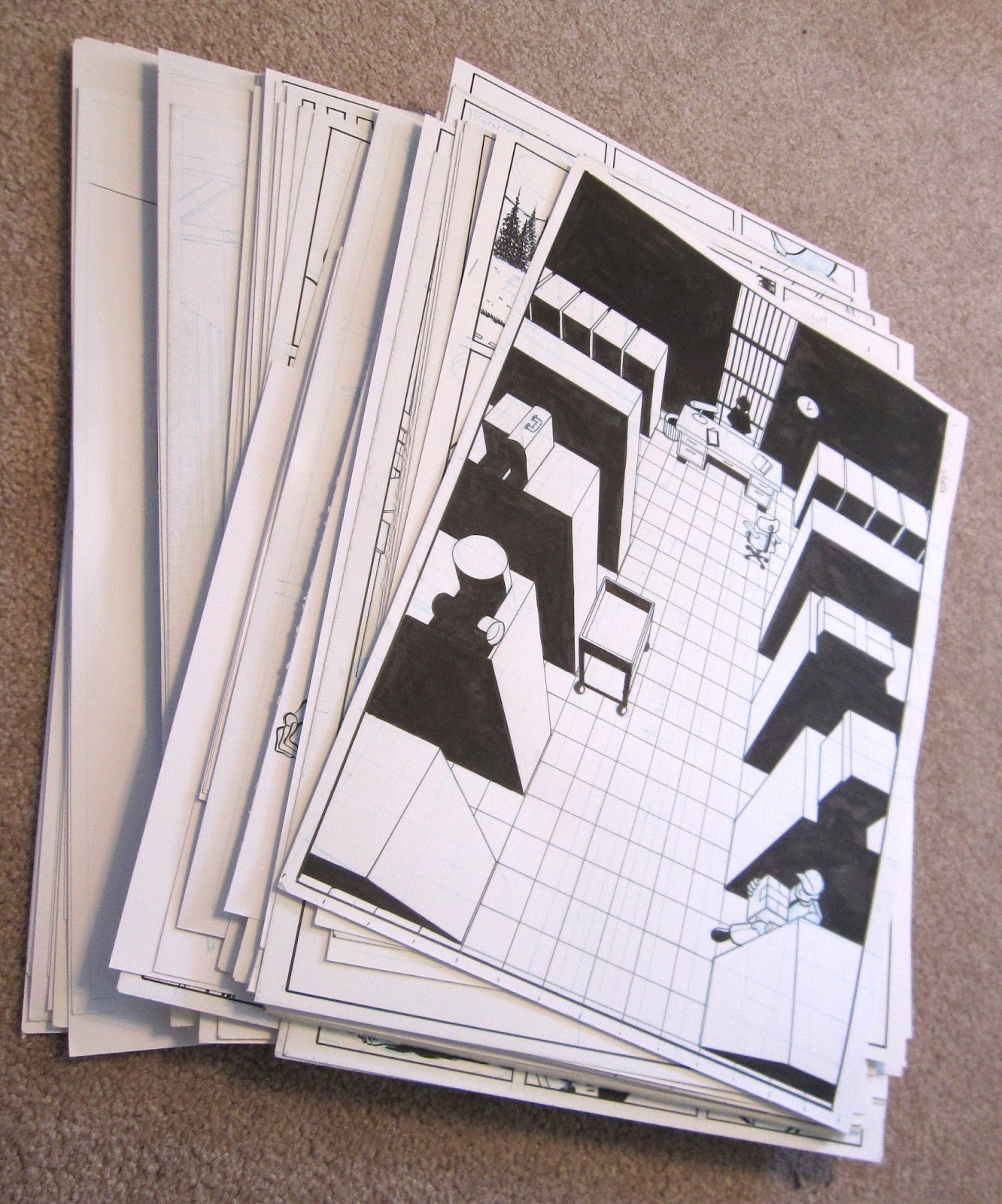
Time to Buy More Paper

27 x 42 cm.

When I started my "Last Mechanical Monster" webcomic late last year, I described how this story emerged from a different story with the same characters that I'd been working on for a couple of years. In 2012 I began penciling the pages of that earlier version and drew more than 100 pages before realizing, a year later, that it wasn't really the story I wanted to tell.

How hard was it to develop a story for two-plus years, draw 100 pages of it, screech to a halt, turn on a dime, and start over in an entirely different direction? Surprisingly easy. I loved the new idea--the webcomic I hope you're reading now--and what had become a tough boring slog through characters and plot points I didn't enjoy turned into an exciting fresh reset. The project went from work to fun, and has mostly stayed fun since.

I'd penciled the original story on sheets of 2-ply Bristol board, a heavy paper with a little texture that takes ink well. It's also not cheap. Faced with the prospect of starting over from scratch, I grabbed a page from the old story's stack, turned it over, and drew Page 1 of the new-and-improved story on its blank side. Verso became recto, and I created Version 2.0 literally on the back of Version 1.0.

Now, more than a year after I began, I've just about run out of paper.

That's a milestone for me! Not only have I surpassed my effort on V1.0, I've basically doubled it, since this time I'm both penciling and inking the pages as I go.

My original V1.0 scheme was to write the entire story first, then pencil the entire story, then ink the entire story. It seemed like a good idea at the time. I thought that process would help me maintain a consistent art style throughout, and give me some flexibility to change the story as I went. For example, if I thought of a great bit while working on Page 100 that required something to be set up on Page 20, I could go back and do that in the script or pencils without wasting time and ink.

In practice, it was difficult and boring to do nothing but writing, then nothing but penciling, for months on end. I was already dreading the upcoming months of nothing but inking. I needed variety. It seemed like nothing ever got finished. Around the same time, I'd begun posting my "Adventures of Old Time-Traveling Brian" comics as a lark; it was so liberating to conceive, write, pencil, ink and post a short story in a single day that I yearned to bring some of that same energy to my long-form comics.

Consequently, for V2.0 I switched up my process so that I now work in small batches of pages, seeing them through essentially to completion. I have an outline for the entire story--I know where it's going and how to get there--but the actual dialog and action for individual pages is written spontaneously. I write, pencil, ink, post. Since I'm a couple of months ahead of deadline, I have time to reflect and revise. Also, because "The Last Mechanical Monster" is a webcomic, I still have some freedom to go back and change past pages to accommodate new ideas.

This process wouldn't work for everyone but it's good for me.

Now I'm off to the art supply store.

* * *

Blogging may be sparse as I pound through a busy summer.

June 26-28 I'll be at a Comics & Medicine Conference in Baltimore. I'm doing a five-minute "lightning" talk, teaching a 90-minute workshop, and moderating one panel. I'm very much looking forward to reconnecting with friends I've made in London, Chicago, Toronto, Riverside and elsewhere, and meeting new ones as well.

July 24-25 I'll be at Comic-Con International in San Diego. I won't be moored to a table or booth. If anyone really wants to find me, I'd suggest leaving a note at the Abrams booth, where I'll be sure to check in from time to time, or hunting me down at the Eisner Awards Friday night. If you want to catch me in a good mood, find me before the Best Webcomic Award is announced. I've also volunteered to do one hour of commission drawing to support the Cartoon Art Museum in San Francisco, but don't know for sure if or when that'll happen.

I'm leaving Comic-Con very early Saturday, July 26, to get back to the Bay Area in time for Splashdown, the USS Hornet's celebration of the 45th Anniversary of Apollo 11. My six long-time readers know that my daughter Laura is on the Hornet Museum's staff, and I'm actually scheduled to give a talk on the big hangar deck's main stage. Details and themes to come, but think "Whatever Happened to the World of Tomorrow?" An hour after I speak, Buzz Aldrin will stand at the same podium to blah blah Second Man on the Moon blah blah blah. I only hope my screaming groupies don't distract from his remarks.

I put a lot of time and effort into preparing for these things, then even more time and effort into looking like I didn't prepare for them. If you've ever seen me give a talk and thought I stunk, I assure you it wasn't for lack of time and effort.


Sunday, June 1, 2014

Happy June Birthdays!

Ah, June: the month that my wife and two sisters all have birthdays within seven days of each other. Or as I call it, "Hell Week."

Tuesday, May 27, 2014

Visions of the Past

Just a quick post and a picture. My sisters came to visit this weekend, and we all had a very nice time reunionating. Elisabeth ("Kid Sis") brought along a sculpture I made for her 10? 11? 12? years ago because it needed some repairs, and she wasn't quite sure how I'd put it together.

Lis and I were both fans of The Avengers before anybody else knew who they were (aside from John Steed and Emma Peel), and this is the Marvel Comics character The Vision:


The character is an android who joined the Avengers while yearning to discover his potential for humanity--much the same arc played by Data on "Star Trek," except the Vision came 20 years earlier. In the upcoming second Avengers movie, I understand he'll be played by Paul Bettany (an uncannily spot-on casting choice I endorse). He's passing through the wall like a ghost (or a vision!) because that's one of his superpowers.

My depiction is made of Sculpy (a sort of molding putty that hardens when baked) on an armature attached to a wood plaque, then painted with acrylics. I don't think I've really seen him since I gave him to Lis, so it was a fun kick in the pants to face my handiwork again. Repairs made to the best of my ability, he's on his way back home.

My Vision's anatomy is a little wonky, and I see things I'd have done better if I could, but I'm not ashamed of it. I should do more of this stuff. It's a lot of fun to occasionally work in three dimensions instead of two.

Wednesday, May 14, 2014

Trip the Light Fantastic

I get infrequent migraines. No need for sympathy or treatment advice, they only hit a few times a year and are always manageable. Until I had my first migraine in my mid-thirties, I thought the term was synonymous with "very bad headache," but that's not it at all. A migraine is a neurological civil war.

I was introduced to migraines in a conference room during a staff meeting when I gradually realized I couldn't read the words on my paper. Looking up, my vision was speckled and sparkly, as if Scotty were beaming everyone up to the Enterprise. I freaked out a little (quietly, inside) not knowing if I was going blind or having a stroke. I rode it out for about 20 minutes, then the headache hit. I later learned that such visual fireworks are a common symptom called an "aura" or a "scintillating scotoma." My migraines are mild; the worst put me out of commission for just a couple of hours.

That's not the interesting part. Here's the interesting part.

A migraine hit me a few months ago and I could tell it was one that I was just going to have to ride out, sitting quietly with my eyes closed. What better way to pass the time than to experiment on myself?

By alternately blinking my eyes, I determined that the visual distortion was present and identical in both eyes. No surprise, but that meant it originated in my brain rather than one eye or optic nerve. I already knew that.

I then sketched the visual distortion. It's difficult to draw because it's one of those peripheral vision things that squirms away if you look directly at it (also keeping in mind that "it" isn't real). Now, it's important to the integrity of the scientific process that I stress I did no research in advance. To the best of my knowledge, my sketch was uncontaminated by other people's descriptions or depictions. Here's what I drew:


The little circle diagram at lower right notes that the jagged half-circle spiral effect started small and then grew to take up half my field of vision. Today I sat down and did my best to render it as an animated GIF, putting it against a landscape to try to capture its transparent shimmery essence--as I wrote in my sketch, like "magenta, cyan and white vibrating crystals."


OK, with that in mind, and remembering that I didn't look up other people's aura impressions until after I drew my sketch, here's a sampling I found on the Internet (I did my best to give credit where it's due but can't promise all the links go back to each image's origin):

This one's subtle, but notice the animated distortion on the left. From here.
From here.
From here.

From here.
From here.
From here.
From here.
From here. 
From here. I like this one especially.

I find that absolutely FASCINATING!

First, that human brains malfunction in such a specific uniform way. These renderings seem startlingly similar to me, most sharing the same crescent spiral shape I typically see. Even down to the little hooky pointy ends of some of the curves. The idea that a thousand unrelated people will all see the same thing if you apply an X-millivolt short-circuit to one spot of their occipital cortex is almost spooky. It's also fantastic!

Second, that people find such varied and unique ways to document a totally subjective experience. Some of them are quite artistic. These drawings don't all resemble mine, but I can look at each of them and tell that its creator was seeing the same thing I did. Every one of them elicits a "Yep, that's it."

Third, it does make you reflect a bit on the difference between real and unreal, objective and subjective, and how reliable our minds and senses really are. I think that's always useful.

It also occurs to me that in other centuries this sort of thing might've gotten me venerated as a shaman. Or burned as a witch. You'd have to pick your time and place carefully. I figure I'm safe discussing it on a 21st Century blog, though if someone wants to accuse me of having a mutant superpower, I'm OK with that, too.

Brains. Go figure.


EDITED TO ADD a few more examples of "aura art" to the gallery above as well as the great piece below, titled "Illustration of Visual Migraine Aura" rendered by physician Hubert Airy in 1870. Nailed it.

From the Migraine Aura Foundation, and who knew there was such a thing?

Monday, May 12, 2014

Gaijin Style

For my birthday last month, my wife Karen gifted me a sushi-making lesson at a local cookware store. Yesterday, for a Mother's Day appetizer, I made the fifth through eighth sushi rolls I've ever made in my life (the first through fourth were accomplished during the class). Keeping in mind that actual Japanese sushi chefs undergo years of training to master the intricate techniques and rituals involved, I think I did commendably well.

My plan was complicated by the fact that my wife Karen and one of my daughters dislike uncooked fish ("bait"). There are fine vegetarian sushi options, but for my appetizer I decided to go off-book and improvise--daringly foolish for my first solo flight.

I browned chunks of unskinned chicken breast in a pan, then chopped it into small bits that I mixed with a homemade teriyaki glaze. I made two types of teriyaki chicken sushi: one with red bell pepper and one with cucumber. Both also had bean sprouts. Having learned in sushi school that traditional sushi only contains an odd number of ingredients, I stuck with three.

Chopped up teriyaki-glazed chicken in the bowl, with bell pepper, cucumber and bean sprouts all mise en placed.
Rice on nori on rolling mat. The small glass bowl has diluted rice wine vinegar for moistening fingers while you work. My sticky rice turned out just right (i.e., sticky)!
Layering up the flavor. Note the Marvel Comics apron that my daughters sewed for me a while back. It's reversible; the other side has a Starship Enterprise pattern. Because I raised them right.
Expert Novice at Work
Four rolls sesame-seeded and ready to go: two for Mother's Day appetizers and two for lunch the next day. I made "inside out" sushi with a layer of rice outside the nori because it's my favorite type, and buries the seaweed texture that some people don't appreciate.
Don't look too closely, a few of these are pretty wonky.
Frankly, I think these could've turned out a little more colorful and attractive. But the most important outcome was that they were delicious. Then a couple of hours later my daughters put out a tremendous Mother's Day spread of grilled polenta, sausage, creamy tomato sauce, Brazilian cheesy puffs (gluten-free!) with garlic butter, and salad with a raspberry vinaigrette.


'Cause that's how the Fies family rolls, baby. Happy Mother's Day to all the mothers or anybody who ever had one.


Wednesday, April 30, 2014

Mom's Cancer Plus a Decade


This may make some of you feel old.

In the early Internet days, people with common interests could congregate via an Internet system called Usenet. Similar to Web bulletin boards or forums, Usenet groups were set up with names such as rec.arts.comics.strips (RACS) so folks who loved, say, comic strips could get together and talk about them. Usenet groups still exist, though many have been overrun by zealots and spam, and many of their users have migrated to other watering holes. RACS is one of a few I know that remains respectably active.

Exactly 10 years ago today, April 30, 2004, I posted the following on RACS:

For Your Consideration Please: A Comic Strip About Cancer

My mother was diagnosed with incurable lung cancer. I made a comic strip about it.

www.momscancer.com is a work in progress. It is my magnum opus, my "Citizen Kane," the project I may have been born to do. While it is not finished, I feel it is at a point where it would benefit from some constructive criticism.

I would appreciate your visits and opinions. I made my first post to RACS in 1999 after lurking for a couple of years, and have been a constructive (though not always frequent) contributor since. I've never asked for anything before and am considerably nervous about do so now; I cannot imagine a more informed or difficult audience to please. Negative opinions will mean as much to me as positive. I've been working for months with y'all in mind. This means a lot to me.

Thanks, gang. As I add chapters in the coming months, I'm sure I will appeal to you again. If you like it, tell a friend.

* * *

Reading that now, I'm embarrassed by both its earnestness and conceit. "Magnum opus" indeed! But that debut changed my life and my family's lives. I serialized Mom's Cancer online because it was free and I didn't know what else to do with it; I mentioned it on RACS because I didn't know how else to get the word out. That one Usenet post was ALL the marketing I ever did. The response was more than I could have anticipated or dreamed. Like the old shampoo commercial said, I told two friends and they told two friends and they told two friends . . . and within a few months it went viral.

Page 1. "How to Diagnose Lung Cancer, Step One." 

Because of RACS, Mom's Cancer later won awards, found a publisher, and gave me a semi-pro career in comics I continue to enjoy. Most important to me, because of RACS my mother got fan mail (!), made pen pals, and I think found some purpose in fighting the disease that eventually killed her in October 2005. Few things made Mom happier than a stranger telling her they'd quit smoking because they'd read her story.

A 10-year update: My sisters still live together in the Los Angeles area, though they long ago sold the Hollywood home they bought with Mom. "Nurse Sis" Brenda remains a nurse, supervising at a major university hospital. "Kid Sis" Elisabeth continues to pursue her passion as an independent filmmaker. My sisters often collaborate to write, produce, and direct their own screenplays and short films that have earned festival accolades.

Nurse Sis and Kid Sis in action.

I get on pretty well with my Dad, which may be surprising because I gave him a hard shot in my book. Aside from my mother's, his was the reaction I feared most, but he couldn't have been cooler about it, saying "You have to tell your story your way." Years after I wrote Mom's Cancer, my family and I actually visited his former-hippy-commune spiritual retreat in the mountains of New Mexico. It was nothing like I drew it.


Mom's dog Hero is still alive and yapping happily with my sisters.

Eight years after its initial publication--after being the first project editor Charlie Kochman plucked from the slush pile to start Abrams Books' new comics line--Mom's Cancer remains in print and sells a few hundred copies a year.

I dream of Mom often. When I do, my dreams are mostly happy ones.


I'm giving a brief talk at an upcoming Comics & Medicine Conference in Baltimore in which I plan to touch on what these 10 years have meant to me. Lessons learned. The fine line I don't want to cross is coming off self-congratulatory, because that's not the point. Rather, through Mom's Cancer I've been privileged to meet some amazing people and, without being presumptuous, to feel like my book spoke for some of them. I've been part of the early days of the growing field of Graphic Medicine, where physicians and teachers such as my friends Ian Williams, Michael Green and MK Czerwiec incorporate comics into patient care and medical school curricula (!). I made other friends around the world, both through Mom's Cancer and my second book, Whatever Happened to the World of Tomorrow (which, it goes without saying, wouldn't have happened without Mom's Cancer), as well as my new webcomic.

Whatever I wanted and expected when I wrote that Usenet post 10 years ago, I never could have anticipated the most gratifying result: the people I met, the friends I made, and the communities I was welcomed into.

In a recent interview, I said: "I know why Mom's Cancer got the attention it did. I also know I'll probably never create anything with the same raw passion, intensity or honesty. It was special. If I live to be 100 and write 30 more books, the one that leads my obit will be Mom's Cancer. And I'm proud, grateful, and satisfied with that."

Thanks.


Tuesday, April 22, 2014

I Am a Fangirl


Comics has a female problem. Girls and women don’t always feel welcome. They bring uninvited baggage, like feelings and opinions. They create and buy the types of stories they want to read. Even worse, sometimes they create and buy ours. Giggling, squealing fangirls have invaded the clubhouse, and some of us boys don't like it.

A recent flare-up ignited when writer, editor and critic Janelle Asselin wrote a piece analyzing the cover of a “Teen Titans” comic book. Among other artistic and thematic criticisms, she noted the unnaturally large and bulbous breasts of the teen character Wonder Girl. Expressing that opinion brought her a deluge of anonymous mockery, intimidation, rape threats and death threats, which resulted in a backlash of reflection, accusation and condemnation (as from Andy Khouri and Heidi MacDonald). 

Just to be clear: we’re talking about telling a stranger she deserves to be raped and killed . . .

. . . because she didn't like the cover of a “Teen Titans” comic book.

Back in February, cartoonist Noelle Stevenson drew a comic about visiting a local comic book shop to support her friends’ work and being mocked by staff who asked if she wanted to buy a “My Little Pony” book while she was at it. Stevenson is one of the hottest talents in comics right now, and her webcomic “Nimona” is a regular stop of mine. She creates the content that keeps those jerks’ shop in business, yet they humiliated her and chased her out the door.

How bad a businessperson are you when you antagonize the source of your product and half your potential patrons (not to mention getting stuck with a pile of “My Little Pony” comics you’ll never sell)? Those people aren’t girls with cooties, you imbeciles; they’re customers with cash.

Last December, writer and TV producer Paul Dini explained that DC’s “Young Justice” cartoon was canceled because it was popular with girls. Turns out the network executives don’t want girls watching superhero cartoons because they believe boys buy more toys. By the way, anybody seen any sales figures for “Frozen” merchandise lately?

What the hell is wrong with people? What the hell is wrong with people in comics?

It’s all been echoing around the Web for a while and I didn’t say anything because the difference between right and wrong seemed obvious and I had nothing interesting to add. There are immature maladjusted asses in every group, their cruelty sharpened by the anonymity of the Internet, and maybe guys reading “Teen Titans” comics in their thirties and forties have more than their fair share. Then yesterday I came across a post by Allison Baker of Comic Book Resources inspired by this t-shirt she found at the just-done WonderCon in Anaheim:

"I like Fangirls how I like my coffee. I HATE coffee."

Now you just made it personal, pardner.

I have two daughters who’d probably fit some guys’ definition of “fangirls.” Long-time readers know their names but I won’t mention them here because they don't want professional contacts googling up their personal interests, and I respect that. They came to fandom through anime, manga and video games, and love the Marvel movies. They’re writer/artists who’ve won prizes for their manga (with no help from Dad). They sell homemade crafts, sewing, and pinback buttons at conventions. They cosplay. They and a group of their friends do skits.

Some cosplayers I've captured at past Comic-Cons (that's me with the Klingons). "Cosplay" is coined from "costume play" and can be simple or elaborate, inexpensive or extravagant. The overwhelming majority of cosplayers do it in a spirit of good Halloween-style fun, though a few do get uncomfortably committed to their characters.

I may have had something to do with their interest. In addition to being a semi-pro cartoonist, I’ve been a comics fan as long as I can remember. I discovered “The Avengers” when I was 12, and began collecting new issues and buying back issues until I had every book from the original series’ 400-odd-issue run. Forty years later I’m a father, my daughters and I can go see a terrific “Captain America” movie, and I can pull a copy of “Avengers #4” from a box in my closet and show them how Stan Lee and Jack Kirby defrosted Steve Rogers in 1964. And then I can tell them the ridiculous part of the story that nobody remembers--how Cap saved the Avengers from an asparagus-headed alien who turned them all to stone, and how years later, in a nod to old fans, John Byrne destroyed the entire planet of the asparagus-headed people during the X-Men’s Dark Phoenix Saga.

That’s how big a nerd I am.

Do you understand what a neat thrill it is to share something like that with your kids? How much fun I had helping them design a booth or build an Iron Man arc reactor? Their Avengers aren’t my Avengers, but it’s all the same thing. Can’t everyone see that it’s all the same wonderful four-colored pulp-papered globe-spanning multi-generational star-spangled thing?

My daughters approach fandom constructively, creatively, in a spirit of community and fun. They write, draw, sew, build, perform, and sell enough at cons to pay for their table. It would break my heart to have anybody scoff at them, question their passion or commitment, or accuse them of being less of a fan because they express it differently. More than that, it would enrage me.

I’m not nerd royalty. However, I’ve published two graphic novels, won some industry awards including an Eisner and Harvey, and am nominated for a webcomic Eisner this year. I’m at least nerd-royalty-adjacent. I may be a nerd-duke or nerd-earl. That and a quarter will buy me a gumball, but I’m establishing my bona fides so I can proclaim by the non-existent powers vested in me: my daughters are better, more authentic fans than the fangirl-hating asses. The haters may know more trivia, but at least my girls paid attention when their fictional heroes championed honor, decency, courage and compassion. What are these stories about if not that? 

How could you claim to be a true comics fan without some of that rubbing off? 

What are you so afraid of?
.
.
EDITED TO ADD: In the comments Walter cited this video, which is as on-point as it could be. The issue's been around a while and can't go away soon enough. There's no club, no selection committee, no secret handshake or by-laws. To paraphrase Vonnegut, you've just got to be kind. 

Friday, April 18, 2014

Mr. Comics Smarty-Pants

My cartoonist pal Mike Lynch drew a comic that must be shared. Some background:

In a blog post a few days ago, Mike wrote about a grocery store he frequents that has a quote by "Pogo" cartoonist Walt Kelly painted on a wall ("Food for thought is no substitute for the real thing"). When Mike asked the clerks who Walt Kelly was, none of them knew. He enlightened them. In the comments of that post, I imagined what those clerks might say to each other when they see Mike heading their way.

Today he turned my comment into a comic.

This is great, unexpected fun for me. As I told Mike, it's the perfect capper to a week that's already been unusually good. With Mike's permission, I'm proud to present our first collaboration: "Mr. Comics Smarty-Pants" with words by Fies and art by Lynch. I wonder if this is how Lee & Kirby or Siegel & Shuster got their starts.


Tuesday, April 15, 2014

Eisner Nominees are Announced

And darned if I'm not one of them.

My webcomic, The Last Mechanical Monster, has been nominated for the comics industry's Oscar, the Eisner Award. My category is Best Digital/Webcomic.

I have many strong simultaneous feelings about that, primarily gratitude. I'll sort out the rest and I'm sure have more to say later.

As I have in the past, I plan to keep my opinions of the other nominees and predictions of who I think will win to myself, at least until voting is over. That just seems like the high road. However, I want to mention a few details that leaped out at me:

Frank Cammuso's Otto's Backwards Day is up for Best Publication for Early Readers. I haven't seen the book but met Frank at my very first trip to the San Diego Comic-Con and the Eisner Awards in July 2005. He does first-rate work and, more important, he's one of the really good guys, so I was very happy to see him earn this recognition.

I was even more thrilled for Jason Walz, whose Homesick is nominated for Best Graphic Album-New. Jason contacted me before Homesick was published because it touches on some of the same themes as Mom's Cancer, and I gave him the best advice I had. I think his book is terrific and we've kept in touch. Homesick is Jason's first graphic novel; I don't have to work too hard to imagine the mix of shock and pride that comes with getting an Eisner nod for a debut work.

I met Sheila Keenan when she was an editor at my publisher Abrams. Now she and Nathan Fox have written Dogs of War, which is up for Best Publication for Teens. I honestly haven't seen the whole book but the excerpts and reviews have been wonderful, and Sheila deserves the honor. This is also her first graphic novel (she wrote, Fox drew).

Finally, Abrams and Editor Charlie are in the running for Best Publication Design and Best Comics-Related Book for The Art of Rube Goldberg by Jennifer George. It's a beautiful, respectful book highlighted by a paper-engineered cover that brings one of Goldberg's wacky machines to life. A treasure for fans of Goldberg or comics in general.

I hadn't planned to attend the San Diego Comic-Con this year (although I did take the precaution of getting a badge--anybody got a spare couch?). Now I'm rethinking that decision.

As I say, more later. For now, thanks to all.

Sunday, April 6, 2014

The Darndest Thing


This may be a case of me learning something that everybody else already knows. But if it's news to me, maybe it'll be news to you, too.

Trolling through an antiques store Sunday, I found a book I hadn't seen before that struck me as the perfect synthesis/collision of mid-20th-Century pop media: 1957's Kids Say the Darndest Things by TV and radio personality Art Linkletter, with an introduction by Walt Disney and illustrations by Charles Schulz.

Disney and Schulz in the same book?!

I'm old enough to remember Linkletter, the affable, avuncular personality who made a living interviewing regular folks and wringing hilarious homespun insights and malaprops from them. Beginning in radio with "People Are Funny" in 1943, Linkletter soon found a gold mine in children, spinning the concept of "Kids Say the Darndest Things" into a TV show, a movie, and this first of several bestselling books. It was warm, corny, kind-hearted entertainment that in the '50s and '60s made Linkletter a star.

It's no surprise that Walt Disney introduced Linkletter's book. The men were friends and occasional business partners. Linkletter hosted the televised opening day of Disneyland just two years earlier, and for years Linkletter got a lucrative cut of every Kodak camera and roll of film sold at the Magic Kingdom.

Linklettter and Disney on live TV on Disneyland's
opening day, July 17, 1955.

The wild card is Schulz. Peanuts had debuted in October 1950, so was probably not yet seven years old when Linkletter's book came out in 1957. Schulz also illustrated a sequel in 1961. Peanuts and Schulz weren't yet the phenomenon they would become but were clearly on their way. It seems to me that this project must have hit a real sweet spot in Schulz's career: much earlier and he wouldn't have been high-profile enough to be offered the job; much later and he would have been too big and busy to accept.

By my quick count, Schulz drew about four dozen spot illustrations for the book. His rendering of Linkletter for the dust jacket is about the only time I can recall him ever doing caricature. The charming drawings are mostly direct illustrations of the text. For example, one kid told Linkletter, "I once had a dog, but he got married and moved to Oakland," and Schulz drew this:

A sort-of-Snoopy drives his new bride to the East Bay

More examples, chosen because I found them particularly neat or interesting:


Gregory wanted to sell his sister for half price.
I thought this was a funny physics-defying gag.
This one reminded me of Schulz's first professional sale to the
"Saturday Evening Post," which was a cartoon of a boy sitting on
a chair and ottoman much too large for him.
One of the advantages of a large family is that
"everybody has somebody else they can boss."
This girl wanted to "be King of the United States and have
two special maids: the Easter Bunny and Santa Claus."
A boy with a bad haircut blamed it on his grandpa, who was
a better carpenter than barber.
Familiar . . . very familiar.
Another caricature of Linkletter (holding a microphone), one
of a small number of adults Schulz drew during his career.
I just thought this was a neat graphic.
Some of the neurosis and angst Schulz was known for
are on display here.
I found this smart and kind of weird, with the fish jumping
up and out at right angles.

I've seen examples of Schulz's early magazine cartoons and his short-lived sports-themed comic strip It's Only a Game, but missed this Linkletter work entirely. This link between one of the greatest cartoonists, one of the most successful movie producers, and one of the most beloved media personalities of the 20th Century kind of makes me see all of them in a different light, and finding new Schulz art I never knew existed feels like discovering a lost Beatles song. Best $10 I've spent in a long time.